
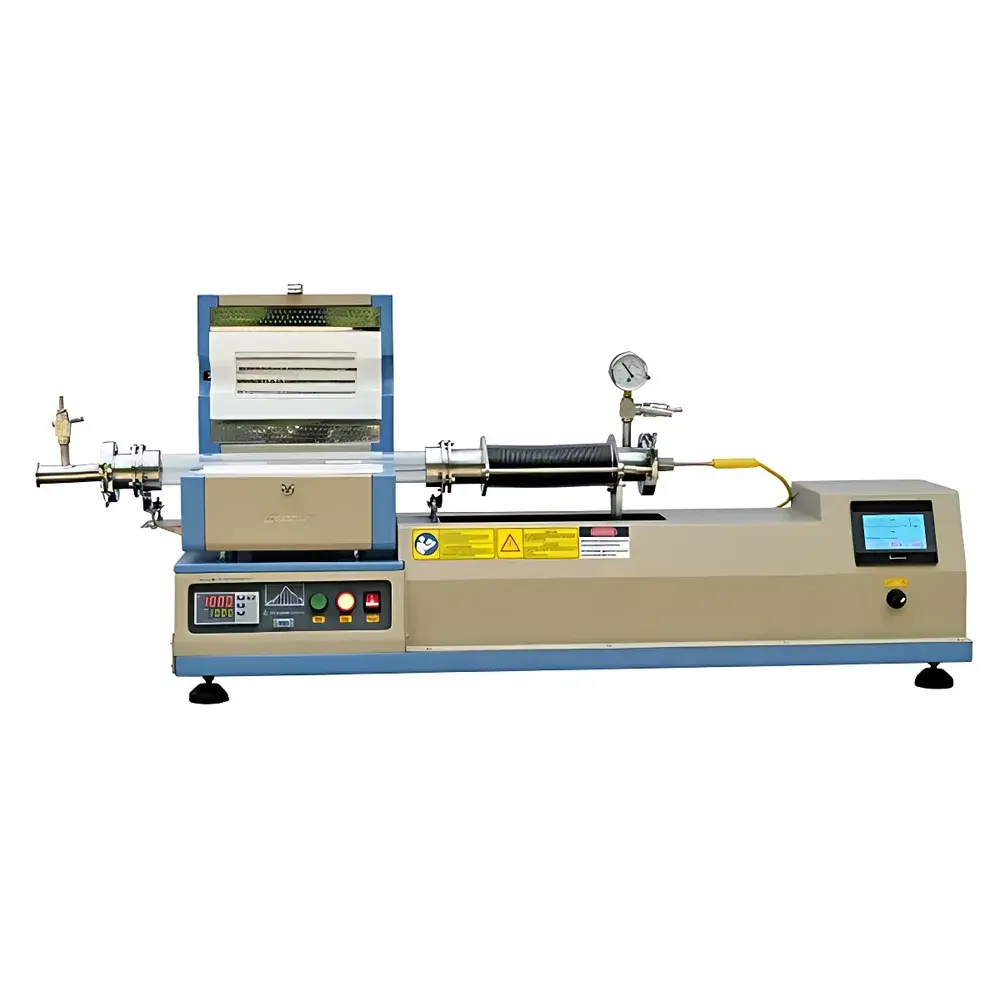
Kejing OTF-1200X-S-HPCVD Horizontal Split-Type Tube Furnace with Motorized Crucible Translation
| Brand | Kejing |
|---|---|
| Origin | Anhui, China |
| Model | OTF-1200X-S-HPCVD |
| Maximum Temperature | 1200 °C (<1 hr) |
| Continuous Operating Temperature | 1100 °C |
| Temperature Uniformity | ±1 °C over 60 mm (at 1000 °C) |
| Heating Zone Length | 200 mm |
| Furnace Tube Dimensions | 50 mm O.D. × 44 mm I.D. × 450 mm L (High-Purity Quartz) |
| Heating Element | Mo-Doped Fe-Cr-Al Alloy |
| Max. Power | 2 kW |
| Heating Rate | 20 °C/min (to max temp) |
| Temperature Control | 30-Stage PID Programmable Controller |
| Thermocouple | K-Type, Omega Sheathed, Motor-Linked |
| Crucible Translation Range | 100 mm |
| Translation Accuracy | ±1 mm |
| Translation Speed | 180 mm/min |
| Vacuum Compatibility | 10⁻² Torr (mechanical pump), 10⁻⁵ Torr (turbo-molecular pump) |
| Sealing | KF Flange with Silicone O-Ring |
| Input Voltage | 208–240 VAC, 50/60 Hz |
Overview
The Kejing OTF-1200X-S-HPCVD is a horizontally split, motorized tube furnace engineered for high-precision thermal processing in materials synthesis and physical vapor transport applications. Unlike conventional static tube furnaces, this system integrates a programmable crucible translation mechanism driven by a stepper motor, enabling precise spatial control of sample position within the axial temperature gradient of the heated zone. The furnace operates on the principle of resistive heating via Mo-doped Fe-Cr-Al alloy elements, delivering stable thermal profiles up to 1200 °C for short-duration experiments and sustained operation at 1100 °C. Its open-frame design facilitates rapid tube exchange and in-situ configuration changes—critical for iterative process development in hybrid physical-chemical deposition (HPCVD), rapid thermal evaporation (RTE), and horizontal Bridgman crystal growth. The integrated, motor-coupled K-type thermocouple provides real-time, position-synchronized temperature feedback directly at the sample location—eliminating reliance on fixed-zone calibration and significantly improving inter-run reproducibility under variable thermal boundary conditions.
Key Features
- Motorized crucible translation system with 100 mm travel range, ±1 mm positional accuracy, and programmable speed (standard: 180 mm/min; custom speeds available upon request)
- Embedded, Omega-sheathed K-type thermocouple mounted directly to the crucible carrier—ensuring dynamic temperature measurement synchronized with sample position
- 30-segment PID programmable temperature controller with ±1 °C accuracy and built-in overheat/thermocouple-failure protection
- KF-flanged vacuum interface with silicone O-ring seal and integrated mechanical pressure gauge; compatible with both rotary vane and turbo-molecular pumping systems
- High-purity quartz tube (50 mm O.D., 44 mm I.D., 450 mm L) rated for continuous use below 1100 °C; optimized for inert, reducing, and low-pressure reactive atmospheres
- Split-frame mechanical design allowing full lateral access to the tube—reducing downtime during sample loading, gas line integration, or tube replacement
- UL-/MET-/CSA-certified electrical components (>24 V); CE-marked; optional TÜV or CSA single-unit certification available (customer-funded)
Sample Compatibility & Compliance
The OTF-1200X-S-HPCVD supports diverse sample geometries—including powder charges, bulk ingots, and substrate-mounted thin films—within its 44 mm internal diameter quartz tube. It complies with standard laboratory safety protocols for elevated-temperature vacuum and gas-handling operations. All operational parameters adhere to ASTM E220 (Standard Test Method for Calibration of Thermocouples) for traceable thermal measurement. The furnace’s pressure-rated design (max. 0.02 MPa absolute internal pressure) aligns with ISO 10527 guidelines for quartz tube handling under thermal stress. For regulated environments, the system’s programmable logic controller (PLC) and touchscreen HMI support audit-trail-ready operation logs when configured with optional data-logging modules—facilitating GLP/GMP-aligned process documentation per FDA 21 CFR Part 11 requirements where electronic records are mandated.
Software & Data Management
Temperature ramping, hold times, and crucible positioning sequences are defined via an intuitive touchscreen HMI with password-protected user levels. The embedded controller stores up to 10 independent multi-stage programs, each supporting simultaneous scheduling of thermal profile and translation trajectory. Real-time temperature and position data are displayed graphically during operation and exportable via USB to CSV format for post-experiment analysis. Optional RS485 or Ethernet communication modules enable integration into centralized lab automation networks (e.g., LabVIEW, Python-based control suites). Firmware updates are performed locally via SD card—ensuring long-term maintainability without cloud dependency. No proprietary software installation is required for basic operation; all control logic resides onboard the industrial-grade PLC.
Applications
- HPCVD (Hybrid Physical-Chemical Vapor Deposition): Precise co-location of evaporant source and substrate within independently controlled thermal zones enables stoichiometric control in binary and ternary compound synthesis (e.g., MoS₂, GaN, perovskite precursors)
- Rapid Thermal Evaporation (RTE): Sub-second thermal response achieved by translating substrates into pre-heated zones—ideal for metal oxide thin-film fabrication and organic semiconductor deposition
- Horizontal Bridgman Crystal Growth: Controlled directional solidification via programmed crucible withdrawal through the furnace’s axial thermal gradient (dT/dx ≈ 15–30 °C/cm), supporting growth of II-VI, III-V, and chalcogenide single crystals
- Thermal Diffusion Studies: Quantitative measurement of dopant migration, phase segregation, or interdiffusion coefficients using time-resolved position-temperature mapping
- Atmospheric-Controlled Annealing: Inert, reducing (H₂/N₂), or oxidizing (O₂/air) treatments with mass-flow-controlled gas mixing (optional MFC manifold)
FAQ
What is the maximum safe operating pressure inside the quartz tube?
The quartz tube must not exceed 0.02 MPa (≈0.2 bar) absolute internal pressure. Always use a certified pressure regulator (recommended range: 0.01–0.1 MPa) when introducing gases from high-pressure cylinders.
Can the furnace operate under high vacuum while at 1150 °C?
No. Quartz tubes must be maintained at near-atmospheric pressure above 1000 °C to prevent devitrification and catastrophic failure. Vacuum operation is restricted to ≤1000 °C.
Is the crucible translation speed adjustable beyond 180 mm/min?
Yes—custom translation speeds (including sub-mm/sec precision modes) are available as a factory-configured option; additional engineering validation and fee apply.
What vacuum level can be achieved with the standard mechanical pump?
Using the included two-stage rotary vane pump, base pressure reaches ≤1×10⁻² Torr. For UHV applications (≤1×10⁻⁵ Torr), a turbo-molecular pump and compatible vacuum gauging system are required.
Are consumables like quartz tubes and heating elements covered under warranty?
No. The one-year limited warranty excludes consumable components—including quartz tubes, heating elements, and silicone O-rings—due to their inherent service-life variability under thermal cycling and chemical exposure.



