
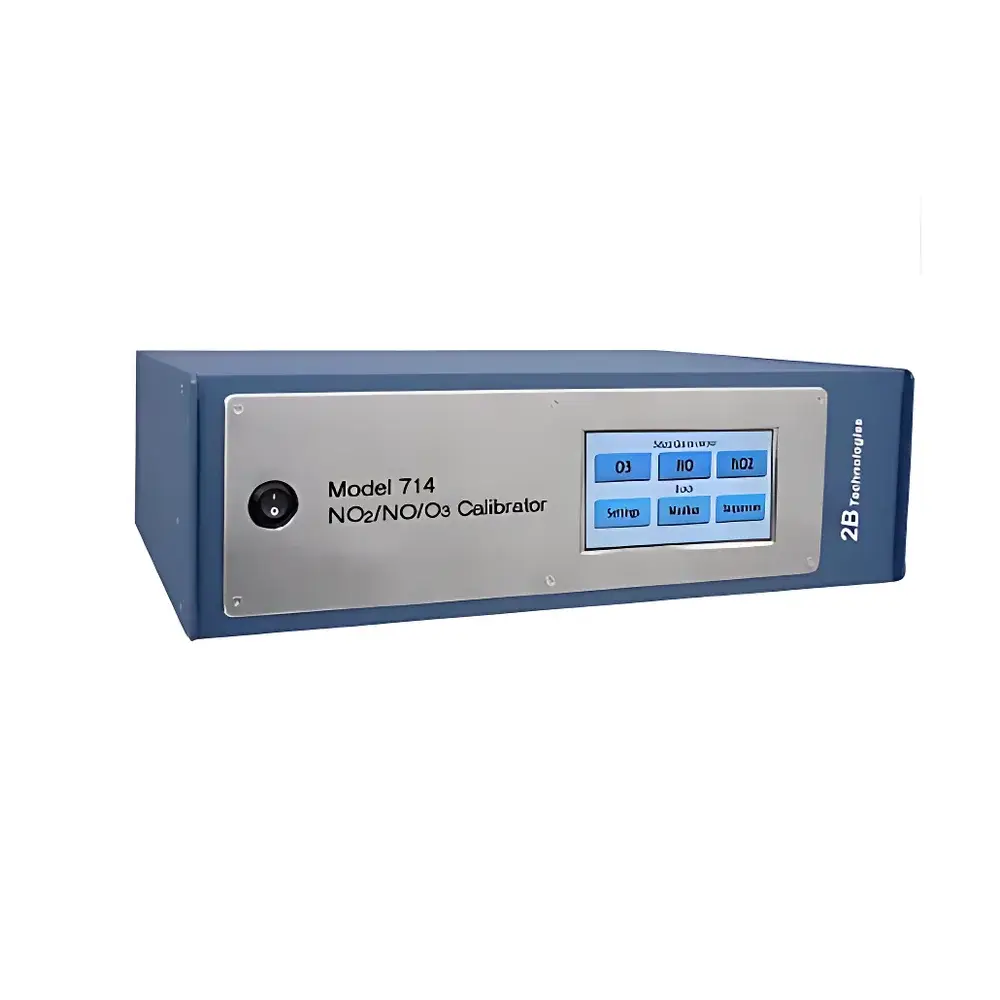
2B Technologies Model 714 NO₂/NO/O₃ Calibration Source
| Brand | 2B Technologies |
|---|---|
| Origin | USA |
| Model | Model 714 |
| NO₂ Range | 0–500 ppb |
| NO Range | 0–1000 ppb |
| O₃ Range | 0–500 ppb |
| Output Flow | 2.0–3.5 L/min (typ. 2.5–3.0 L/min) |
| Accuracy | ±2.0 ppb or ±2.0% of reading (whichever is greater) |
| Response Time to 95% of Setpoint | <30 s |
| Power | 12 V DC, 3.5 A max (42 Wh), or 100–240 V AC, 5 A |
| Dimensions (Rack-Mount) | 43 × 37 × 14 cm (17" × 14.5" × 5.5") |
| Weight | 7.0 kg (15.5 lb) |
| Operating Temperature | 0–40 °C |
| Storage Temperature | −20–60 °C |
| Relative Humidity | 0–80% RH (non-condensing) |
| Altitude | 0–2000 m |
Overview
The 2B Technologies Model 714 NO₂/NO/O₃ Calibration Source is a compact, NIST-traceable transfer standard engineered for field and laboratory calibration of ambient air monitoring instruments measuring nitrogen dioxide (NO₂), nitric oxide (NO), and ozone (O₃). Unlike conventional calibration systems reliant on compressed gas cylinders, the Model 714 generates certified concentrations of all three gases *in situ* using photolytic synthesis—eliminating logistical constraints, stability uncertainties associated with NO cylinder standards, and regulatory burdens of high-pressure gas handling. Its core methodology integrates two independent, vacuum-UV (185 nm) photolysis pathways: O₂ photolysis in a dry, purified air stream to produce O₃; and N₂O photolysis to generate NO via electronically excited oxygen atoms (O*) reacting stoichiometrically with residual N₂O. NO₂ is then synthesized quantitatively through gas-phase titration (GPT), where precisely metered O₃ reacts with excess NO (NO + O₃ → NO₂ + O₂), yielding NO₂ concentrations directly traceable to the primary NIST O₃ photometer standard. This architecture ensures metrological continuity across all three analytes without reliance on secondary gas standards or external dilution systems.
Key Features
- Triple-gas calibration capability (NO, NO₂, O₃) in a single rack-mountable instrument (43 × 37 × 14 cm)
- NIST-traceable output with accuracy of ±2.0 ppb or ±2.0% (whichever is greater) for NO and O₃
- Portable N₂O supply using commercially available 8 g or 16 g food-grade cartridges—no high-pressure cylinders required
- Integrated desiccant dryer for humidity control in the O₃ generation path, improving O₃ yield reproducibility
- Touchscreen HMI supporting up to 99 user-defined calibration sequences, each with up to 15 programmable steps (e.g., ramp, hold, step-change)
- Low power consumption: 18 W typical operating power; compatible with 12 V DC (field-deployable) or universal 100–240 V AC input
- Fast dynamic response: <30 s to reach 95% of target concentration across full range (0–500 ppb NO₂/O₃, 0–1000 ppb NO)
- Ruggedized design optimized for mobile labs, regulatory compliance audits, and EPA FEM/FEM-equivalent instrument verification
Sample Compatibility & Compliance
The Model 714 is explicitly designed to support calibration of U.S. EPA Federal Equivalent Method (FEM) and Federal Reference Method (FRM) analyzers—including 2B’s own Model 405 nm NO₂/NO/NOₓ monitor—and third-party chemiluminescence, UV absorption, and electrochemical sensors. Its photolytically generated gases meet stringent requirements for traceability under ISO/IEC 17025:2017 for calibration laboratories and align with ASTM D6570 and EPA 40 CFR Part 53 protocols for ozone and nitrogen oxides calibration validation. All delivered gas streams are free of hydrocarbon contaminants and metal particulates, ensuring compatibility with sensitive optical and catalytic detection cells. The system includes a NIST-traceable calibration certificate documenting uncertainty budgets for each gas species at multiple concentration points, satisfying documentation requirements for GLP, GMP, and regulatory audit trails (e.g., EPA QA Handbook, Volume II).
Software & Data Management
Calibration sequences are configured locally via the integrated 4.3-inch resistive touchscreen interface—no external PC required. Each sequence stores time-stamped setpoints, dwell times, and flow parameters; up to 99 sequences reside in non-volatile memory. Output concentration logs (with timestamps and lamp intensity values) are exportable via USB flash drive in CSV format for integration into LIMS or QA/QC reporting workflows. While the Model 714 does not implement FDA 21 CFR Part 11 electronic signature controls natively, its deterministic photolytic generation mechanism and immutable internal logging provide robust auditability for regulated environments. Sequence execution can be triggered manually or via TTL-level external start signal, enabling synchronization with automated calibration routines in networked monitoring stations.
Applications
- Primary field calibration of ambient air quality monitors deployed in AQMesh networks, regulatory reference sites, and research campaigns
- Verification and adjustment of zero/span responses for chemiluminescent NOₓ analyzers and UV photometric O₃ monitors
- Performance evaluation of low-cost sensor (LCS) arrays requiring multi-gas reference exposure
- Method validation studies supporting ISO 13964 and EN 14625 compliance testing
- Mobile laboratory deployments where portability, low power draw, and cylinder-free operation are critical (e.g., vehicle-based mapping, drone-ground station coordination)
- Training and proficiency testing for air quality technicians and EPA-certified auditors
FAQ
How is NIST traceability established for NO and NO₂ outputs?
NO is generated via N₂O photolysis—a process whose quantum yield is well-characterized and invariant. NO₂ is produced by stoichiometric GPT using NIST-traceable O₃; thus, NO₂ concentration inherits the same uncertainty budget as the O₃ standard. Certificates include expanded uncertainties (k=2) per ISO/IEC Guide 98-3.
Can the Model 714 calibrate instruments requiring higher flow rates?
The nominal output flow is 2.0–3.5 L/min. For analyzers requiring >3.5 L/min, a calibrated mass flow splitter or external dilution system must be used upstream—though this introduces additional uncertainty not covered by the Model 714’s stated accuracy specification.
What maintenance is required for long-term accuracy?
Annual recalibration of photolysis lamp intensities and MFCs is recommended. The desiccant dryer cartridge should be replaced every 6 months under continuous operation or when humidity breakthrough is observed. No consumables beyond N₂O cartridges and desiccant are required.
Is the instrument suitable for unattended operation?
Yes—programmed sequences execute autonomously. However, N₂O cartridge replacement and desiccant servicing require manual intervention. Remote status monitoring (e.g., lamp health, temperature, flow) is not supported without optional I/O expansion modules.
Does the Model 714 comply with EPA PS-1 or PS-2 performance specifications?
It is not an analyzer but a calibration source; therefore, it does not undergo PS-1/PS-2 testing. It satisfies the generator requirements outlined in EPA 40 CFR Part 53 Appendix A3 for O₃ and Appendix A5 for NO/NO₂ calibration systems used in FEM verification.
Related Products







