
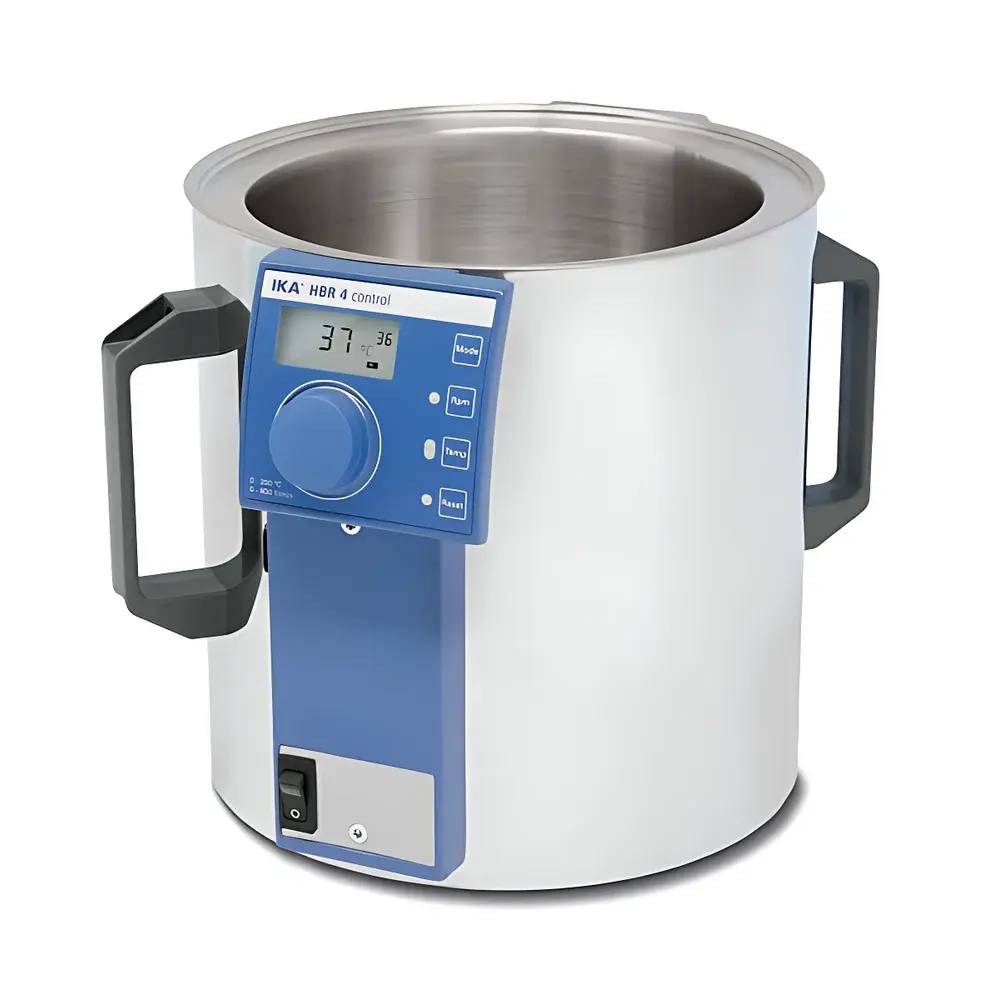
IKA HBR 4 control Heating Bath with Integrated Magnetic Stirrer
| Brand | IKA |
|---|---|
| Origin | Germany |
| Manufacturer | IKA-Werke GmbH & Co. KG |
| Model | HBR 4 control |
| Heating Power | 1000 W |
| Max. Bath Volume | 4 L |
| Temp. Range | RT to 200 °C |
| Temp. Control Accuracy | ±1 K (water, 3 L @ 90 °C) / ±2 K (silicone oil, 3 L @ 150 °C) |
| Stirring Speed Range | 150–800 rpm |
| Stirring Motor Output | 1 W |
| Safety Cut-off Range | 50–210 °C |
| Protection Class | DIN 12877 Class II |
| IP Rating | IP20 |
| Dimensions (W×D×H) | 340 × 250 × 340 mm |
| Weight | 4.4 kg |
| Power Supply | 230/115/100 V, 50/60 Hz |
| Interface | RS 232 |
| External Sensor Support | PT1000 |
| Material (Wetted Parts) | Stainless Steel 1.4301 (AISI 304) |
| Minimum Fill Level | 20 mm |
Overview
The IKA HBR 4 control is a precision-engineered heating bath with integrated magnetic stirring, designed for reproducible thermal control and homogeneous sample conditioning in laboratory environments. Based on resistive heating of the bath medium—typically water or low-viscosity silicone oil (≤50 mPa·s)—the unit delivers stable temperature regulation across a wide operational range from ambient to 200 °C. Its cylindrical stainless steel (1.4301/AISI 304) bath vessel features bottom-mounted heating elements, ensuring efficient thermal transfer and minimal temperature gradients. The device complies fully with DIN 12877 Part 2 for laboratory heating equipment, meeting Class II safety requirements including dual independent overtemperature protection circuits and dry-run prevention via fill-level monitoring. Unlike open-loop hotplates, the HBR 4 control operates as a closed thermal system where heat exchange occurs via conduction through the bath medium, enabling superior uniformity and reduced evaporation loss—critical for extended reaction monitoring, dissolution testing, or viscosity calibration workflows.
Key Features
- Integrated high-torque magnetic stirrer (150–800 rpm, 1 W output) with digital speed display and continuous adjustment—enabling simultaneous heating and mixing without external stir bars or overhead drives
- Dual-sensor temperature control architecture: real-time monitoring of setpoint, actual bath temperature, and independently adjustable safety limit (50–210 °C)
- High-resolution LCD interface displaying all operational parameters—including power output, elapsed time, and error codes—for full situational awareness
- RS 232 serial interface standard-equipped for bidirectional communication with LabVIEW, MATLAB, or custom SCADA systems; supports remote parameter setting and data logging
- PT1000-compatible external probe input for direct sample-temperature feedback, enabling cascade control configurations compliant with GLP/GMP documentation standards
- Ergonomic dual handle design and compact footprint (340 × 250 × 340 mm) optimized for benchtop integration in regulated QC labs and research facilities
Sample Compatibility & Compliance
The HBR 4 control accommodates vessels up to 4 L capacity, with minimum fill height of 20 mm to ensure thermal sensor immersion and prevent heater damage. Compatible media include deionized water, glycerol-water mixtures, and silicone oils up to 50 mPa·s viscosity—validated per ISO 2556 and ASTM D445 protocols for thermal stability and shear-thinning behavior. All wetted surfaces are constructed from electropolished stainless steel 1.4301 (equivalent to AISI 304), offering corrosion resistance against mild acids, alkalis, and organic solvents encountered in pharmaceutical synthesis and polymer processing. The unit bears CE marking and conforms to EN 61010-1 (Safety Requirements for Electrical Equipment for Measurement, Control, and Laboratory Use) and EN 60529 (IP20 ingress protection). Its DIN 12877 Class II certification ensures automatic shutdown under fault conditions—including sensor failure, overheating, or insufficient fluid level—meeting mandatory requirements for ISO/IEC 17025-accredited laboratories.
Software & Data Management
While the HBR 4 control operates autonomously via its front-panel interface, its RS 232 port enables seamless integration into validated data acquisition ecosystems. When connected to compliant software platforms (e.g., IKA LabWorld, third-party LIMS, or 21 CFR Part 11–enabled applications), the device transmits timestamped temperature/stirring logs with audit-trail capability. Firmware supports configurable data polling intervals (1–60 s), error flagging (e.g., “E02: Low Level”, “E05: Sensor Open”), and non-volatile memory retention of last-used parameters—even after power interruption. For FDA-regulated environments, optional configuration packages provide electronic signature support, user access levels, and change-control records aligned with ALCOA+ principles.
Applications
- Controlled-temperature dissolution testing per USP and Ph. Eur. 2.9.3 using calibrated vessels and PT1000 probe feedback
- Pre-heating and conditioning of reagents prior to GC, HPLC, or titration workflows requiring thermal equilibration
- Viscometer calibration baths operating at fixed temperatures (e.g., 25 °C, 40 °C, 100 °C) per ISO 3219 and ASTM D2196
- Enzyme kinetics studies requiring precise thermal ramping (via external controller) combined with continuous mixing
- Stability testing of emulsions, suspensions, and colloidal dispersions under isothermal agitation
FAQ
Does the HBR 4 control support external temperature feedback for closed-loop control?
Yes—it accepts PT1000 resistance thermometers via dedicated analog input, enabling sample-temperature-based control instead of bath-medium-based setpoints.
What is the maximum allowable ambient temperature for continuous operation?
The unit is rated for environments up to 40 °C ambient temperature and ≤80 % relative humidity (non-condensing), per EN 60529.
Can the device be used with flammable solvents?
No—this instrument is not explosion-proof and is certified only for use with non-flammable heat-transfer media such as water, glycols, or silicone oils.
Is firmware update capability available?
Firmware updates are performed exclusively via RS 232 using IKA-provided utilities; no internet connectivity or cloud dependency is required.
How is traceability maintained during IQ/OQ/PQ validation?
Factory calibration certificates (traceable to DKD/DAkkS standards) are supplied with each unit; all operational parameters—including temp. deviation, stir speed accuracy, and safety cutoff response time—are verifiable per ISO/IEC 17025 Annex A.2.



