
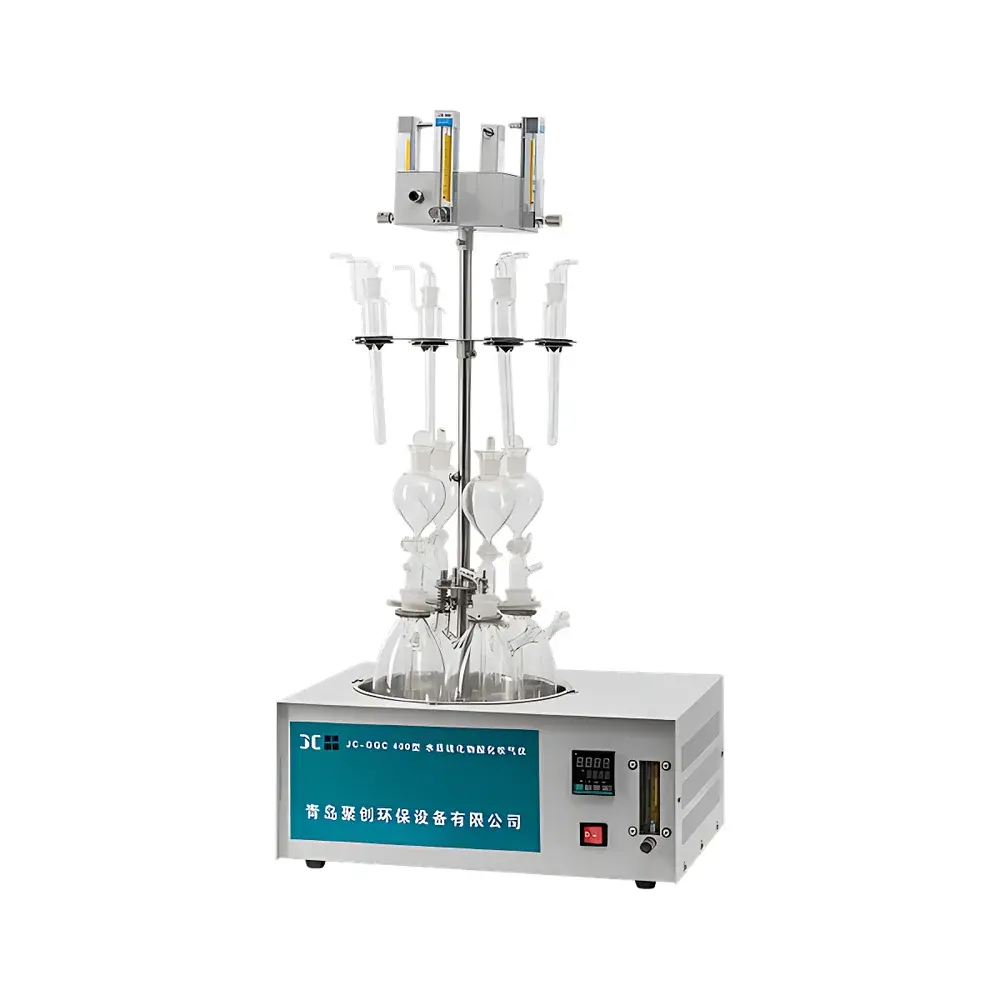
JU CHUANG JC-GGC400 Acidification-Aeration Apparatus for Sulfide Analysis
| Brand | JU CHUANG ENVIRONMENTAL |
|---|---|
| Origin | Shandong, China |
| Manufacturer Type | Direct Manufacturer |
| Product Category | Domestic |
| Model | JC-GGC400 |
| Instrument Type | Sub-boiling Distillation Apparatus |
| Heating Method | Electric |
| Cooling Method | Air-cooled |
| Distillation Flow Rate | 0–10 L/min |
| Heating Ramp Time | ≤5 min |
| Endpoint Control | Automatic Temperature Hold |
| Heating Positions | 4 independent channels |
Overview
The JU CHUANG JC-GGC400 Acidification-Aeration Apparatus is a dedicated laboratory system engineered for the quantitative determination of dissolved and acid-volatile sulfides (AVS) in aqueous environmental samples. It operates on the principle of controlled acidification followed by nitrogen-purged gas stripping—converting sulfide species (e.g., HS⁻, S²⁻, metal sulfides) into gaseous H₂S, which is then selectively trapped in an alkaline absorbent solution (typically Zn(Ac)₂ or NaOH) for subsequent colorimetric or electrochemical analysis. This method conforms to established standard protocols including EPA Method 376.1, ISO 16235:2016, and HJ 1226–2021 (China’s national standard for sulfide determination in water). Unlike conventional distillation or digestion setups, the JC-GGC400 integrates precise temperature regulation, programmable gas flow control, and parallel sample processing to minimize analyst intervention while ensuring high reproducibility and low blank interference—critical for trace-level sulfide quantification in complex matrices such as wastewater, sediment porewater, and industrial effluents.
Key Features
- Four independent heating modules with individual digital temperature control (range: ambient to 95 °C, ±0.5 °C accuracy), enabling simultaneous processing of up to four samples under identical or customized thermal profiles.
- Integrated nitrogen mass flow controller (MFC) with adjustable purge rate (0–10 L/min) and real-time flow monitoring, ensuring consistent gas-phase transfer efficiency and minimizing H₂S loss due to channeling or insufficient sweep velocity.
- Sub-boiling distillation architecture: electric heating elements maintain sample temperature below boiling point to suppress co-distillation of volatile organic interferences (e.g., mercaptans, thiophenes) and reduce foaming in high-solids samples.
- Automatic endpoint control via temperature-hold logic: once setpoint is reached, the system sustains thermal stability without overshoot, eliminating manual timing errors and improving inter-batch consistency.
- Air-cooled condensation path with optimized surface-area-to-volume ratio minimizes back-diffusion of H₂S vapor and eliminates need for external chilled water supply—reducing infrastructure dependency and operational complexity.
- Corrosion-resistant construction: all wetted parts—including reaction vessels, gas manifolds, and trap connectors—are fabricated from borosilicate glass and PTFE-lined stainless steel to withstand prolonged exposure to acidic media and H₂S gas.
Sample Compatibility & Compliance
The JC-GGC400 accommodates liquid samples ranging from 50 mL to 500 mL volume, including raw sewage, treated effluent, surface water, groundwater, sludge extracts, and marine porewater. Its modular design supports optional accessories such as magnetic stirrer integration for heterogeneous suspensions and quartz wool frits for particulate retention during acidification. The apparatus meets essential requirements for GLP-compliant laboratories: full traceability of operating parameters (temperature, time, flow rate) is achievable when paired with external data loggers. While the unit itself does not embed FDA 21 CFR Part 11–compliant audit trails, its operational parameters are fully documentable in laboratory notebooks or LIMS-integrated workflows aligned with ISO/IEC 17025 accreditation criteria.
Software & Data Management
The JC-GGC400 operates via front-panel digital interface with LED display and tactile membrane keys—designed for robustness in humid, chemically aggressive lab environments. No proprietary software is required for basic operation; however, analog output signals (0–5 V or 4–20 mA) for temperature and flow can be interfaced with third-party SCADA or LabVIEW-based acquisition systems. For regulatory reporting, users typically export run logs manually or integrate with validated spreadsheet templates that comply with USP <1058> analytical instrument qualification (AIQ) documentation standards. Firmware updates (if applicable) are delivered via USB flash drive, supporting version-controlled maintenance records.
Applications
- Environmental monitoring labs performing routine compliance testing under national discharge permits (e.g., China’s GB 3838–2002, U.S. NPDES).
- Academic research on sulfur biogeochemistry in anoxic sediments, sulfate-reducing bacterial activity, and redox speciation modeling.
- Industrial QA/QC in petrochemical refineries evaluating sour water stripper performance and corrosion risk assessment.
- Municipal wastewater treatment plants optimizing anaerobic digester operation and biosolids stabilization protocols.
- Metallurgical facilities assessing acid mine drainage chemistry and heavy metal–sulfide co-precipitation behavior.
FAQ
Is the JC-GGC400 compatible with EPA Method 376.1?
Yes—the system implements the core procedural elements of EPA 376.1, including acidification at pH ≤2, nitrogen sparging at ≥50 mL/min per sample, and alkaline trapping. Users must validate recovery using certified reference materials (e.g., NIST SRM 1643e) per Section 8.2 of the method.
Can it process solid-phase samples like sediments or soils?
Direct solid processing is not supported; samples must be pre-extracted (e.g., via centrifugation or filtration) to obtain aqueous phase. Optional glass frit adapters may be used to retain suspended solids during acid addition.
What maintenance is required for long-term reliability?
Routine cleaning of glassware with dilute HCl followed by deionized water rinse is recommended after each use. PTFE seals should be inspected quarterly; nitrogen MFC calibration is advised annually using a certified flow meter.
Does the apparatus include H₂S detection capability?
No—the JC-GGC400 is a sample preparation platform only. Quantitative detection requires downstream analysis via methylene blue spectrophotometry (APHA 4500-S²⁻ B), ion-selective electrode, or GC-PFPD.
How is cross-contamination between channels prevented?
Each of the four heating positions features isolated gas pathways with dedicated trap ports and non-recirculating nitrogen supply—eliminating carryover between samples when operated according to manufacturer-recommended purge duration (≥15 min post-run).



