
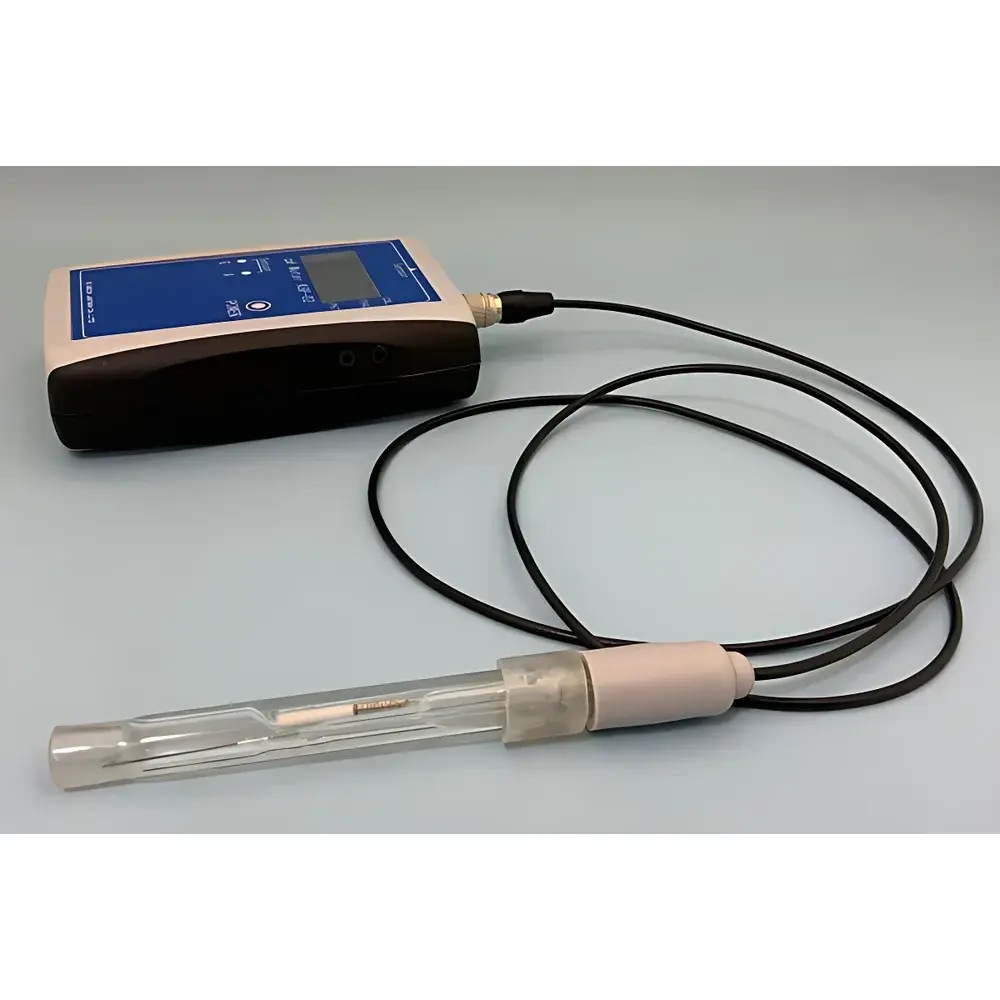
ASCH ASP-02 Portable Skin pH Meter
| Brand | ASCH |
|---|---|
| Origin | Japan |
| Model | ASP-02 |
| Measurement Range | 0–9 pH |
| Resolution | 0.1 pH |
| Accuracy | ±0.2 pH |
| Response Time | ≤10 s |
| Calibration | Two-point with pH 4.0 and pH 7.0 standard buffers |
| Operating Temperature | 0–50 °C |
| Storage Environment | 5–50 °C, 5–85% RH (non-condensing) |
| Power Supply | 2 × AA alkaline batteries |
| Main Unit Dimensions | 122 × 80 × 33.5 mm (H×W×D) |
| Main Unit Weight | ~200 g |
| Electrode Dimensions | 135 mm length × φ12 mm diameter |
| Cable Length | 1 m |
| Electrode Weight | ~60 g |
| Sample Interface | Flat-surface combination pH electrode for direct skin contact |
Overview
The ASCH ASP-02 Portable Skin pH Meter is a dedicated electrochemical measurement instrument engineered for non-invasive, real-time assessment of surface pH on human skin. It operates on the principle of potentiometric measurement using a flat-surface combination pH electrode, which establishes stable, low-pressure contact with stratum corneum without requiring electrolyte gel or invasive sampling. The device leverages Nernstian response kinetics to convert hydrogen ion activity at the skin–electrode interface into a calibrated voltage signal, digitally resolved to 0.1 pH units. Designed for use in dermatological research, cosmetic formulation development, and pharmaceutical stability testing, the ASP-02 meets the operational requirements of ISO 16128–2 (cosmetic ingredient definitions), ASTM E2915 (standard guide for assessing skin barrier function), and supports GLP-aligned documentation when integrated with validated calibration and usage logs.
Key Features
- Flat-profile combination pH electrode optimized for conformal contact with curved and uneven skin surfaces—minimizes pressure-induced artifact and eliminates need for conductive gels
- Integrated two-point calibration routine (pH 4.0 and pH 7.0) with audible and visual confirmation; calibration data stored in device memory with timestamping
- Low-power architecture enabling >200 hours of continuous operation on two AA alkaline cells; auto-power-off after 10 minutes of inactivity
- Compact handheld form factor (122 × 80 × 33.5 mm) with ergonomic grip and IP54-rated enclosure for resistance to incidental splashes and dust ingress
- Digital display with backlight for low-light clinical or field environments; real-time temperature compensation (0–50 °C) applied per NIST-traceable algorithms
- Electrode housing constructed from medical-grade polypropylene with autoclavable cap (up to 121 °C, 15 min); compatible with standard pH electrode storage solutions
Sample Compatibility & Compliance
The ASP-02 is validated for direct measurement on intact epidermis—including facial, volar forearm, and post-occlusive sites—as well as aqueous and buffered liquid samples (e.g., toners, micellar waters, topical emulsions). It complies with IEC 61010–1 for electrical safety in laboratory equipment and incorporates design features aligned with ISO 22716 (Good Manufacturing Practice for cosmetics) regarding instrument qualification and traceability. While not a diagnostic medical device, its measurement protocol adheres to published methodologies in Journal of the European Academy of Dermatology and Venereology (JEADV) consensus guidelines for standardized skin surface pH evaluation. All calibration and measurement records can be manually logged to satisfy internal QA audits or regulatory submissions under FDA 21 CFR Part 11 when paired with controlled documentation practices.
Software & Data Management
The ASP-02 operates as a standalone instrument with no embedded Bluetooth or USB connectivity. Data integrity is maintained through deterministic analog-to-digital conversion and on-device calibration verification. Users are expected to record measurements manually in bound lab notebooks or LIMS-integrated spreadsheets. For laboratories implementing electronic records, the device supports integration via external digital loggers (e.g., RS-232–enabled data acquisition modules, sold separately) that capture timestamped pH and temperature values. Firmware does not store historical readings beyond current calibration parameters, ensuring compliance with data minimization principles under GDPR and HIPAA-compliant handling protocols when used in clinical research settings.
Applications
- Dermatological research: longitudinal monitoring of acid mantle recovery following surfactant exposure, occlusion, or topical corticosteroid application
- Cosmetic product development: benchmarking pH of cleansers, moisturizers, and baby care formulations against ISO 16128–1 biocompatibility thresholds
- Pharmaceutical QA/QC: verifying pH stability of topical gels, foams, and transdermal patches across shelf life under ICH Q5C conditions
- Clinical trial support: site-level instrumentation for multi-center studies evaluating skin barrier integrity in atopic dermatitis or rosacea cohorts
- Educational laboratories: hands-on instruction in cutaneous physiology, electrochemical sensor fundamentals, and Good Laboratory Practice (GLP) documentation
FAQ
Is the ASP-02 compliant with FDA or CE regulatory requirements?
The ASP-02 is classified as a general-purpose pH meter intended for research and quality control—not as an in vitro diagnostic (IVD) device. It carries CE marking under the Low Voltage Directive (2014/35/EU) and EMC Directive (2014/30/EU), but is not FDA-cleared or MDR-certified.
Can the electrode be sterilized between subjects?
Yes—the electrode body is autoclavable at 121 °C for 15 minutes. However, the cable assembly and main unit must not be exposed to steam or high humidity; only the probe tip and shaft are rated for sterilization.
Does the device support single-point calibration?
No. Two-point calibration (pH 4.0 and pH 7.0) is mandatory per the manufacturer’s validation protocol and required to maintain stated accuracy of ±0.2 pH across the full 0–9 range.
What is the recommended electrode maintenance schedule?
Rinse with deionized water after each use; store immersed in 3 M KCl solution. Perform calibration verification before each measurement session and full recalibration every 24 hours during continuous use.
Is temperature compensation automatic or manual?
Automatic. The integrated thermistor continuously monitors ambient and junction temperature, applying real-time Nernst slope correction per IUPAC-recommended equations.




