
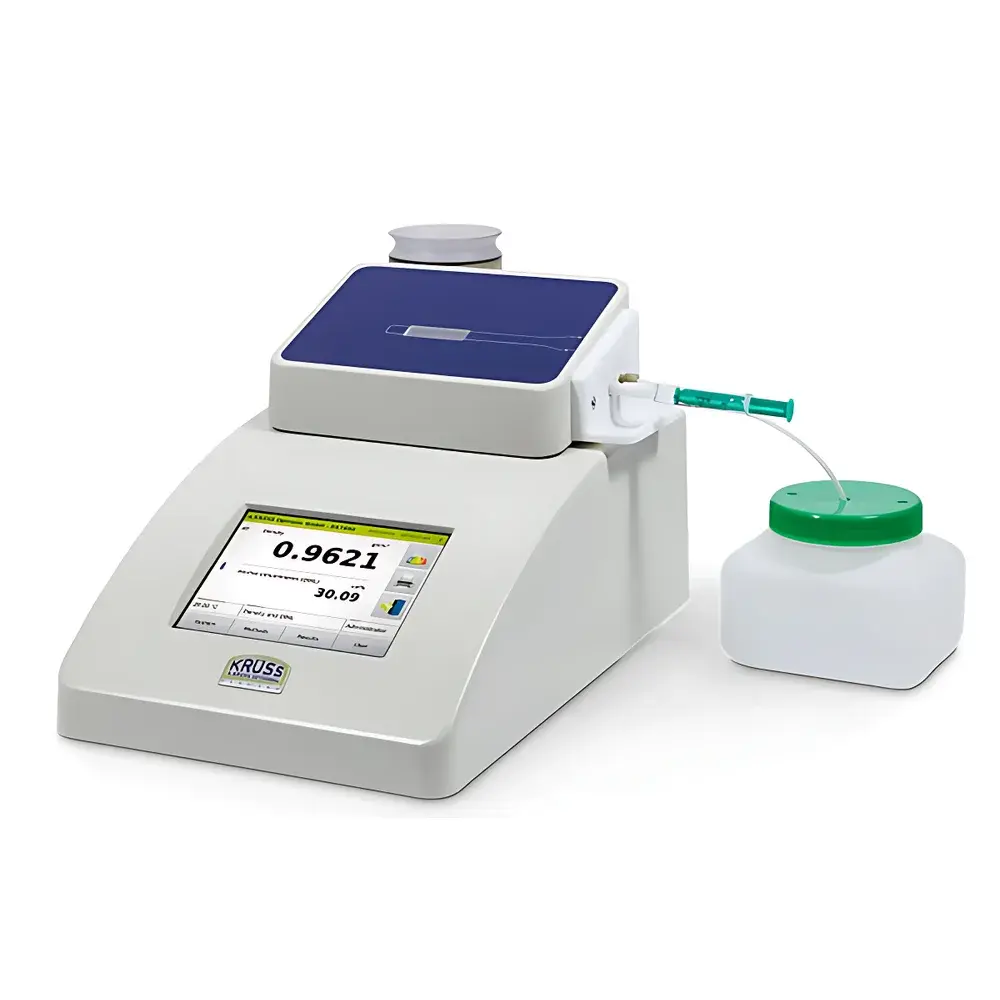
A.Krüss DS7800 Digital Density Meter (U-Tube Oscillation Principle)
| Brand | A.Krüss / A.Krüss Optronic |
|---|---|
| Origin | Germany |
| Model | DS7800 |
| Instrument Type | Laboratory Benchtop Oscillating U-Tube Densimeter |
| Sample Type | Liquid |
| Density Range | 0.0000–1.9999 g/cm³ |
| Density Accuracy | ±0.0001 g/cm³ |
| Temperature Control Range | 10–40 °C |
| Minimum Sample Volume | 2 mL |
| Compliance | ASTM D4052-18, ASTM D5002, ISO 12185:1996, ISO 2811-3:2011, SH/T 0604-2000, GB/T 21862.3-2008 |
Overview
The A.Krüss DS7800 Digital Density Meter is a high-precision laboratory benchtop instrument engineered for accurate and repeatable density determination of liquid samples using the oscillating U-tube principle. Based on fundamental physical relationships between sample mass, volume, and resonant frequency, the DS7800 measures the natural oscillation frequency of a precisely manufactured borosilicate glass U-tube filled with the test liquid. This frequency is directly correlated to the sample’s density via calibration curves traceable to NIST-certified reference standards. The instrument operates within a tightly regulated thermal environment—maintained by an integrated Peltier-based semiconductor temperature control system—ensuring measurement stability across the full operating range of 10–40 °C with ±0.02 °C reproducibility. Designed for routine quality control and R&D applications in regulated environments, the DS7800 delivers five-digit density resolution (0.0000–1.9999 g/cm³) and meets international standard requirements including ASTM D4052-18, ISO 12185:1996, and ISO 2811-3:2011.
Key Features
- High-stability U-tube oscillation sensor fabricated from optical-grade borosilicate glass, minimizing thermal drift and mechanical hysteresis
- Integrated Peltier temperature control system with real-time monitoring and active stabilization across 10–40 °C
- Dedicated drying unit and peristaltic pump for automated sample handling and residual moisture removal between measurements
- 5.7-inch VGA LCD touchscreen (320 × 240 pixels) with intuitive graphical interface supporting six languages (English, German, French, Spanish, Italian, Chinese)
- 32-bit embedded processor enabling rapid data acquisition, on-board polynomial calibration (up to 10-point), and real-time signal processing
- Triple-level password protection (operator, supervisor, administrator) compliant with GLP/GMP documentation requirements
- Standard Ethernet (RJ45), USB 2.0, and RS-232 interfaces for seamless integration into LIMS, SCADA, or PC-based data archiving systems
- Built-in SQL database supporting storage of up to 999 measurement records with timestamp, operator ID, method name, and environmental parameters
- Low power consumption (≤60 W) and cast aluminum housing designed for long-term reliability in continuous laboratory operation
Sample Compatibility & Compliance
The DS7800 is optimized for Newtonian and mildly non-Newtonian liquids with viscosity ≤500 mPa·s and vapor pressure compatible with ambient-pressure filling. Compatible sample matrices include aqueous solutions, organic solvents, hydrocarbon mixtures, pharmaceutical formulations, food-grade syrups, alcoholic beverages, and industrial process fluids. Its design conforms to regulatory frameworks governing analytical instrumentation in regulated industries: it supports audit-trail-enabled user management, electronic signature readiness, and 21 CFR Part 11–compliant data integrity when deployed with validated software configurations. Calibration verification uses certified dry air and double-distilled water as primary standards; multi-point polynomial calibration (4–10 points) ensures linearity across extended density ranges. Full compliance documentation—including conformity statements to ISO/IEC 17025:2017 testing principles—is available upon request.
Software & Data Management
Data capture, analysis, and export are managed through the instrument’s native firmware and optional PC software suite. All measurements are automatically timestamped and logged with metadata including temperature, oscillation period, damping factor, and calibration status. Results can be exported in CSV or XML format via USB flash drive or network transfer. The embedded SQL database enables structured querying by date range, operator, or custom method ID. Ethernet connectivity permits remote configuration, firmware updates, and live monitoring via HTTP or TCP/IP protocols. For enterprise deployment, the DS7800 supports direct LIMS integration using ASTM E1384-compliant message formatting. Audit trail generation includes user login/logout events, parameter changes, calibration actions, and result modifications—all time-stamped and non-erasable without administrative override.
Applications
- Chemical manufacturing: concentration monitoring of acids, bases, and solvent blends
- Pharmaceutical QC: density verification of excipients, APIs, and parenteral solutions per USP <841>
- Cosmetics: formulation consistency checks for emulsions, surfactant solutions, and fragrance oils
- Beverage & brewing: alcohol content estimation (via density/alcohol correlation tables), sugar concentration (Brix), and wort analysis
- Food industry: fat content screening in dairy products, syrup density grading, and juice adulteration detection
- Petroleum refining: crude oil API gravity determination, distillate specification verification, and additive blending control
- Pulp & paper: black liquor solids content estimation and caustic soda concentration tracking
- Electronics: purity assessment of etchants, photoresist developers, and cleaning agents
- Wastewater treatment: sludge density profiling and polymer dosing optimization
FAQ
What is the minimum required sample volume for a valid measurement?
The DS7800 requires only 2 mL of sample per analysis, minimizing reagent consumption and waste generation.
Can the instrument perform automatic temperature ramping during sequential measurements?
No—the DS7800 maintains a single user-defined setpoint per measurement cycle; temperature ramping requires external scripting or manual intervention.
Is validation support documentation provided for GMP environments?
Yes—A.Krüss supplies IQ/OQ documentation templates, calibration certificates traceable to NIST standards, and a full compliance matrix mapping features to FDA 21 CFR Part 11, EU Annex 11, and ISO/IEC 17025 requirements.
How often must the U-tube be cleaned or replaced?
Under normal use with low-residue samples, the U-tube requires cleaning after every 50–100 measurements; lifetime exceeds 10,000 cycles with proper maintenance.
Does the DS7800 support custom unit conversions (e.g., API gravity, Baumé, Brix)?
Yes—99 user-definable methods allow configuration of derived units, polynomial equations, and lookup tables for industry-specific reporting formats.



