
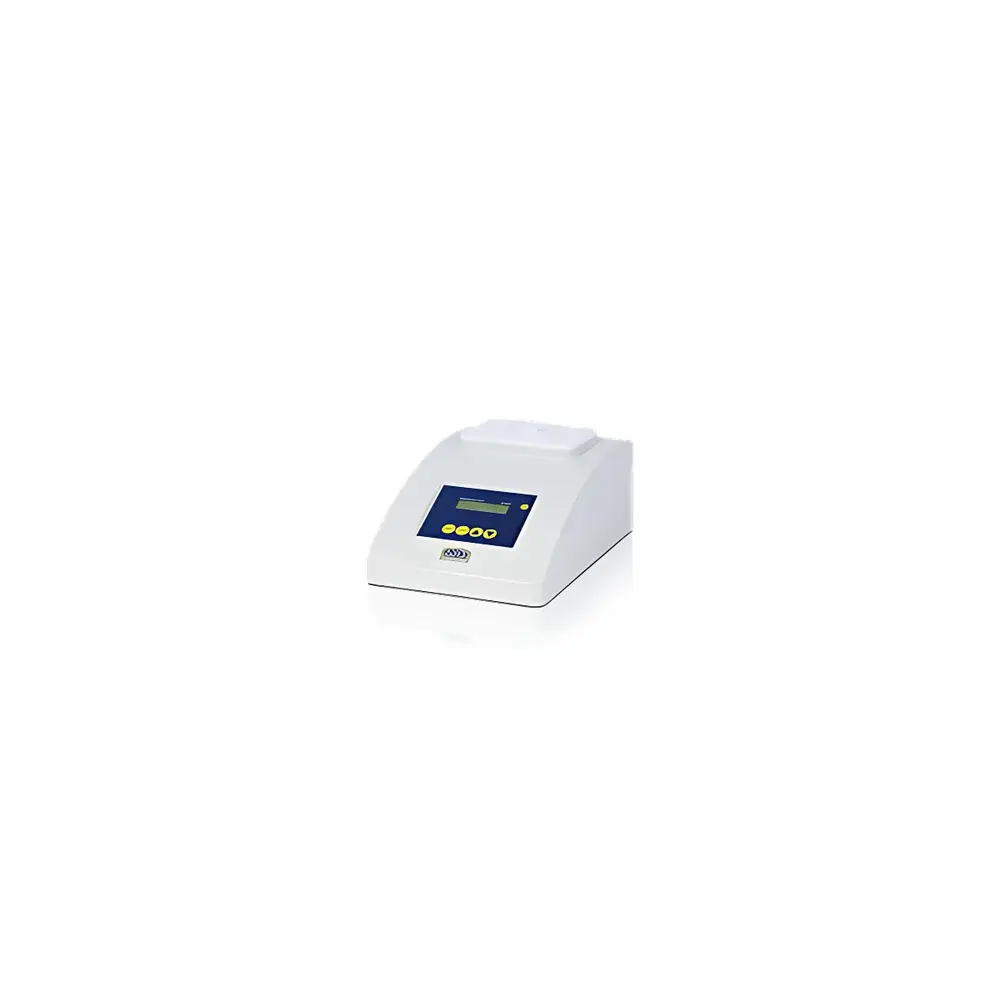
A.KRÜSS M5000 Automated Melting Point Apparatus
| Brand | A.KRÜSS / A.KRÜSS Optronic |
|---|---|
| Origin | Germany |
| Model | M5000 |
| Temperature Range | 25–400 °C |
| Heating Rate | 1 °C/min |
| Temperature Repeatability | ±0.2 °C |
| Temperature Accuracy | ±0.3 °C (25–200 °C), ±0.5 °C (200–400 °C) |
| Capillary Diameter | 1.4 mm |
| Sample Capacity | 1 capillary per measurement |
| Temperature Resolution | 0.1 °C |
| Cooling | Integrated fan-assisted cooling |
| Safety Rating | IP20 |
| Dimensions (L×W×H) | 230 × 210 × 110 mm |
| Weight | 1.8 kg |
| Power Supply | 85–264 V AC, 47–440 Hz |
| Interface | RS-232 |
Overview
The A.KRÜSS M5000 Automated Melting Point Apparatus is a compact, benchtop thermal analysis instrument engineered for precise and reproducible determination of melting points in crystalline organic and pharmaceutical compounds. It operates on the classical capillary tube method—where solid samples are loaded into standardized glass capillaries and subjected to a controlled, linear temperature ramp while optical detection monitors phase transition onset and completion. Designed for routine quality control laboratories, research institutions, and teaching environments, the M5000 delivers traceable thermal measurements compliant with pharmacopoeial standards including USP <741>, Ph. Eur. 2.2.14, and JP 2.60. Its robust architecture integrates real-time video-assisted observation, programmable heating profiles, and automatic endpoint recognition based on optical transmittance change—eliminating subjective visual interpretation and reducing inter-operator variability.
Key Features
- Fully automated melting point detection with integrated high-contrast LCD display showing real-time temperature, heating rate, and optical signal trend
- Precision temperature control with 0.1 °C resolution and active PID regulation across the full 25–400 °C operating range
- Optically sealed keypad with chemical-resistant surface for easy decontamination and long-term reliability in lab environments
- Intelligent fan-cooling system enabling rapid cooldown from 400 °C to ambient in under 10 minutes—minimizing turnaround time between sequential analyses
- Acoustic and visual end-point alert triggered at melt onset (clear point) and completion (liquid point), configurable per user preference
- Integrated safety hood included as standard equipment, conforming to IP20 ingress protection for operator safety during operation
- RS-232 serial interface supporting direct connection to thermal printers or legacy LIMS systems for audit-ready hardcopy reporting
Sample Compatibility & Compliance
The M5000 accepts standard 1.4 mm outer-diameter capillary tubes (100 supplied with unit), compatible with ASTM E324-19 (Standard Test Methods for Melting Point of Organic Solids) and ISO 6383-1:1984 (Plastics – Determination of Vicat Softening Temperature). It accommodates powders, crystals, and small granules—requiring only 1–2 mg sample mass per test. The instrument meets essential electrical safety requirements per IEC 61010-1:2010 and is CE-marked for use in EU laboratories. While not equipped with 21 CFR Part 11-compliant electronic signatures or audit trail functionality out-of-the-box, its deterministic measurement logic and stable calibration protocol support GLP-aligned documentation when paired with validated SOPs and external record-keeping systems.
Software & Data Management
The M5000 operates via embedded firmware without requiring external PC software—ensuring operational continuity during network outages or IT policy restrictions. All critical parameters—including date/time stamp, setpoint, actual temperature curve, and detected melt intervals—are stored in non-volatile memory for up to 100 recent measurements. Data export is facilitated through RS-232 output using ASCII-delimited format (e.g., “2024-05-12T09:23:17,178.3°C,179.1°C”), enabling seamless integration into Excel-based QA databases or custom laboratory informatics tools. Firmware updates are performed via USB-to-serial adapter (optional accessory), with version history logged internally for traceability during regulatory inspections.
Applications
- Pharmaceutical raw material identity verification and purity assessment per ICH Q5 and Q6A guidelines
- Quality assurance of fine chemicals, dyes, polymers, and agrochemical intermediates
- Educational demonstration of thermal transitions in undergraduate chemistry and materials science curricula
- Stability testing of heat-sensitive APIs during accelerated storage studies
- Batch release testing where pharmacopoeial compliance (USP, EP, JP) is mandated
- Method development and validation support for compendial melting point procedures
FAQ
What capillary dimensions are supported by the M5000?
The instrument is calibrated and optimized for standard capillaries with 1.4 mm outer diameter and 0.1–0.2 mm wall thickness—consistent with USP <741> specifications.
Can the M5000 be used for decomposition point determination?
While primarily designed for sharp-melting crystalline substances, it may detect onset of decomposition if accompanied by visible darkening or gas evolution—but dedicated thermogravimetric (TGA) instrumentation is recommended for quantitative decomposition analysis.
Is calibration traceable to national standards?
Yes—factory calibration uses NIST-traceable reference materials (e.g., indium, caffeine, phenacetin), and users may perform periodic verification using certified secondary standards.
Does the M5000 support multi-step heating programs?
No—the M5000 implements a single linear ramp mode (1 °C/min default); advanced programmable ramps require higher-tier models such as the A.KRÜSS M5600.
How often should the optical sensor be cleaned?
Visual inspection is recommended before each batch; cleaning with lint-free swab and isopropanol is advised if condensation or residue is observed on the viewing window—typically every 50–100 measurements under normal use.
Related Products



