
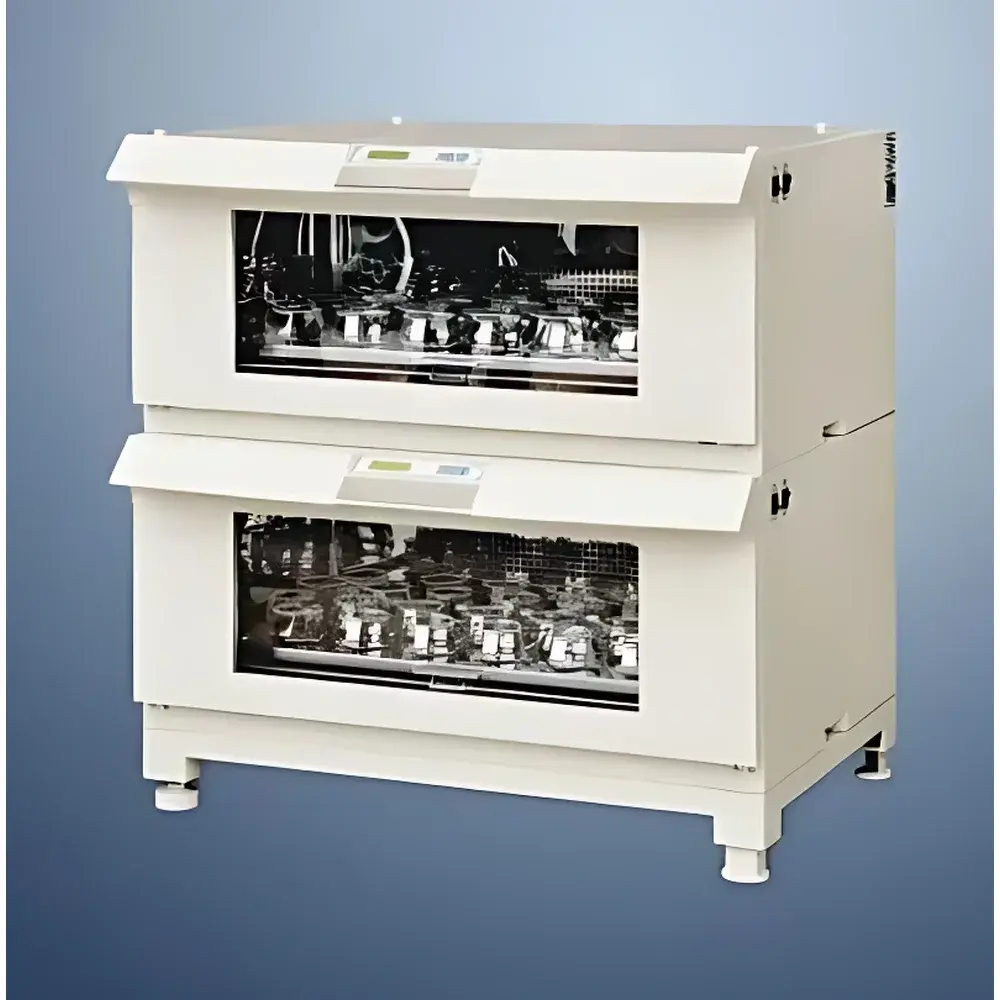
ZWYC-2402 Intelligent Stackable Combination Incubator Shaker
| Origin | Shanghai, China |
|---|---|
| Manufacturer Type | Authorized Distributor |
| Origin Category | Domestic (PRC) |
| Model | ZWYC-2402 |
| Pricing | Available Upon Request |
| Control Algorithm | PID with Environmental Scan Microprocessor |
| Display | Full-Color Touchscreen Interface |
| Air Circulation | Forced Convection |
| Oscillation Mode | Orbital Shaking |
| Drive Mechanism | Single-Axis Drive |
| Door Operation | Manual Down-Pull Damped Opening |
| Ambient Temperature Range | 10–35 °C |
| Chamber Count | 2 |
| Temperature Range | 4–60 °C |
| Temperature Resolution | 0.1 °C |
| Temperature Uniformity | ±1 °C at 37 °C |
| Temperature Stability | ±0.1 °C at 37 °C |
| Programmable Segments/Steps | 9 segments / 18 steps |
| Timer Range | 0.1–99.9 h |
| Speed Range | 0–300 rpm |
| Speed Accuracy | ±1 rpm |
| Orbit Diameter | Φ0–50 mm (Infinitely Adjustable) |
| Cooling System | Dual-Stage Air-Cooled Refrigeration (R134a), Frost-Free, Power-Modulated |
| Acceleration Profile | Soft-Start Ramp Control |
| Shelf Quantity | 2 |
| Tray Dimensions | 800 × 430 mm |
| Chamber Volume per Layer | 182 L |
| Interior Dimensions per Layer | 920 × 532 × 373 mm |
| External Dimensions | 1100 × 910 × 1330 mm |
| Packaging Dimensions | 1220 × 1030 × 1500 mm |
| Net Weight | 390 kg |
| Gross Weight | 440 kg |
| Power Consumption | 2400 W |
| Electrical Supply | AC 220 V, 50/60 Hz |
| Data Output | RS-232 Serial Port + Embedded Thermal Microprinter |
| Safety Systems | Dual Independent Overtemperature Cutouts (Adjustable & Fixed), Over-Speed Alarm, Low-Water Level Detection & Auto-Replenishment, Leakage Current Protection, Circuit Breaker for Overcurrent, Compressor Overload Protection, Sensor Fault Monitoring, Power-Fail Recovery, Emergency Stop Logic |
Overview
The ZWYC-2402 Intelligent Stackable Combination Incubator Shaker is an engineered platform for precision-controlled orbital shaking under regulated thermal conditions across two independently configurable chambers. Designed for high-reliability cell culture, microbial fermentation, enzyme kinetics, and hybridization workflows, it integrates microprocessor-based PID temperature regulation with programmable orbital motion in a modular, space-efficient architecture. Its dual-chamber configuration enables parallel experiments under divergent setpoints—e.g., comparative growth studies at 30 °C vs. 37 °C—or sequential staging of temperature-sensitive protocols. The system employs forced convection airflow with optimized duct geometry to ensure uniform thermal distribution (±1 °C at 37 °C), while the single-axis orbital drive delivers stable, low-vibration motion across the full 0–300 rpm range with ±1 rpm repeatability. All critical parameters—including temperature, speed, time, and humidity (in optional configurations)—are governed by an environmental scan microcontroller that continuously monitors sensor feedback and dynamically adjusts actuation outputs to maintain setpoint fidelity.
Key Features
- Full-color capacitive touchscreen interface with intuitive icon-driven navigation and real-time graphical display of temperature, speed, and elapsed time
- Dual independent incubation chambers (each 182 L volume), stackable design supporting vertical space optimization in core facilities and GMP-compliant labs
- Programmable multi-segment protocol engine: up to 9 segments and 18 steps per chamber, supporting ramp-hold cycles, stepwise temperature gradients, oscillation modulation, and timed shutdown/restart sequences
- Integrated water-level sensing and auto-refill system with audible/visual alerts to prevent evaporation-induced sample desiccation during extended runs
- Comprehensive safety architecture: dual redundant overtemperature cutoffs (fixed and user-adjustable), independent over-speed detection, leakage current protection, compressor overload monitoring, and sensor fault diagnostics
- Soft-start acceleration control minimizes mechanical shock to fragile cultures and suspension cells during initiation and speed transitions
- Corrosion-resistant construction: electropolished stainless steel interior, powder-coated steel exterior, tempered glass observation window, and removable stainless steel trays with spring-loaded clamps
- RS-232 serial interface compliant with standard laboratory data acquisition systems; embedded thermal printer supports GLP-compliant hardcopy record generation with timestamp and parameter traceability
Sample Compatibility & Compliance
The ZWYC-2402 accommodates standard microbiological and molecular biology vessels—including Erlenmeyer flasks (up to 5 L), culture bottles, deep-well plates, and roller bottles—via interchangeable tray configurations. Its 800 × 430 mm platform supports custom fixture mounting for specialized bioreactor modules or sensor-integrated bioprocess containers. From a regulatory standpoint, the instrument’s parameter memory, power-fail recovery, audit trail-capable print output, and deterministic PID control logic align with foundational expectations of ISO/IEC 17025-accredited testing laboratories and support adherence to FDA 21 CFR Part 11 when paired with validated electronic record procedures. While not certified as GMP-grade out-of-the-box, its design principles—including traceable calibration points, non-volatile parameter storage, and hardware-enforced safety interlocks—facilitate qualification under IQ/OQ/PQ frameworks common in pharmaceutical QC environments.
Software & Data Management
Operation is managed entirely through the onboard embedded controller; no external PC is required for routine use. All user-defined protocols, calibration offsets, and operational logs are stored in non-volatile memory with write-protection options. The RS-232 port enables bidirectional communication with LIMS or SCADA platforms using ASCII command sets (e.g., “GET_TEMP”, “SET_SPEED=150”). Printed records include date/time stamp, chamber ID, setpoint history, and alarm event log—supporting manual review for GLP audits. Firmware updates are performed via USB flash drive, with version rollback capability and checksum validation to ensure integrity. Parameter encryption prevents unauthorized modification of critical settings in shared-lab deployments.
Applications
This shaker serves as a primary tool in academic research labs studying aerobic/anaerobic microbial physiology, industrial biotechnology teams optimizing recombinant protein expression in E. coli or yeast, and clinical diagnostics units performing nucleic acid hybridization assays requiring precise thermal ramping. It is routinely deployed in: bacterial growth curve analysis under variable O2/CO2 regimes (when configured with gas ports), mammalian suspension culture scale-up, antibody production in CHO cells, enzymatic assay development under kinetic temperature gradients, and environmental microbiology studies involving soil or wastewater isolates. Its dual-chamber capacity also supports control-vs.-treatment experimental designs without cross-contamination risk.
FAQ
Does the ZWYC-2402 support CO2 or humidity control?
The base ZWYC-2402 model includes temperature and orbital shaking control only. Optional variants (e.g., ZW-D series) integrate CO2 inlet ports and humidification modules—contact technical sales for configuration-specific documentation.
Is remote monitoring or Ethernet connectivity available?
No native Ethernet or Wi-Fi interface is provided. Remote supervision requires integration via the RS-232 port using third-party serial-to-Ethernet converters compatible with Modbus RTU or custom ASCII protocols.
What is the maximum flask size supported per chamber?
With standard spring clamps, the platform accommodates up to four 5 L Erlenmeyer flasks simultaneously. Larger vessels require custom tray engineering and load-balancing verification.
Can the unit be validated for GMP use?
Yes—the architecture supports IQ/OQ execution. Documentation packages including factory calibration certificates, electrical safety test reports, and firmware version logs are supplied upon request.
How is temperature uniformity verified across the chamber volume?
Uniformity is measured per ASTM E145-22 Annex A4 using nine calibrated thermocouples positioned at defined spatial coordinates; results are reported in the Certificate of Conformance shipped with each unit.
Related Products



