
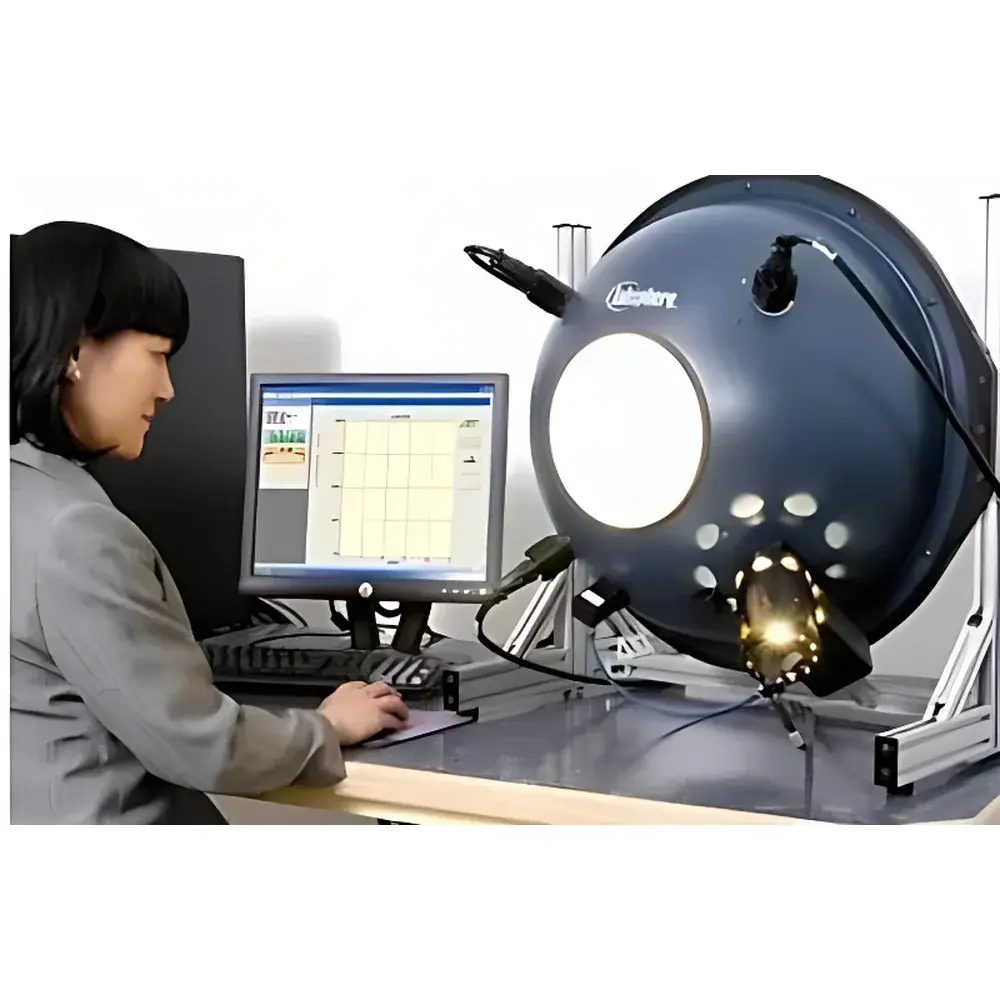
SPL Uniform Light Source System
| Brand | SPL |
|---|---|
| Origin | USA |
| Manufacturer Type | Authorized Distributor |
| Product Origin | Imported |
| Model | SPL |
| Light Source Type | Broadband Xenon Arc Lamp with Integrating Sphere |
| Illumination Mode | External Illumination |
| Uniformity | >98% (Exit Port) |
| Calibration Traceability | NIST-Traceable Radiometric and Photometric Data |
| Adjustable Output | Continuous and Stepwise Control of Luminous/Radiant Flux |
Overview
The SPL Uniform Light Source System is a precision-engineered optical calibration instrument designed for high-fidelity radiometric and photometric characterization of imaging sensors, remote sensing payloads, and detector arrays. Built around a stabilized broadband xenon arc lamp coupled with a high-efficiency integrating sphere, the system generates spatially uniform, Lambertian output across its exit port—enabling traceable, repeatable illumination for laboratory-based sensor validation and metrological alignment. Its core principle relies on multiple diffuse reflections within a spectrally neutral, highly reflective sphere interior to homogenize angular and spatial intensity distribution. This architecture ensures compliance with ISO 14880-2 (optical test methods for imaging systems) and supports applications requiring strict adherence to ASTM E308 (computing CIE tristimulus values) and ISO/CIE 11664 (colorimetry standards).
Key Features
- NIST-traceable calibration certificates provided for spectral irradiance (W·m⁻²·nm⁻¹), spectral radiance (W·sr⁻¹·m⁻²·nm⁻¹), illuminance (lux), luminance (cd·m⁻²), and uniformity (≥98% over defined aperture)
- Lambertian emission profile verified per CIE 15:2018, ensuring cosine-corrected angular response essential for camera and detector flat-field correction
- Externally mounted configuration enables integration into existing optical benches, vacuum chambers, or environmental test enclosures without internal modification
- Continuous and discrete-step intensity control via calibrated attenuator wheel and electronic lamp power regulation—supporting dynamic range testing from 0.1 cd·m⁻² to >10⁴ cd·m⁻²
- Integrating sphere coating optimized for 250–2500 nm spectral coverage, with minimal UV degradation and long-term reflectance stability (<0.5% drift/year)
- Modular port design accommodates standard M62×1 or CF100 flanges for vacuum compatibility and alignment with collimators, monochromators, or filter wheels
Sample Compatibility & Compliance
The SPL Uniform Light Source System is compatible with a broad class of optoelectronic devices, including but not limited to: frame-transfer and scientific CMOS CCD/CMOS image sensors; focal plane arrays (FPAs) used in Earth observation satellites; microbolometer-based thermal imagers (when equipped with appropriate IR-transmissive sphere coating); and photodiode-based radiometers requiring spatially resolved responsivity mapping. It meets functional requirements outlined in NASA GSFC-STD-7000A (Remote Sensing Instrument Calibration), USP (Photometric Testing of Imaging Systems), and supports GLP-compliant audit trails when integrated with validated data acquisition software.
Software & Data Management
The system operates with SPL’s proprietary LightCal Suite v3.x—a Windows-based application supporting automated exposure sequencing, spectral flux ramping, and real-time uniformity monitoring via external reference photodiodes. All calibration datasets are stored in HDF5 format with embedded metadata compliant with FAIR principles (Findable, Accessible, Interoperable, Reusable). Export options include CSV, XML, and IEEE Std 1596.1-2021-compliant radiometric reports. When deployed in regulated environments, optional 21 CFR Part 11-compliant modules provide electronic signatures, role-based access control, and immutable audit logs for IQ/OQ/PQ documentation.
Applications
- Flat-field correction and pixel response non-uniformity (PRNU) mapping for astronomical and planetary imaging sensors
- End-to-end radiometric calibration of multispectral and hyperspectral push-broom scanners prior to airborne or spaceborne deployment
- Quantitative validation of quantum efficiency (QE) curves for back-illuminated EMCCDs and sCMOS detectors
- Linearity assessment and dynamic range verification of digital cinema cameras per SMPTE RP 187
- Validation of low-light performance metrics (e.g., minimum resolvable contrast, photon transfer curve) in bioluminescence and fluorescence microscopy systems
- Reference source for inter-laboratory comparison exercises organized under BIPM CCPR-K1.a guidelines
FAQ
Is the SPL Uniform Light Source System suitable for vacuum-compatible optical setups?
Yes—the system features optional CF100 or KF40 vacuum flange configurations and uses outgassing-certified adhesives and coatings compliant with ECSS-Q-ST-70-02C.
Can spectral irradiance be adjusted independently at specific wavelengths?
No—spectral output is determined by the xenon arc lamp’s intrinsic emission profile and sphere coating reflectance; however, bandpass filters or monochromator coupling can be added externally to achieve wavelength-selective illumination.
What is the recalibration interval recommended for NIST-traceable accuracy?
Annual recalibration is recommended; SPL provides on-site or return-to-factory services with full uncertainty budgets per ISO/IEC 17025:2017.
Does the system support automated shutter control and synchronization with camera trigger signals?
Yes—TTL-compatible shutter interface and programmable delay generators are available as factory-installed options.
How is uniformity measured and verified across the exit port?
Uniformity is characterized using a motorized XY scanning photometer with ≤25 µm spatial resolution and calibrated V(λ)-matched silicon photodiode, following procedures defined in ISO 15739:2013 Annex D.




