
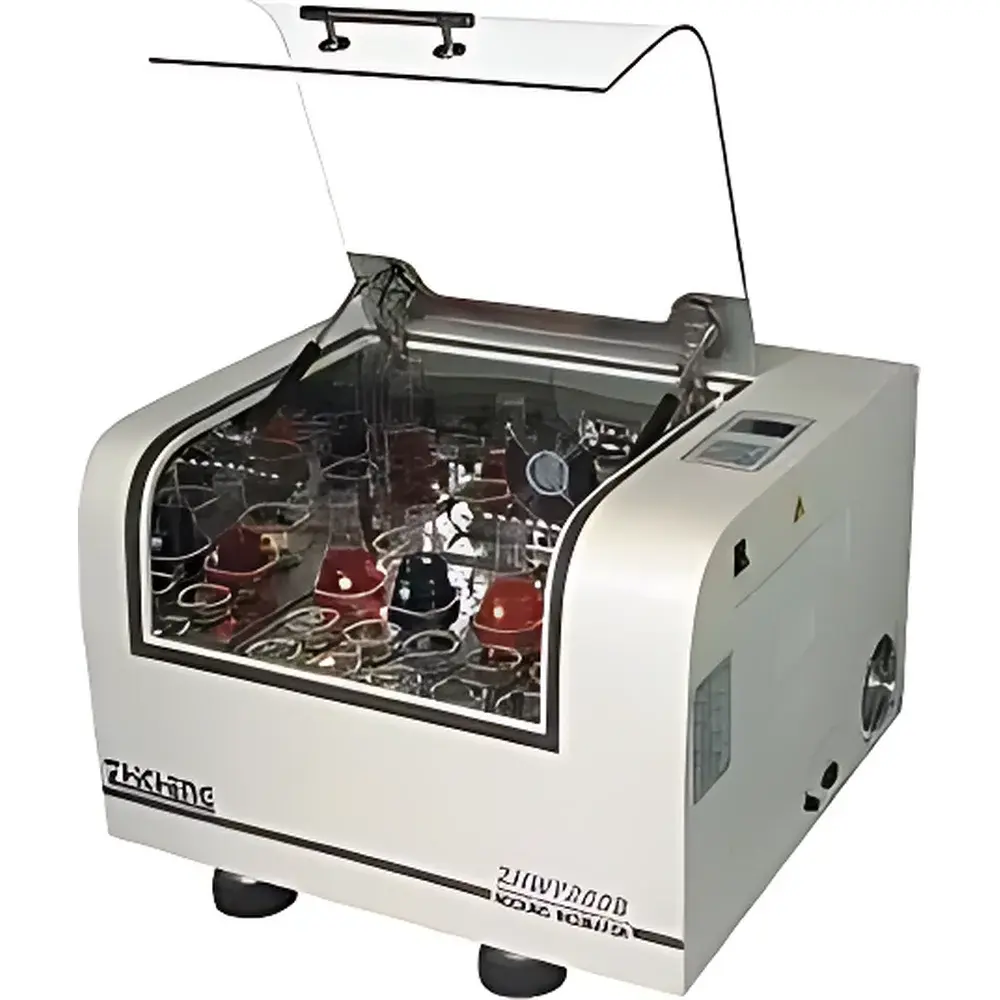
Zhicheng ZWY-240 Full-Temperature Multi-Amplitude Orbital Shaker
| Origin | Shanghai, China |
|---|---|
| Manufacturer Type | Authorized Distributor |
| Origin Category | Domestic (China) |
| Model | ZWY-240 |
| Pricing | Upon Request |
| Temperature Range | 4–60 °C |
| Temperature Resolution | 0.1 °C |
| Temperature Uniformity | ≤±1 °C (at 37 °C) |
| Temperature Stability | ≤±0.1 °C (at 37 °C) |
| Orbital Speed Range | 30–400 rpm |
| Speed Accuracy | ±1 rpm |
| Amplitude Adjustment | Φ0–50 mm, continuously variable |
| Chamber Volume | 69 L |
| Shelf Dimensions | 400 × 370 mm |
| Maximum Load Capacity | 50 mL × 23 |
| Power Supply | AC 220 V, 50/60 Hz |
| Rated Power | 700 W |
| Net Weight | 100 kg |
| Gross Weight | 132 kg |
| External Dimensions (W×D×H) | 730 × 685 × 555 mm |
| Internal Chamber Dimensions (W×D×H) | 490 × 450 × 315 mm |
| Timer Range | 0–500 h |
| Control System | PID microprocessor-based environmental scanning controller |
| Display | Backlit LCD with real-time parameter readout |
| Air Circulation | Forced convection |
| Oscillation Mode | Orbital (circular) |
| Drive Mechanism | Single-axis multi-amplitude eccentric cam drive |
| Safety Features | Over-temperature alarm (audible/visual), motor overheat protection, auto power cutoff on thermal runaway, power failure recovery, encrypted parameter lock, acceleration ramp control |
Overview
The Zhicheng ZWY-240 Full-Temperature Multi-Amplitude Orbital Shaker is an engineered platform for precise, reproducible cultivation and biochemical incubation under controlled temperature and orbital agitation. Designed for laboratories requiring simultaneous regulation of thermal environment and mechanical stimulation, it employs a PID-controlled forced-convection heating system coupled with a single-axis eccentric cam drive mechanism to deliver stable, low-vibration orbital motion across a wide amplitude spectrum (Φ0–50 mm, continuously adjustable) and speed range (30–400 rpm). Unlike fixed-amplitude shakers, the ZWY-240’s multi-amplitude architecture enables systematic optimization of oxygen transfer rates (OTR) in microbial cultures, suspension cell lines, and enzymatic assays—critical for scaling fermentation conditions or replicating physiological shear environments. Its all-metal chamber with electrostatically coated steel interior and tempered glass viewing window ensures durability, corrosion resistance, and visual process monitoring without compromising thermal integrity.
Key Features
- Continuous amplitude adjustment (Φ0–50 mm) via calibrated eccentric cam mechanism, enabling fine-tuned control of mixing intensity and gas–liquid interfacial area
- PID microprocessor controller with environmental scanning capability for adaptive temperature regulation and minimized overshoot
- Backlit LCD display showing real-time values for setpoint temperature, actual chamber temperature, speed, amplitude, and remaining timer duration
- Programmable timer (0–500 h) with auto-restart function after power interruption—maintains experimental continuity per GLP-compliant protocols
- Intelligent acceleration ramping: motor starts gradually at user-defined speed, eliminating mechanical shock to fragile samples such as adherent cell monolayers or protein aggregates
- Dual safety architecture: independent over-temperature detection circuit triggers audible/visual alarm and cuts heater power; separate motor thermal sensor prevents coil damage during extended high-speed operation
- Parameter encryption lock prevents unauthorized modification of critical settings—supports audit trail requirements under ISO/IEC 17025 and FDA 21 CFR Part 11 when integrated with validated LIMS
- Brushless AC induction motor with constant torque output across full speed range—no carbon brushes, zero maintenance, rated for >20,000 hours of continuous operation
Sample Compatibility & Compliance
The ZWY-240 accommodates standard microbiological and cell culture vessels including Erlenmeyer flasks (50–1000 mL), deep-well plates, and test tube racks, with maximum load configurations verified per ASTM D4169 for vibration-induced stress tolerance. Its temperature uniformity (≤±1 °C at 37 °C) and stability (≤±0.1 °C) meet ISO 20387:2018 requirements for biobanking equipment qualification. The unit complies with IEC 61010-1 (Safety Requirements for Electrical Equipment for Measurement, Control, and Laboratory Use) and electromagnetic compatibility standards EN 61326-1. While not certified for GMP manufacturing environments, its design supports IQ/OQ/PQ validation packages for QC labs operating under cGMP, USP , or CLIA guidelines.
Software & Data Management
The ZWY-240 operates autonomously via embedded firmware with no external software dependency. All operational parameters—including temperature setpoint, speed, amplitude, timer, and alarm thresholds—are stored in non-volatile memory with battery-backed retention. Parameter change logs are timestamped and retained for up to 1,000 events, supporting traceability in regulated environments. Optional RS-485 serial interface (available upon request) enables integration into centralized lab monitoring systems using Modbus RTU protocol for remote status polling and alarm notification. Data export requires manual transcription from LCD display; no USB or Ethernet port is included, preserving electromagnetic isolation and minimizing cybersecurity surface area per NIST SP 800-53 controls.
Applications
This shaker serves core workflows in academic, pharmaceutical, and industrial life science laboratories: aerobic bacterial culture (e.g., E. coli, Bacillus subtilis) under defined O2 transfer conditions; mammalian suspension cell expansion (CHO, HEK293); yeast fermentation kinetics studies; enzyme activity assays requiring homogeneous substrate dispersion; hybridization buffer equilibration in molecular diagnostics; and tissue dissociation pre-processing. Its wide amplitude range allows direct correlation between oscillation geometry and dissolved oxygen profiles—enabling empirical modeling of kLa (volumetric mass transfer coefficient) without requiring ancillary DO probes. The 69 L chamber volume supports parallel processing of multiple flask sizes, improving throughput in strain screening or media optimization experiments.
FAQ
What is the maximum flask capacity supported at 400 rpm?
At 400 rpm, the recommended maximum is 500 mL flasks (9 units) or 250 mL flasks (12 units), assuming balanced loading and use of appropriate clamps. Higher volumes require speed reduction to maintain mechanical stability.
Does the ZWY-240 support CO2 or humidity control?
No. It is a temperature- and agitation-controlled incubator only. For CO2-regulated applications, consider dedicated CO2 shaker incubators with gas blending and IR sensing modules.
Is calibration documentation provided with the unit?
A factory calibration certificate for temperature and speed sensors is included. Users must perform periodic verification using NIST-traceable thermistors and tachometers per internal SOPs or ISO/IEC 17025 accreditation requirements.
Can the shaker be operated in a cold room at 10 °C ambient?
Yes—the specified ambient operating range is 5–25 °C. Below 5 °C, condensation risk increases; above 25 °C, cooling efficiency degrades and may compromise temperature stability at setpoints near 4 °C.
What maintenance is required for long-term reliability?
Annual inspection of drive belt tension (if applicable), cleaning of air intake filters, and verification of door seal integrity. The brushless motor requires no scheduled servicing; lubrication-free bearings are rated for 50,000 hours.





