
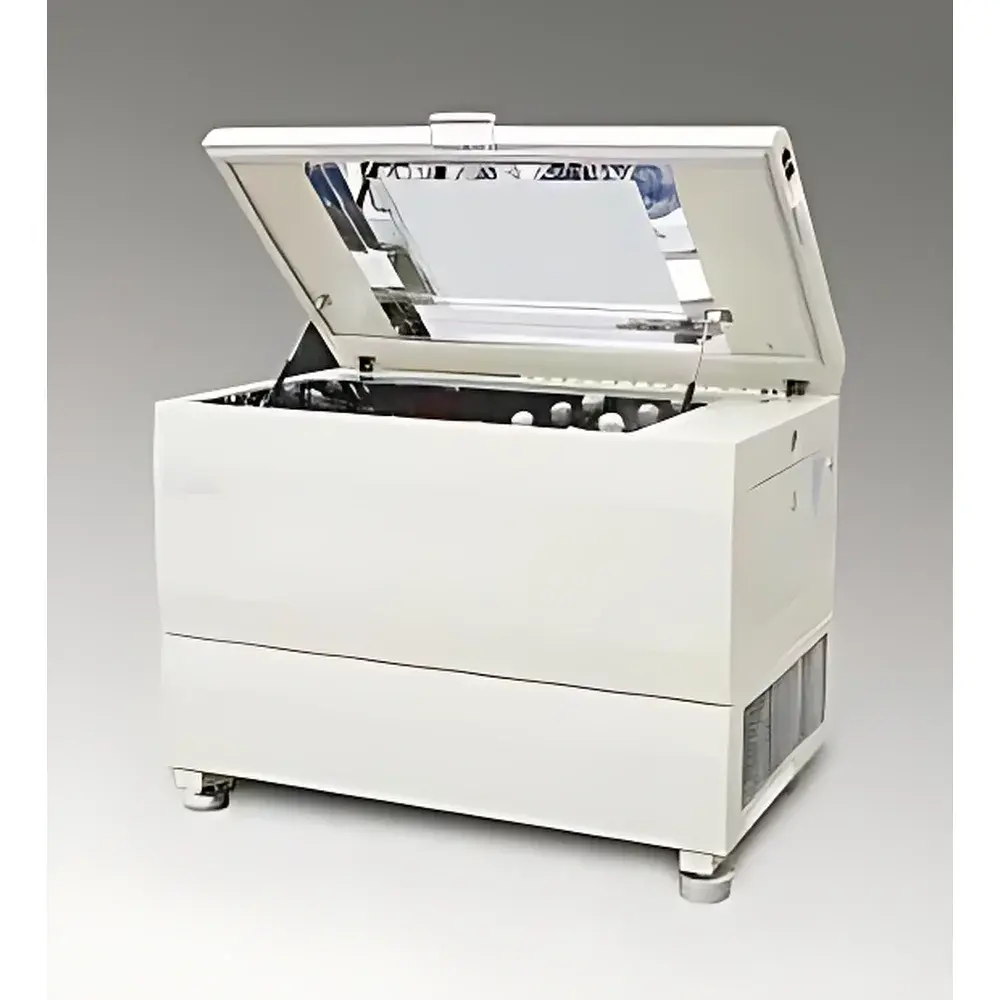
ZWF-A211 Horizontal Reciprocating Programmable Shaker
| Origin | Shanghai, China |
|---|---|
| Manufacturer Type | Authorized Distributor |
| Origin Category | Domestic (China) |
| Model | ZWF-A211 |
| Pricing | Available Upon Request |
Overview
The ZWF-A211 Horizontal Reciprocating Programmable Shaker is an advanced benchtop incubator shaker engineered for precision-controlled oscillatory motion in life science laboratories. It operates on a horizontal reciprocating motion principle—distinct from orbital or rotary shaking—delivering uniform linear back-and-forth displacement ideal for applications requiring consistent shear stress distribution across suspension cultures, hybridization reactions, and solid-phase binding assays. Designed for continuous operation under controlled thermal environments (4–60 °C), the unit integrates PID-driven microprocessor control with environmental scanning logic to maintain high reproducibility in temperature and speed regulation. Its forced-air convection system ensures rapid thermal equilibration and uniform chamber conditions (±1 °C at 37 °C), while the reciprocating drive mechanism—based on precision-machined cam-follower transmission—delivers stable, low-vibration motion across the full frequency range (30–240 rpm, ±1 rpm accuracy). The shaker complies with IEC 61010-1 safety standards for laboratory equipment and meets structural requirements for GLP-compliant environments.
Key Features
- Horizontal reciprocating oscillation mode with adjustable amplitude (Φ0–50 mm, stepless)
- PID-controlled microprocessor with environmental scanning chip for adaptive thermal and speed regulation
- 6-segment × 12-step programmable protocol support—including ramping, stepping, cycling, and temperature-staged profiles (max. 100 h per segment)
- Backlit LCD display showing real-time and setpoint values for temperature, speed, time, and amplitude
- Dual independent overtemperature protection: adjustable mechanical cut-off + electronic limit sensor
- Comprehensive safety suite: door-open stop, leakage current protection, overload trip, refrigeration compressor overload monitoring, and power-failure recovery
- Auto-refill water level management system with audible/visual low-water alert
- Brushless AC induction motor—maintenance-free, wide-speed-range, constant-torque output
- Soft-start acceleration algorithm minimizing sample disturbance during initiation
- Electrostatically sprayed steel cabinet; mirror-polished stainless-steel interior; tempered glass observation window
- Detachable stainless-steel platform (896 × 530 mm) compatible with universal flask clamps and custom fixtures
Sample Compatibility & Compliance
The ZWF-A211 accommodates standard culture vessels including Erlenmeyer flasks (100–3000 mL), test tubes, microplates, and hybridization bottles—up to 15 × 2000 mL or 6 × 3000 mL simultaneously. Its 284 L chamber volume and optimized airflow path ensure minimal thermal stratification and consistent mixing across heterogeneous load configurations. The device supports ISO/IEC 17025-aligned validation protocols and includes features required for regulated environments: parameter encryption, audit-trail-capable memory (retains ≥1000 runtime logs), clock-synchronized timestamping, and RS-232 serial interface for external data capture. While not FDA 21 CFR Part 11–certified out-of-box, its firmware architecture permits integration into validated LIMS or ELN systems via standardized ASCII command sets.
Software & Data Management
Embedded firmware enables local configuration, real-time monitoring, and onboard printing via integrated thermal printer (micro-format, non-removable). All user-defined programs—including temperature ramps, speed transitions, dwell times, and alarm thresholds—are stored in non-volatile memory with password protection (AES-128 encrypted parameter fields). The RS-232 port supports bidirectional communication using Modbus RTU or proprietary ASCII protocol, enabling remote scripting via LabVIEW, Python, or MATLAB. Data export options include CSV-formatted runtime logs (timestamp, Tset, Tactual, rpm, alarm status) and printable protocol summaries. Firmware updates are performed via USB-to-serial adapter (not included); version history and checksum verification are retained in device memory.
Applications
This shaker is routinely deployed in molecular biology labs for DNA/RNA hybridization, Western blot membrane incubation, and antigen-antibody binding kinetics. In microbiology and fermentation research, it supports aerobic bacterial growth studies where linear agitation minimizes foam formation and improves oxygen transfer efficiency compared to orbital motion. Its precise temperature ramping capability makes it suitable for enzyme activity profiling, protein refolding assays, and thermosensitive cell line expansion. Additional use cases include environmental sample extraction (e.g., soil leaching), pharmaceutical dissolution testing (per USP guidance), and quality control of diagnostic reagents under accelerated stability conditions.
FAQ
What is the difference between reciprocating and orbital motion in shakers?
Reciprocating motion provides linear back-and-forth displacement, generating lower shear forces and more uniform suspension in viscous or particulate-laden media—ideal for hybridization and immunoassays. Orbital motion induces circular agitation better suited for suspension cultures requiring higher oxygenation.
Does the ZWF-A211 support CO₂ control or humidity regulation?
No—this model (ZWF-A211) is a non-humidified, ambient-air-cooled unit. For CO₂ or humidity control, refer to the ZW-D series variants.
Can the shaker operate unattended for extended periods?
Yes—equipped with auto-restart after power interruption, programmable timers up to 500 hours, and comprehensive fault detection with latched alarms.
Is calibration documentation provided with the instrument?
Factory calibration certificates for temperature and speed sensors are included; traceable NIST-standard recalibration services are available through authorized service centers.
What maintenance is required for long-term reliability?
No routine motor servicing is needed due to brushless design. Recommended quarterly checks include condensate tray cleaning, door seal inspection, and verification of water-level sensor response.




