
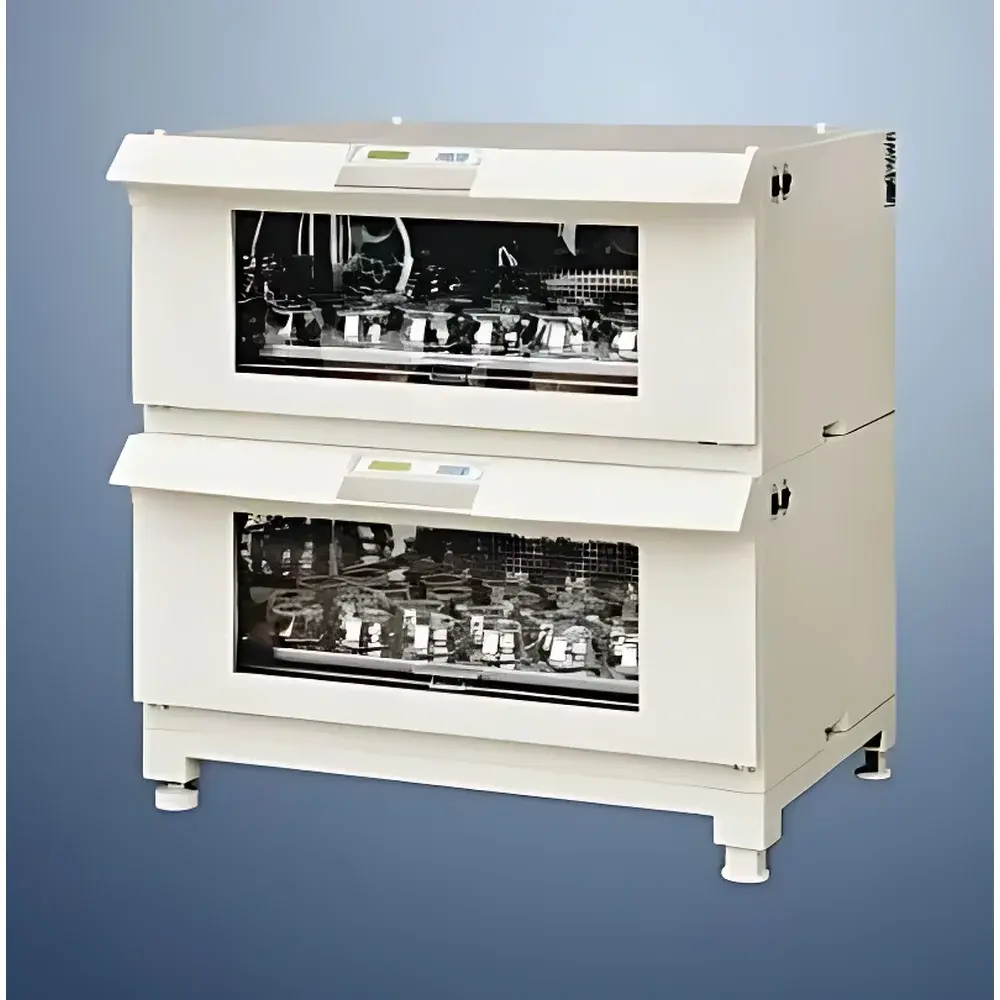
ZWYY-D2402 Intelligent Stackable Multi-Function Incubated Shaker
| Origin | Shanghai, China |
|---|---|
| Manufacturer Type | Authorized Distributor |
| Origin Category | Domestic (China) |
| Model | ZWYY-D2402 |
| Pricing | Upon Request |
| Control Algorithm | PID with Environmental Scan Microprocessor |
| Display | 7-inch Full-Color TFT Touchscreen |
| Air Circulation | Forced Convection |
| Oscillation Mode | Orbital Shaking |
| Drive Mechanism | Single-Axis Brushless AC Induction Motor |
| Door Operation | Manual Down-Pull Damped Opening |
| Ambient Temp. Range | 10–35 °C |
| Chamber Count | Dual Independent Chambers |
| Temp. Range | 4–60 °C |
| Temp. Resolution | 0.1 °C |
| Temp. Stability | ±0.5 °C @ 37 °C |
| Temp. Uniformity | ±1.0 °C @ 37 °C |
| Humidity Range | 40–85 %RH |
| Humidity Resolution | 0.1 %RH |
| Humidity Stability | ≤±2 %RH |
| Humidity Uniformity | ≤±6 %RH |
| CO₂ Range | 0–20 % |
| CO₂ Resolution | 0.1 % |
| CO₂ Accuracy | ±0.46 % |
| Programmability | 9 Segments / 18 Steps (Curve & Stepwise) |
| Timer Range | 0.1–99.9 h |
| Speed Range | 0–300 rpm |
| Speed Accuracy | ±1 rpm |
| Orbit Diameter | Φ0–50 mm (Infinitely Adjustable) |
| Acceleration Profile | Soft-Start Ramp Control |
| Shelf Count | 2 per Chamber |
| Tray Dimensions | 800 × 430 mm |
| Capacity per Chamber | 182 L |
| Interior Dimensions per Chamber | 920 × 532 × 373 mm |
| External Dimensions | 1100 × 910 × 1330 mm |
| Packaging Dimensions | 1220 × 1030 × 1500 mm |
| Net Weight | 390 kg |
| Gross Weight | 440 kg |
| Power Consumption | 2400 W |
| Voltage/Frequency | AC 220 V, 50/60 Hz |
| Refrigeration System | Dual-Stacked, Frost-Free, R134a-Based, Power-Modulated Air-Cooling |
| Humidification Method | Steam Generation |
| CO₂ Sensor | NDIR (Non-Dispersive Infrared) |
| Safety Systems | Dual Independent Over-Temp Cutouts (Adjustable), Over-Speed Alarm, Low-Water Level Detection with Auto-Refill, Power-Fail Recovery, Leakage & Over-Current Circuit Breaker, Compressor Overload Protection, Sensor Fault Monitoring, Door-Open Interlock, Real-Time Evaporation Compensation Algorithm |
Overview
The ZWYY-D2402 Intelligent Stackable Multi-Function Incubated Shaker is an engineered platform for precision-controlled, multi-parameter bioreactor-grade cultivation and incubation. Designed for laboratories requiring simultaneous control of temperature, humidity, CO₂ concentration, and orbital oscillation across two independent chambers, it integrates advanced environmental regulation with programmable kinetic profiles to support reproducible cell culture, microbial fermentation, hybridization assays, and enzymatic reaction kinetics. Its core operating principle combines forced-convection thermal management with microprocessor-driven PID feedback loops—each chamber independently regulated via high-stability platinum resistance thermometers (PT100), capacitive humidity sensors, and NDIR-based CO₂ detection. The system implements real-time evaporation compensation algorithms and adaptive refrigeration modulation to maintain setpoint fidelity under dynamic load conditions, ensuring minimal sample desiccation and metabolic drift over extended incubation cycles.
Key Features
- Dual independent incubation chambers with fully segregated environmental control systems—enabling parallel experiments under distinct temperature, humidity, and CO₂ conditions.
- Orbital shaking mechanism powered by a maintenance-free, brushless AC induction motor delivering stable torque across 0–300 rpm with ±1 rpm accuracy and infinitely adjustable orbit diameter (Φ0–50 mm).
- Full-color 7-inch TFT touchscreen interface supporting intuitive drag-and-drop programming of up to 9 segments and 18 steps—including ramp, hold, step-change, and cyclic profiles for temperature, speed, humidity, and CO₂.
- Frost-free dual-stack refrigeration system using R134a with power-modulated compressor control, enabling precise sub-ambient cooling down to 4 °C without condensation or ice accumulation.
- Steam-based humidification with auto-refill water reservoir and low-water-level optical detection—integrated with predictive evaporation modeling to sustain 40–85 %RH with ≤±2 %RH stability.
- NDIR CO₂ sensor calibrated to ISO 8573-1 traceable standards, offering linear response across 0–20 % with ±0.46 % absolute accuracy and automatic atmospheric pressure compensation.
- Comprehensive safety architecture: triple-redundant over-temperature protection (including adjustable independent cutouts), door-open interlock, leakage circuit breaker, compressor overload monitoring, and real-time sensor health diagnostics.
- Power-fail recovery logic preserves all active parameters and resumes operation at original setpoints following grid interruption—critical for GLP-compliant long-term cultures.
Sample Compatibility & Compliance
The ZWYY-D2402 accommodates standard laboratory vessels—including Erlenmeyer flasks (up to 5 L), Petri dishes, multi-well plates, and roller bottles—via interchangeable stainless-steel electro-polished trays and universal spring clamps. Its interior features mirror-finish 316L stainless steel construction, seamless welds, and rounded corners to facilitate cleaning validation per ISO 14644-1 Class 7 cleanroom requirements. The unit complies with IEC 61010-1:2010 for electrical safety in laboratory equipment and meets EMC immunity thresholds per IEC 61326-1. While not certified for medical device use under FDA 21 CFR Part 820, its data logging capabilities (via RS-232 and embedded thermal printer) support audit-ready documentation aligned with GLP and GMP Annex 11 principles—particularly when paired with third-party validated software for electronic signature and change control.
Software & Data Management
All operational parameters—including real-time temperature, humidity, CO₂, speed, and alarm status—are continuously logged to internal flash memory with timestamp resolution of 1 second. Data export is supported via RS-232 serial interface (ASCII protocol) for integration into LIMS or ELN platforms. The embedded thermal printer provides immediate hardcopy output of program logs, calibration events, and alarm histories—formatted to meet ALCOA+ data integrity criteria (Attributable, Legible, Contemporaneous, Original, Accurate). Optional firmware updates include CSV export functionality and configurable audit trail depth (up to 30 days), satisfying routine QC record retention mandates per ISO/IEC 17025:2017 Clause 7.5.2.
Applications
This shaker serves as a primary platform for mammalian and insect cell suspension culture, aerobic bacterial fermentation (e.g., E. coli, Bacillus spp.), yeast propagation, hybridoma expansion, and recombinant protein expression workflows. Its dual-chamber design enables controlled comparative studies—such as hypoxia vs. normoxia CO₂ gradients, or differential humidity effects on fungal sporulation. In molecular biology, it supports stringent hybridization protocols requiring precise thermal ramping and agitation synchronization. Regulatory labs utilize its programmable step cycles for USP bacterial endotoxin assay preparation and ASTM D5547-22 microbiological media validation. The system’s thermal uniformity (±1 °C @ 37 °C) and CO₂ linearity make it suitable for ISO 13408-2–compliant aseptic process simulation.
FAQ
Is the ZWYY-D2402 compliant with FDA 21 CFR Part 11?
No—the embedded printer and RS-232 interface support data traceability but lack electronic signature, role-based access control, and audit trail immutability required for Part 11 compliance. Integration with validated third-party software is recommended for regulated environments.
Can both chambers operate at different CO₂ concentrations simultaneously?
Yes—each chamber has an independent NDIR sensor and gas injection manifold, enabling concurrent CO₂ setpoints from 0 to 20 % with no cross-contamination.
What is the maximum flask size supported per tray?
Standard configuration accommodates four 2 L Erlenmeyer flasks or two 5 L flasks using optional heavy-duty clamps; total load capacity per chamber is 25 kg.
Does the system support remote monitoring via Ethernet or Wi-Fi?
Not natively—the current hardware includes only RS-232. Ethernet connectivity requires external serial-to-Ethernet converters validated for lab network segmentation.
How frequently does the CO₂ sensor require recalibration?
Annual calibration against NIST-traceable gas standards is recommended; factory calibration certificate is provided with each unit, and zero-point verification can be performed in-air at startup.





