
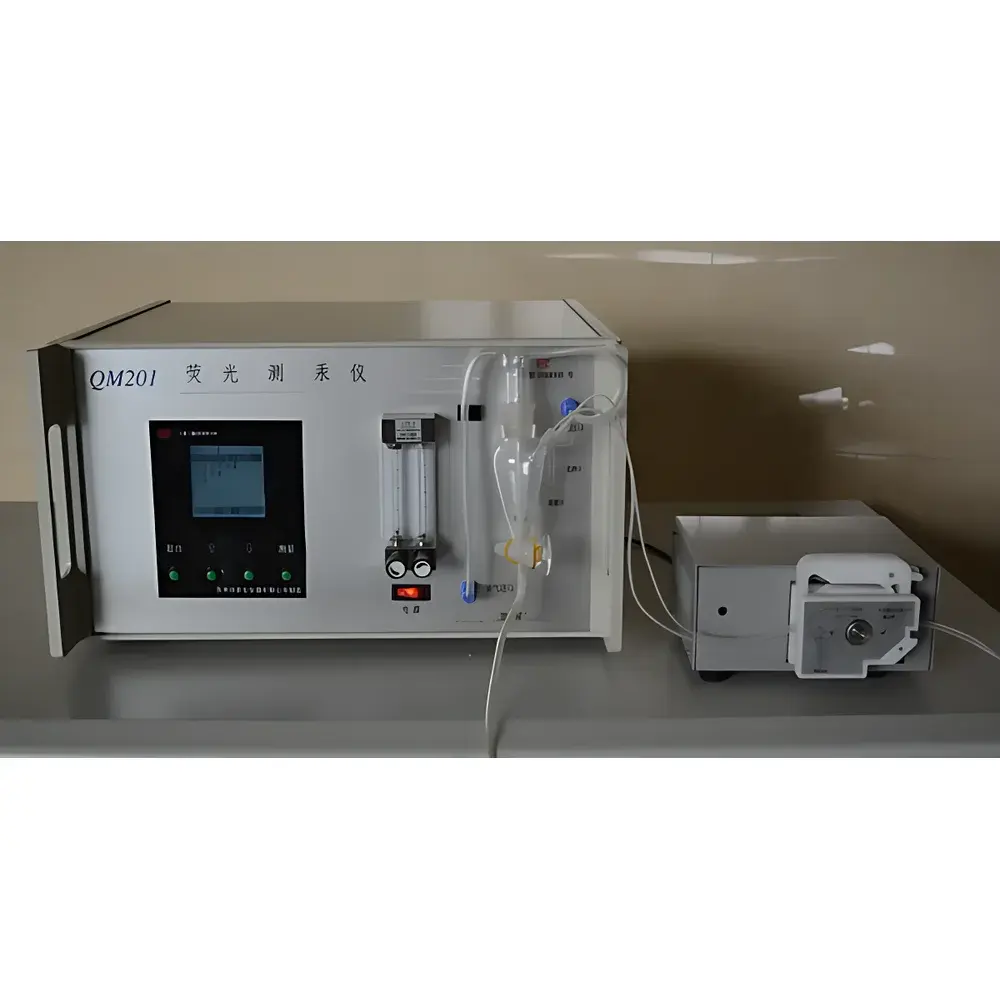
JBS QM201 Cold Vapor Atomic Fluorescence Mercury Analyzer
| Brand | JBS |
|---|---|
| Origin | Jiangsu, China |
| Manufacturer Type | Direct Manufacturer |
| Instrument Type | Benchtop Laboratory Analyzer |
| Principle | Cold Vapor Atomic Fluorescence Spectrometry (CVAFS) |
| Detection Limit | ≤0.003 µg/L |
| Repeatability (RSD) | ≤5% |
| Linearity Error | ±5% |
| Zero Drift | <0.2 mV |
| Measurement Range | 0.01–100 µg/L |
| Noise Level | <0.1 mV |
| Correlation Coefficient (Calibration Curve) | ≥0.996 |
| Operating Temperature | 5–35 °C |
| Relative Humidity | ≤80% |
| Environmental Requirements | Low-vibration, low-EMI, mercury-free ambient, well-ventilated location with external exhaust capability |
Overview
The JBS QM201 Cold Vapor Atomic Fluorescence Mercury Analyzer is a dedicated benchtop instrument engineered for the quantitative determination of trace and ultra-trace mercury concentrations in liquid, solid, and gaseous matrices. It operates on the principle of cold vapor atomic fluorescence spectrometry (CVAFS), a highly selective and sensitive technique in elemental analysis. In CVAFS, mercury in the sample is chemically reduced—typically using sodium borohydride or stannous chloride—to elemental mercury vapor, which is then swept into a quartz cell within an optical path. A high-intensity ultraviolet lamp (typically 253.7 nm) excites the ground-state Hg atoms, and the resulting atomic fluorescence emission is detected at the same wavelength using a photomultiplier tube (PMT) with narrow-band filtering. This resonance-based detection provides exceptional specificity for mercury, minimizing interferences from other elements and enabling reliable quantification at sub-part-per-quadrillion (ng/L) levels.
Key Features
- Benchtop design optimized for routine laboratory deployment, requiring minimal footprint and no dedicated cleanroom infrastructure.
- Integrated semi-automatic peristaltic pump sampling system with programmable flow control, ensuring consistent reagent delivery and sample introduction.
- Modular reaction vessel configuration—compatible with both sealed quartz reaction cells and open-vessel digestion setups—facilitating rapid cleaning and cross-contamination mitigation.
- Stabilized UV excitation source with thermal management to maintain spectral output consistency over extended operation cycles.
- Dual-channel analog signal processing with real-time baseline correction, supporting robust signal-to-noise performance (<0.1 mV RMS noise).
- Zero-drift compensation algorithm, maintaining baseline stability below 0.2 mV over 8-hour continuous operation under controlled environmental conditions.
- Compliance-ready architecture: supports manual audit trail logging; firmware design accommodates future integration with 21 CFR Part 11-compliant software modules.
Sample Compatibility & Compliance
The QM201 accepts aqueous samples—including surface water, wastewater, drinking water, and biological fluids—without pre-concentration when mercury levels fall within its linear dynamic range (0.01–100 µg/L). Solid matrices (e.g., soil, sediment, hair, fish tissue, cereals, coal, and geological samples) require acid digestion (EPA Method 7473 or ISO 17892-7 compliant protocols) prior to hydride generation. Gaseous samples (e.g., ambient air or stack emissions) may be analyzed following gold-amalgamation trapping and thermal desorption. The instrument meets core performance criteria aligned with EPA Method 1631E (Mercury in Water by Oxidation, Purge and Trap, and CVAFS), ASTM D6725 (Standard Test Method for Mercury in Crude Oil), and ISO 12846:2012 (Water quality — Determination of mercury — Method using atomic fluorescence spectrometry). Its measurement uncertainty profile supports use in GLP-regulated environmental monitoring and food safety testing environments.
Software & Data Management
The QM201 operates via embedded microcontroller firmware with a front-panel LCD interface for method selection, calibration execution, and real-time signal visualization. Raw analog outputs (mV vs. time) are accessible via analog BNC port for integration with third-party data acquisition systems. Calibration curves are generated using least-squares linear regression; correlation coefficients ≥0.996 are verified during each daily startup sequence. All measurement events—including calibration date/time, operator ID (manually entered), standard concentrations, and sample IDs—are logged in non-volatile memory with timestamping. While native software is not included, the instrument’s RS-232 serial interface enables interoperability with LIMS platforms and custom Python/Excel-based reporting tools. Audit trail export (CSV format) is supported for regulatory review.
Applications
- Environmental laboratories performing compliance monitoring of mercury in wastewater discharge, groundwater, and surface water per national regulatory frameworks (e.g., China’s GB 3838-2002, US EPA NPDES requirements).
- Public health and CDC-affiliated labs quantifying mercury in human biomonitoring specimens (whole blood, urine, hair) for exposure assessment.
- Food safety agencies analyzing mercury in seafood, rice, infant formula, and dietary supplements to verify adherence to Codex Alimentarius limits (e.g., 0.5 mg/kg in fish).
- Geological survey institutes assessing mercury contamination in soils and sediments associated with artisanal gold mining or legacy industrial sites.
- Research institutions conducting speciation studies when coupled with HPLC-CVAFS interfaces (external configuration).
- Oil & gas QA/QC labs verifying mercury content in crude oil feedstocks to prevent catalyst poisoning in refining units.
FAQ
What sample preparation is required for solid matrices?
Solid samples must undergo oxidative acid digestion (e.g., HNO₃/H₂SO₄/KMnO₄ or microwave-assisted aqua regia) to liberate bound mercury into solution prior to CVAFS analysis.
Does the QM201 support automatic calibration verification?
No—calibration verification requires manual injection of certified reference standards at defined intervals; however, the instrument stores all calibration parameters and residuals for traceability.
Can the QM201 be installed in a standard chemistry lab without special ventilation?
No—due to potential mercury vapor release during analysis, installation requires connection to a dedicated fume hood or external exhaust ducting capable of maintaining ≥0.5 m/s face velocity at the instrument’s exhaust port.
Is the detector PMT replaceable by the user?
Yes—the photomultiplier tube is a field-replaceable module with standardized socket interface; replacement requires recalibration using NIST-traceable Hg standards.
What is the recommended maintenance schedule?
Daily: rinse fluid lines and reaction cell with deionized water; weekly: inspect peristaltic pump tubing for fatigue; annually: validate optical alignment and UV lamp intensity using factory-provided alignment kit.






