
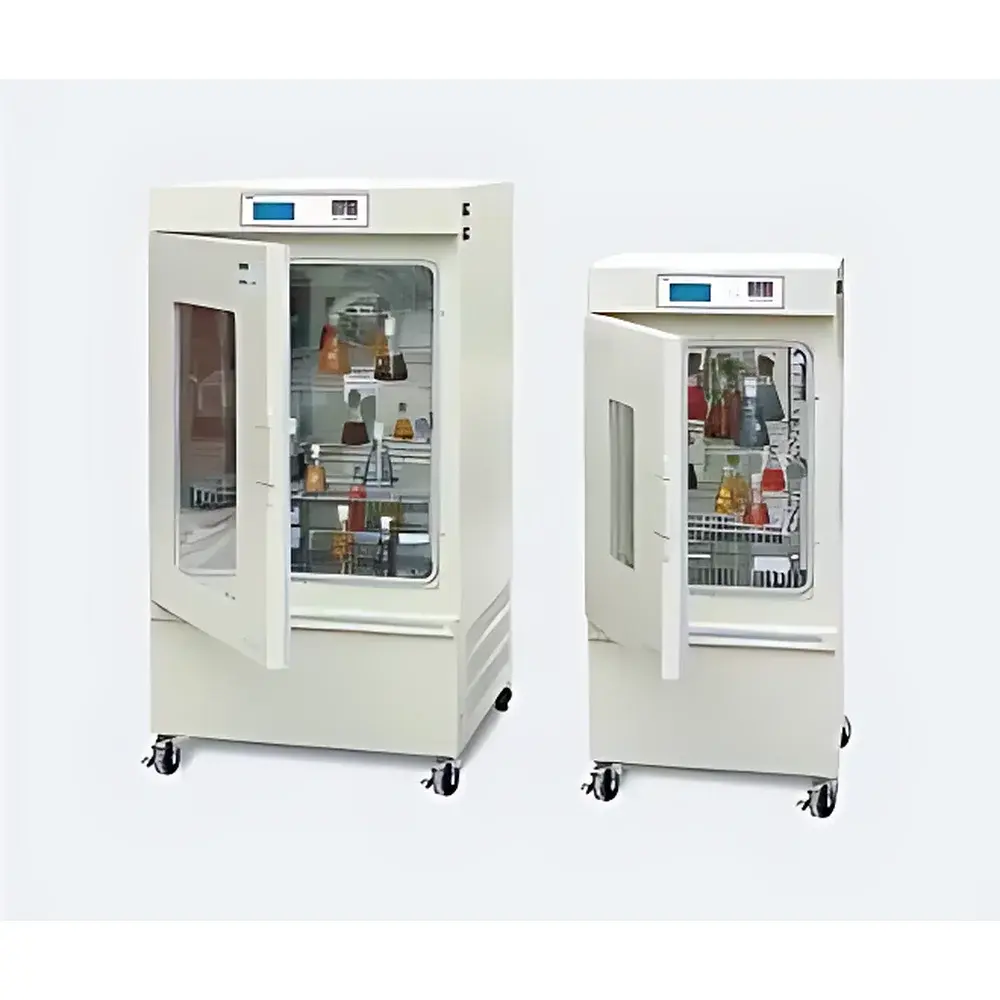
Zhicheng ZXSD-A1430 Ten-Stage Programmable Biochemical Incubator
| Brand | Zhicheng |
|---|---|
| Origin | Shanghai, China |
| Manufacturer Type | Direct Manufacturer |
| Product Category | Domestic |
| Model | ZXSD-A1430 |
| Pricing | Upon Request |
| Temperature Range | 4–65 °C |
| Temperature Resolution | 0.1 °C |
| Temperature Uniformity | ≤±1 °C (at 37 °C) |
| Temperature Fluctuation | ≤±0.5 °C |
| Chamber Volume | 430 L |
| Interior Dimensions (W×D×H) | 700×645×950 mm |
| External Dimensions (W×D×H) | 830×785×1660 mm |
| Net Weight | 108 kg |
| Power Supply | AC 220 V, 50/60 Hz |
| Rated Power | 1200 W |
| Control Method | Fuzzy Logic Control |
| Display | LCD |
| Air Circulation | Forced Convection |
| Door Type | Dual-layer door with observation window and insulated inner glass door |
| Programming Capacity | 10 segments (0 = preset standby |
| Step Duration Range | 1–999 minutes per step |
| Refrigeration System | Air-cooled, R134a refrigerant, frost-free operation with power modulation |
| Safety Features | Independent over-temperature protection (adjustable 30–80 °C), independent overheat prevention device, leakage current & overcurrent circuit breaker, compressor overload protection, self-diagnostic alarms (power failure, sensor fault, upper/lower limit deviation) |
| Optional Accessories | Embedded thermal printer, RS-232 serial interface |
| Interior Construction | Mirror-finish stainless steel chamber, electropolished stainless steel shelves (standard 2, max 4), tempered glass inner door |
| Heating Technology | Full-directional radiant heating with optimized airflow duct design |
Overview
The Zhicheng ZXSD-A1430 Ten-Stage Programmable Biochemical Incubator is an engineered platform for precise, reproducible environmental control in life science laboratories. Designed for applications requiring dynamic temperature profiles—such as microbial growth kinetics, enzyme activity assays, cell line adaptation, and stability testing—it integrates fuzzy logic control architecture with high-fidelity thermal management. Unlike fixed-setpoint incubators, the ZXSD-A1430 implements multi-segment programming logic to execute complex thermal trajectories: users may define up to ten operational segments (including one pre-conditioning “zero” segment and nine active control segments), each comprising up to two sequential steps—totaling eighteen discrete thermal transitions. This capability supports stepwise ramping, hold-and-soak protocols, cyclic thermal stress testing, and time-dependent biochemical reaction staging—all without manual intervention.
Key Features
- Fuzzy logic temperature control system ensures rapid stabilization and minimal overshoot across the full 4–65 °C operating range, with resolution of 0.1 °C and fluctuation ≤±0.5 °C under steady-state conditions.
- Full-directional radiant heating combined with micro-flow forced convection delivers uniform thermal distribution—verified at ≤±1 °C deviation at 37 °C throughout the 430 L working chamber (700 × 645 × 950 mm internal dimensions).
- Intelligent frost-free refrigeration using R134a refrigerant enables seamless transition between ambient and sub-ambient temperatures while eliminating manual defrost cycles and condensation-related contamination risks.
- Dual-layer door assembly includes a thermally insulated inner tempered glass door and outer structural door—reducing heat loss by >35% compared to single-door designs and maintaining visual access without compromising thermal integrity.
- Comprehensive safety architecture comprises five independent hardware-level protections: adjustable over-temperature cutoff (30–80 °C), dedicated overheat prevention circuit, residual-current device (RCD), overcurrent circuit breaker, and compressor overload monitor.
- Self-diagnostic firmware continuously validates sensor integrity, power continuity, and thermal boundary compliance—triggering audible/visual alerts for power interruption, PT100 sensor drift, or deviation beyond user-defined upper/lower limits.
- LCD interface supports parameter password lockout, calibration offset adjustment, clock-synchronized scheduling, automatic restart after power recovery, and non-volatile memory retention for all user-defined programs and setpoints.
Sample Compatibility & Compliance
The ZXSD-A1430 accommodates standard microbiological and cell culture vessels—including Petri dishes, flasks (up to 2 L), multi-well plates, and serum bottles—within its mirror-polished stainless steel chamber and electropolished stainless steel shelving (2 standard, expandable to 4). The absence of sharp interior corners and smooth-welded seams conform to ISO 14644-1 Class 7 cleanroom-compatible surface standards for low-particulate environments. While not certified to IEC 61010-1 or UL 61010B as a standalone medical device, the unit meets general laboratory equipment safety requirements per GB 4793.1–2007 (Chinese national equivalent of IEC 61010-1) and incorporates design elements aligned with GLP-compliant workflows—including audit-trail-ready parameter logging when interfaced via RS-232 and optional thermal printer.
Software & Data Management
Native firmware supports local configuration and real-time monitoring via front-panel LCD with intuitive menu navigation. For extended data handling, the integrated RS-232 serial port enables bidirectional communication with external PCs running terminal emulation software or custom LabVIEW/Python-based acquisition scripts. When equipped with the optional embedded thermal printer, the incubator generates timestamped hardcopy logs of temperature history, alarm events, program execution status, and diagnostic codes—serving as primary documentation for method validation, equipment qualification (IQ/OQ), and routine maintenance records. All logged parameters comply with ALCOA+ principles (Attributable, Legible, Contemporaneous, Original, Accurate, Complete, Consistent, Enduring, Available) when exported and archived according to institutional SOPs.
Applications
- Microbial cultivation under controlled thermal gradients for antibiotic susceptibility testing and bioprocess optimization.
- Biochemical assay development involving temperature-sensitive enzymes, including restriction digests, ligations, and PCR pre-incubation steps.
- Long-term stability studies of biological reagents, vaccines, and diagnostic kits per ICH Q5C guidelines.
- Plant tissue culture and seed germination trials requiring diurnal temperature cycling or stratification protocols.
- Environmental simulation for ecotoxicology studies, including thermal stress response modeling in aquatic and terrestrial model organisms.
- Storage and conditioning of culture media, sera, and standardized reference materials under validated holding conditions.
FAQ
What is the maximum number of programmable temperature segments supported?
The ZXSD-A1430 supports up to ten total segments: Segment “0” serves as a pre-programmed standby phase (e.g., ambient equilibration), while Segments 1 through 9 constitute fully configurable control phases—each allowing two sequential steps for a maximum of eighteen discrete thermal actions.
Does the incubator support remote monitoring or network connectivity?
The standard configuration includes an RS-232 serial interface for point-to-point connection to a host PC. Ethernet or Wi-Fi modules are not available; however, third-party serial-to-Ethernet converters may be deployed in compliance with local IT security policies.
Can the internal shelves be adjusted or removed for large-format vessels?
Yes—shelves are mounted on sliding rails with multiple height positions. Two shelves are supplied as standard; up to four may be installed simultaneously. Removal of all shelves permits unobstructed placement of oversized containers up to 700 mm wide and 950 mm tall.
Is the unit suitable for GMP-regulated environments?
While not supplied with 21 CFR Part 11-compliant electronic signatures or built-in audit trail generation, the ZXSD-A1430’s hardware redundancy, calibration traceability, and optional printed output enable integration into GMP workflows when paired with validated procedures for data capture, review, and retention.
What maintenance intervals are recommended for long-term reliability?
Routine inspection of door gaskets, condenser coil cleaning (every 3–6 months depending on ambient dust load), and annual verification of temperature sensor accuracy against NIST-traceable references are advised. Compressor oil and refrigerant levels require no scheduled servicing under normal operating conditions due to sealed-system design.



