
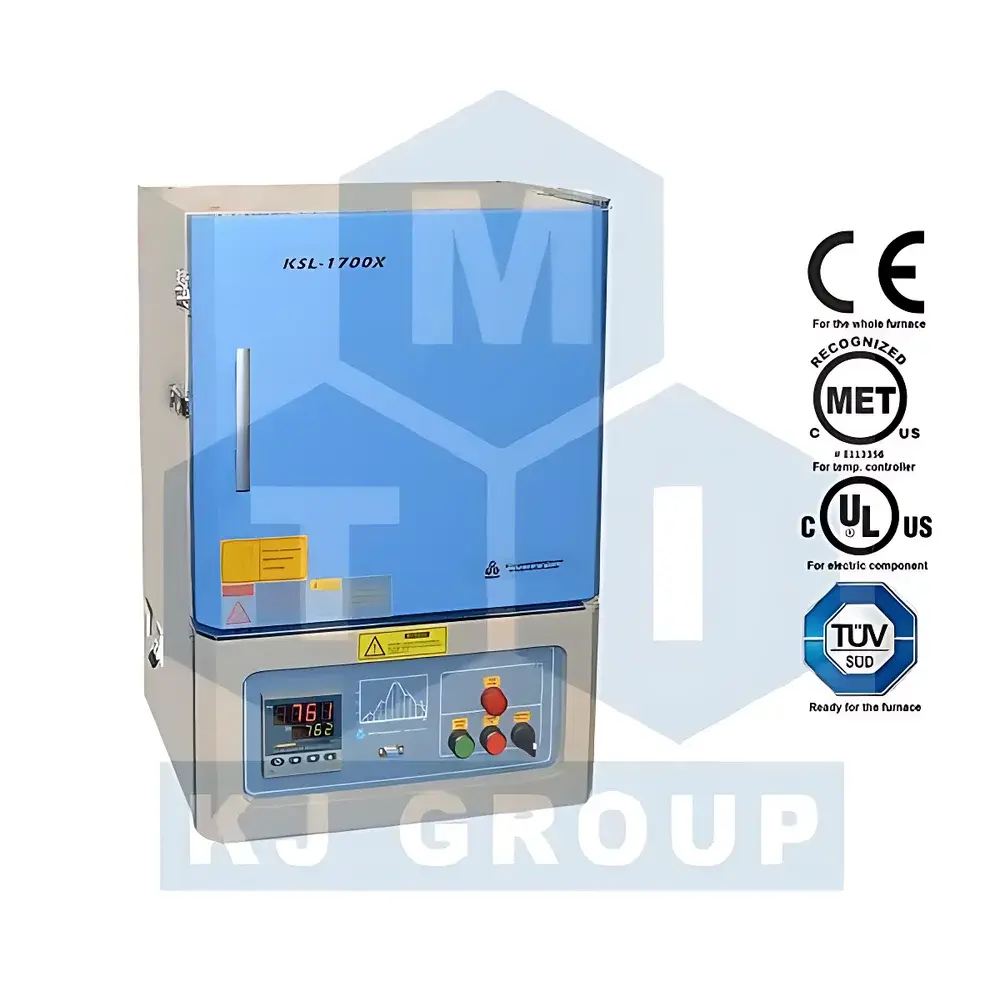
Hefei Kejing KSL-1750X-A1 High-Temperature Box Furnace
| Brand | Hefei Kejing |
|---|---|
| Origin | Anhui, China |
| Model | KSL-1750X-A1 |
| Maximum Temperature | 1750 °C |
| Temperature Uniformity | ±1 °C |
| Rated Power | 3 kW |
| Heating Rate (to Max Temp) | 10 °C/min |
| Internal Chamber Dimensions | 150 × 150 × 150 mm |
| Heating Element | Silicon Molybdenum (MoSi₂) Rods |
| Thermocouple Type | Type B (Pt–30%Rh / Pt–6%Rh) |
| Control System | 30-Stage Programmable PID Controller (518P) |
| Chamber Lining | Polycrystalline Alumina Fiber with US-Imported 1750 °C Alumina Reflective Coating |
| Certification | CE, UL/MET/CSA (components >24 V), Optional TÜV or CSA Single-Unit Certification Available |
Overview
The Hefei Kejing KSL-1750X-A1 is a high-temperature box furnace engineered for precision thermal processing in materials science laboratories, ceramic R&D facilities, and advanced metallurgy applications. It operates on the principle of resistive heating via silicon molybdenum (MoSi₂) rods, delivering stable, repeatable temperatures up to 1750 °C within a fully insulated chamber. Unlike vacuum or inert-atmosphere tube furnaces, this unit is designed for ambient-air or controlled-gas (non-flammable, non-corrosive) environments—making it ideal for sintering, annealing, ashing, and heat treatment of refractory oxides, carbides, and high-purity ceramics. Its robust architecture integrates a polycrystalline alumina fiber insulation core coated with a proprietary high-emissivity, high-reflectivity alumina layer (imported from the U.S.), which enhances thermal efficiency, reduces power consumption, and extends service life under cyclic high-temperature operation.
Key Features
- Maximum operating temperature of 1750 °C with long-term stability at ≤1700 °C
- ±1 °C temperature uniformity across the 150 × 150 × 150 mm usable chamber volume
- 30-stage programmable PID controller (518P) enabling complex thermal profiles—including ramp-hold-cool sequences—with user-defined dwell times and rate limits
- Type B (Pt–30%Rh / Pt–6%Rh) thermocouple for accurate, drift-resistant measurement in the 0–1820 °C range
- Side-opening door design with reinforced ceramic fiber gasket for rapid sample access and minimal thermal loss
- Compliance-ready electrical architecture: all components rated above 24 V certified to UL, MET, and CSA standards
- CE-marked construction meeting EN 61000-6-3 (EMC) and EN 61000-6-4 (immunity) requirements
Sample Compatibility & Compliance
This furnace accommodates standard ceramic crucibles (e.g., alumina, zirconia), graphite boats, and metal holders—provided they are rated for ≥1750 °C exposure. Due to its non-vacuum, non-sealed chamber design, it is strictly unsuitable for flammable, explosive, or reducing atmospheres (e.g., H₂, CO, CH₄). While compatible with inert gases (Ar, N₂) and weakly oxidizing environments, introduction of strongly corrosive gases—including Cl₂, HF, NH₃, SO₂, or H₂S—requires prior notification; optional chamber surface passivation or custom alumina-silica composite lining can be applied upon request. The furnace conforms to general laboratory safety protocols per ISO 13857 and IEC 61010-1. For regulated environments (e.g., GLP/GMP labs), optional audit-trail-capable software integration supports 21 CFR Part 11 compliance when paired with validated computer control modules.
Software & Data Management
The standard 518P controller supports USB data logging and real-time temperature curve export (CSV format) via optional interface module. For full traceability, the optional PC-based control software enables remote monitoring, automated report generation (including timestamped setpoint/actual temperature logs), and electronic signature workflows compliant with FDA 21 CFR Part 11 Annex 11 requirements. All system events—including power interruptions, alarm triggers, and manual overrides—are time-stamped and stored locally with 30-day retention. Firmware updates are delivered via secure HTTPS download and require digital signature verification before installation.
Applications
- Sintering of advanced ceramics (Al₂O₃, ZrO₂, SiC, Si₃N₄)
- Thermal annealing of thin-film coatings and optical substrates
- Ash content analysis per ASTM D3174 and ISO 1171
- High-temperature calcination of catalyst precursors and battery cathode materials (e.g., LiCoO₂, NMC)
- Heat treatment of refractory metals and intermetallic compounds
- Calibration of high-temperature reference standards (e.g., fixed-point cells)
FAQ
Is this furnace suitable for vacuum or hydrogen atmosphere operation?
No. The KSL-1750X-A1 lacks vacuum-tight sealing and gas purging ports. It is rated only for ambient air or externally supplied inert/oxidizing gases with verified chemical compatibility.
What maintenance is required for long-term reliability?
Annual inspection of MoSi₂ rod integrity, thermocouple calibration against NIST-traceable references, and reapplication of high-temperature alumina coating if microcracking exceeds 0.5 mm depth in the chamber lining.
Can the furnace be integrated into an automated production line?
Yes—via optional RS485 Modbus RTU or Ethernet/IP communication modules, supporting PLC-level coordination and centralized SCADA monitoring.
Does the 1-year warranty cover heating elements?
No. MoSi₂ rods and thermocouples are classified as consumables and excluded from standard warranty coverage per ISO 9001 Clause 8.5.3; extended wear-part service contracts are available.



