
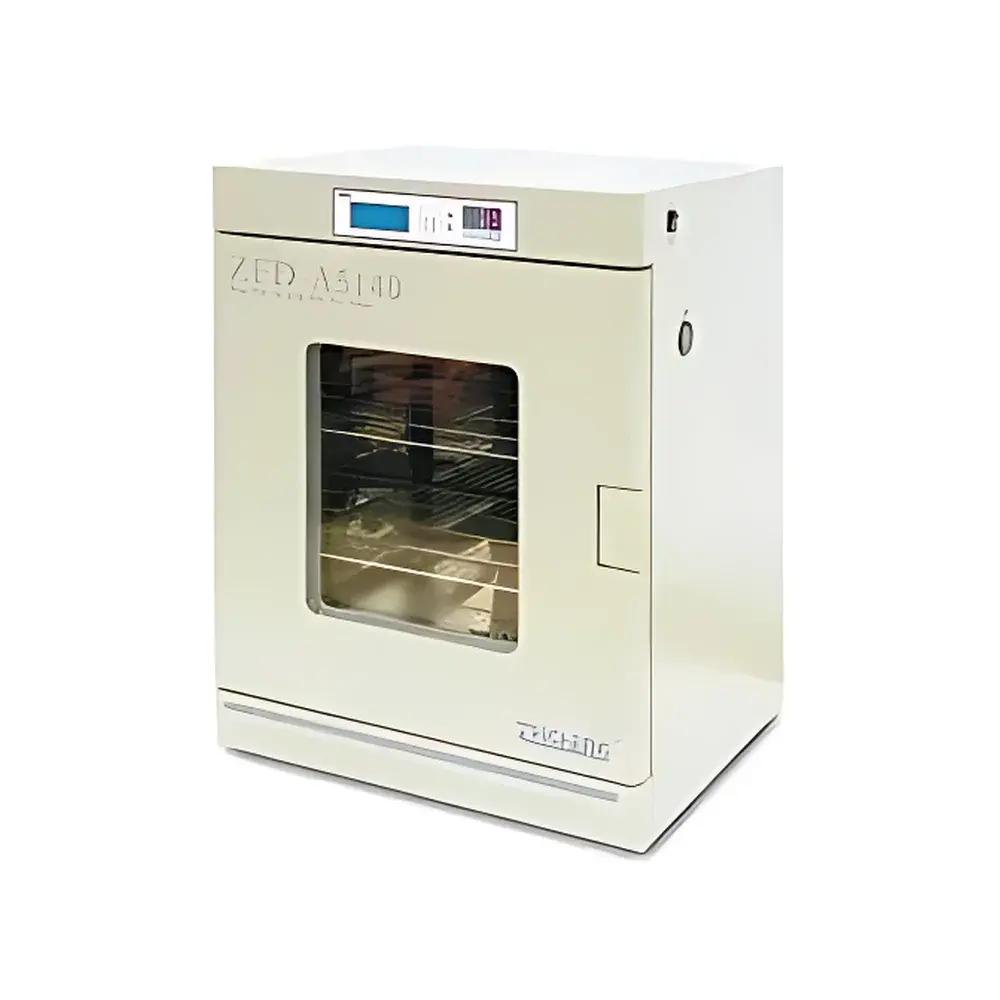
Zhicheng ZXFD-A5140 Ten-Stage Programmable Forced-Convection Dry Oven with Bottom-Mounted Heating
| Brand | Zhicheng |
|---|---|
| Origin | Shanghai, China |
| Manufacturer Type | Direct Manufacturer |
| Country of Origin | China |
| Model | ZXFD-A5140 |
| Quotation | Upon Request |
| Capacity | 140 L |
| Temperature Range | Ambient +5°C to 200°C |
| Temperature Resolution | 0.1°C |
| Temperature Uniformity | ≤±2.5% (at max operating temperature) |
| Temperature Fluctuation | ≤±1°C |
| Control Method | Fuzzy Logic Control |
| Display | LCD |
| Airflow Direction | Vertical upward convection from bottom-mounted heater |
| Programming | 10 segments / 18 steps (Segment 0 = pre-set timing |
| Step Duration | 1–999 minutes per step |
| Internal Dimensions (W×D×H) | 500×470×600 mm |
| External Dimensions (W×D×H) | 690×600×980 mm |
| Net Weight | 80 kg |
| Power Supply | AC 220 V, 50/60 Hz |
| Rated Power | 1600 W |
| Shelving | 2 standard stainless steel electropolished shelves (max. 4) |
| Safety Features | Independent overtemperature cut-off (adjustable 30–80°C), independent overheat prevention device, leakage current protection, overcurrent trip, power failure alarm, sensor fault detection, upper/lower limit temperature alarms |
| Interface | RS-232 serial port |
| Optional Output | Embedded thermal mini-printer |
| Insulation | High-efficiency mineral wool with double-wall construction |
| Interior Material | Mirror-finish stainless steel |
| Door | Double-glazed tempered glass with outer layer compliant with EN 61000-3-2 safety standards |
Overview
The Zhicheng ZXFD-A5140 is a precision-engineered, ten-stage programmable forced-convection dry oven designed for laboratory-grade drying, sterilization, thermal hardening, and moisture removal applications in life science, pharmaceutical, clinical, and materials research environments. Unlike static convection ovens, the ZXFD-A5140 employs a bottom-mounted vertical airflow system—engineered to generate uniform, laminar thermal circulation across the entire 140 L chamber volume. This configuration minimizes thermal stratification and ensures consistent heat transfer to samples regardless of placement, making it especially suitable for validation-critical processes such as dry-heat sterilization of glassware (per ISO 17665-1 and USP ) or thermal denaturation studies requiring reproducible kinetic profiles.
Key Features
- Fuzzy logic temperature control algorithm delivering high stability (≤±1°C fluctuation) and fine resolution (0.1°C) across the full operating range (ambient +5°C to 200°C)
- 10-segment, 18-step programmable sequence capability—enabling complex thermal profiles including ramp-hold-cool cycles, multi-stage dehydration, or time-resolved thermal inactivation assays
- Bottom-mounted heating element combined with optimized baffle-guided vertical airflow ensures superior temperature uniformity (≤±2.5% at 200°C), validated per ASTM E2297-18
- Dual-layer safety architecture: independent adjustable overtemperature protector (30–80°C range), dedicated overheat prevention device, and isolated earth-leakage circuit breaker meeting IEC 61000-4-5 surge immunity requirements
- Intelligent self-diagnostic system with real-time alerts for power interruption, RTD sensor failure, and upper/lower temperature limit breaches—supporting GLP-compliant audit trails
- Mirror-finish electropolished stainless steel interior (AISI 304), corrosion-resistant shelving (up to 4 configurable positions), and double-glazed tempered observation door compliant with EN 61000-3-2 surface temperature limits
- Embedded RS-232 interface for integration with LIMS or centralized lab monitoring systems; optional built-in thermal printer supports timestamped event logging (start/stop, alarms, setpoint changes)
Sample Compatibility & Compliance
The ZXFD-A5140 accommodates diverse sample formats—including Petri dishes, volumetric flasks, culture tubes, glass slides, polymer substrates, and electronic components—within its 500 × 470 × 600 mm working chamber. Its geometric cavity design eliminates dead-air zones and reduces particle accumulation, supporting cleanroom-compatible operation when used with HEPA-filtered ambient air. The unit conforms to key regulatory frameworks applicable to thermal processing equipment: it satisfies mechanical safety requirements under EN 61010-1, electromagnetic compatibility per EN 61326-1, and thermal performance criteria outlined in ISO 8573-1 (for dry-heat depyrogenation validation). While not certified for Class II biological safety, its dry-heat profile aligns with FDA-recommended parameters for glassware sterilization (≥160°C for ≥2 hours or ≥180°C for ≥30 minutes).
Software & Data Management
Operation is managed via an intuitive LCD interface with password-protected parameter editing (user-defined access levels prevent unauthorized calibration or program modification). All operational parameters—including active segment, elapsed time, current temperature, and alarm history—are retained in non-volatile memory during power loss, and the system automatically resumes the last valid program upon power restoration (“power recovery mode”). The RS-232 port enables bidirectional communication with third-party software platforms for remote monitoring, data export (CSV/TXT), and automated report generation. When equipped with the optional thermal printer, the device generates traceable hardcopy logs containing date/time stamps, temperature readings at 1-minute intervals, and critical event markers—fully compatible with 21 CFR Part 11 audit requirements when paired with appropriate electronic signature controls.
Applications
- Dry-heat sterilization of surgical instruments, pipettes, and glassware in clinical and microbiological laboratories
- Thermal denaturation and cross-linking studies of proteins, nucleic acids, and hydrogels
- Moisture content analysis and residual solvent removal in pharmaceutical excipients and active ingredients
- Pre-drying of soil, plant tissue, and environmental filter samples prior to gravimetric or elemental analysis
- Accelerated aging tests for polymers, coatings, and electronic encapsulants per ASTM D3045
- Baking and curing of thin-film sensors, printed circuit boards, and MEMS devices
- Heat treatment of calibration standards and reference materials requiring stable thermal environments
FAQ
What is the maximum allowable operating temperature, and how is temperature uniformity verified?
The ZXFD-A5140 operates up to 200°C. Uniformity is validated using nine calibrated PT100 probes placed per ASTM E2297-18 (3×3 grid), with deviation ≤±2.5% of setpoint at maximum temperature.
Can the unit be integrated into a networked lab infrastructure?
Yes—via RS-232 serial interface. Custom drivers and ASCII protocol documentation are provided for integration with LabVIEW, Python-based SCADA, or enterprise LIMS platforms.
Does the oven support GMP/GLP-compliant recordkeeping?
With the embedded thermal printer and enabled event logging, it meets foundational ALCOA+ principles. Full 21 CFR Part 11 compliance requires external electronic signature and audit trail software.
Is the bottom-heating configuration suitable for volatile organic solvents?
No. This model is intended for aqueous or low-volatility matrix drying only. For flammable solvents, a Class B explosion-proof oven with intrinsically safe airflow control is required.
How many shelves can be installed, and what is their load capacity?
Standard configuration includes two electropolished stainless steel shelves (max. 4); each shelf supports up to 15 kg evenly distributed load.




