
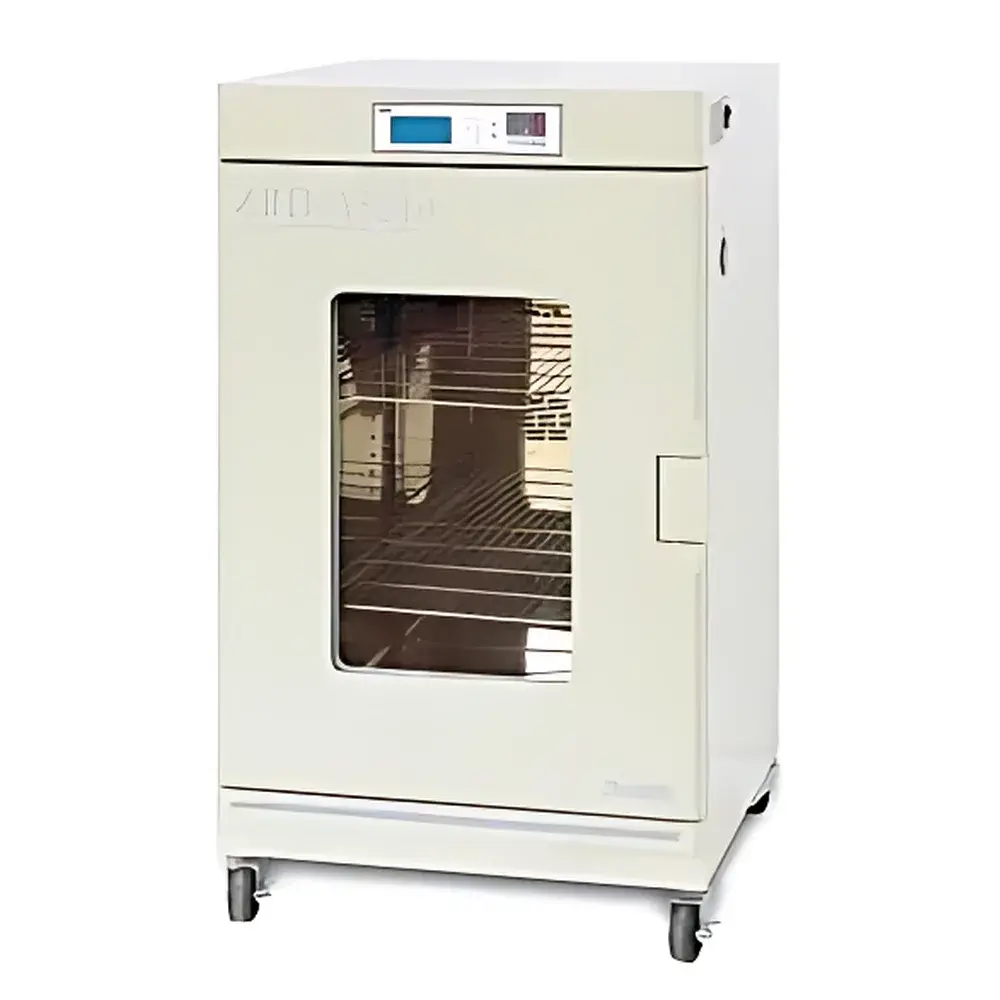
Zhicheng ZXRD-A5110 Ten-Stage Programmable Forced-Convection Dry Oven with Rear-Mounted Heating
| Brand | Zhicheng |
|---|---|
| Origin | Shanghai, China |
| Manufacturer Type | Direct Manufacturer |
| Country of Origin | China |
| Model | ZXRD-A5110 |
| Quotation | Upon Request |
| Control Method | Fuzzy Logic Control |
| Display | LCD |
| Airflow Direction | Rear Horizontal Blowing |
| Ambient Temperature Range | 5–35 °C |
| Temperature Range | Ambient +5 to 200 °C |
| Temperature Resolution | 0.1 °C |
| Temperature Uniformity | ≤ ±2.5% (at max operating temperature) |
| Temperature Fluctuation | ≤ ±1 °C |
| Programming Capacity | 10 Segments / 18 Steps |
| Time per Step | 1–999 min |
| Chamber Volume | 110 L |
| Interior Dimensions (W×D×H) | 420 × 400 × 650 mm |
| External Dimensions (W×D×H) | 610 × 530 × 1030 mm |
| Net Weight | 61 kg |
| Power Consumption | 1300 W |
| Supply Voltage | AC 220 V, 50/60 Hz |
| Shelving | 2 standard stainless steel electropolished shelves (max. 4) |
| Safety Features | Independent overtemperature cut-off (adjustable 30–80 °C), independent overheat prevention device, leakage current protection, overcurrent circuit breaker, power failure alarm, sensor fault detection, upper/lower limit temperature alarms |
| Connectivity | RS-232 interface, embedded micro-printer output |
| Insulation | Double-wall construction with high-efficiency mineral wool insulation |
| Interior Material | Mirror-finish 304 stainless steel |
| Door | Tempered double-glazed viewing window compliant with EN 61000-6-3 and EN 61000-6-4 safety requirements |
Overview
The Zhicheng ZXRD-A5110 is a precision-engineered, ten-stage programmable forced-convection dry oven designed for laboratory-grade thermal processing in life science, pharmaceutical, clinical, and materials research environments. Unlike conventional static ovens, the ZXRD-A5110 employs rear-mounted horizontal airflow combined with a fully optimized duct geometry to generate uniform, low-turbulence air circulation across the entire chamber volume—critical for reproducible drying, sterilization, and thermal stability testing. Its core operation relies on dry heat convection at elevated temperatures (up to 200 °C), enabling microbial inactivation via protein denaturation, oxidative damage to cellular components, and intracellular electrolyte imbalance—mechanisms aligned with ISO 14937 and USP guidelines for dry-heat sterilization validation. The system implements fuzzy logic control architecture, dynamically adjusting heater duty cycle and fan speed in real time based on feedback from a high-response platinum RTD sensor array and environmental scanning microprocessor, ensuring stable setpoint adherence under variable load conditions.
Key Features
- Ten-segment, eighteen-step programmable controller supporting complex thermal profiles—including ramp-hold-cool sequences, multi-step isothermal holds, and timed transitions—with segment-specific dwell times (1–999 minutes each)
- Rear-mounted horizontal forced-air delivery system engineered for minimal thermal stratification and optimal cross-chamber uniformity (≤ ±2.5% at 200 °C)
- Mirror-finish 304 stainless steel interior chamber and electropolished stainless steel shelving—resistant to corrosion, easy to decontaminate, and compliant with ISO 14644-1 Class 7 cleanroom-compatible surface standards
- Double-glazed, tempered observation window with outer pane surface temperature maintained below 40 °C per EN 61000-6-3, eliminating burn risk during routine monitoring
- Triple-layer redundant safety architecture: independently adjustable overtemperature limiter (30–80 °C), dedicated overheat prevention device, and isolated earth-leakage circuit breaker with automatic trip reset inhibition
- Comprehensive self-diagnostic suite including power-failure logging, sensor integrity verification, upper/lower limit deviation alerts, and real-time fault code display on the LCD interface
- Embedded micro-printer and RS-232 serial port support audit-ready data export for GLP/GMP documentation workflows
Sample Compatibility & Compliance
The ZXRD-A5110 accommodates a broad spectrum of sample formats—including glassware (vials, Petri dishes, pipettes), polymer substrates, ceramic components, electronic assemblies, and biological specimens on inert carriers—without introducing volatile organic residues or condensation artifacts associated with steam-based methods. Its dry-heat profile meets critical regulatory benchmarks for depyrogenation (≥ 250 °C for ≥ 45 min is not applicable; however, the unit supports validated cycles per ISO 17665-1 Annex B for lower-temperature dry-heat applications requiring extended exposure). All electrical subsystems conform to IEC 61010-1:2010 for laboratory equipment safety, while electromagnetic compatibility adheres to EN 61326-1:2013. The unit is CE-marked and manufactured under ISO 9001-certified quality management systems.
Software & Data Management
While the onboard controller operates autonomously without external software dependency, the RS-232 interface enables bidirectional communication with third-party LIMS or ELN platforms using ASCII-based command protocols (e.g., “TEMP?”, “RUN”, “STOP”). The embedded thermal printer generates time-stamped hardcopy logs of setpoint, actual temperature, elapsed time, and alarm events—supporting FDA 21 CFR Part 11 compliance when paired with user-defined electronic signature procedures. Parameter memory retains all user configurations—including calibration offsets, password-protected access levels, and program templates—across power cycles. Optional firmware updates (via USB-to-serial adapter) ensure long-term protocol alignment with evolving analytical standards.
Applications
- Dry-heat sterilization of reusable glassware and metal instruments in microbiology and cell culture labs
- Residual moisture removal from hygroscopic reagents, excipients, and lyophilized intermediates prior to formulation
- Thermal denaturation studies of purified proteins and nucleic acids under controlled kinetic conditions
- Accelerated aging tests for packaging materials, adhesives, and biomedical polymers per ASTM F1980
- Pre-heating and conditioning of substrates for thin-film deposition, coating adhesion testing, and solder paste reflow simulation
- Stability assessment of diagnostic reagents and reference standards under ICH Q1A(R2) long-term and accelerated storage conditions
- Dehydration of botanical and environmental samples for gravimetric analysis per EPA Method 505
FAQ
What is the maximum validated sterilization temperature for this oven?
The ZXRD-A5110 achieves a maximum operational temperature of 200 °C. While full depyrogenation typically requires ≥250 °C, this unit supports validated dry-heat cycles for microbial reduction (e.g., 160 °C for 120 min) per ISO 14937 Annex C.
Can the oven be integrated into a networked lab infrastructure?
Yes—via its RS-232 interface and ASCII command set, it supports integration with SCADA systems, centralized monitoring dashboards, and automated data archival pipelines.
Is calibration traceability provided with the unit?
Each unit ships with a factory calibration certificate referencing NIST-traceable standards; users may perform field verification using Class A platinum resistance thermometers per ISO/IEC 17025 guidelines.
How many shelves can be installed simultaneously without compromising airflow uniformity?
The standard configuration includes two electropolished stainless steel shelves; up to four may be installed, though uniformity validation is recommended when exceeding two shelves under loaded conditions.
Does the unit comply with energy efficiency directives such as EU Ecodesign?
It meets ErP Directive 2009/125/EC Tier 1 requirements for laboratory ovens, featuring adaptive heating algorithms and high-density mineral wool insulation to minimize standby losses.





