
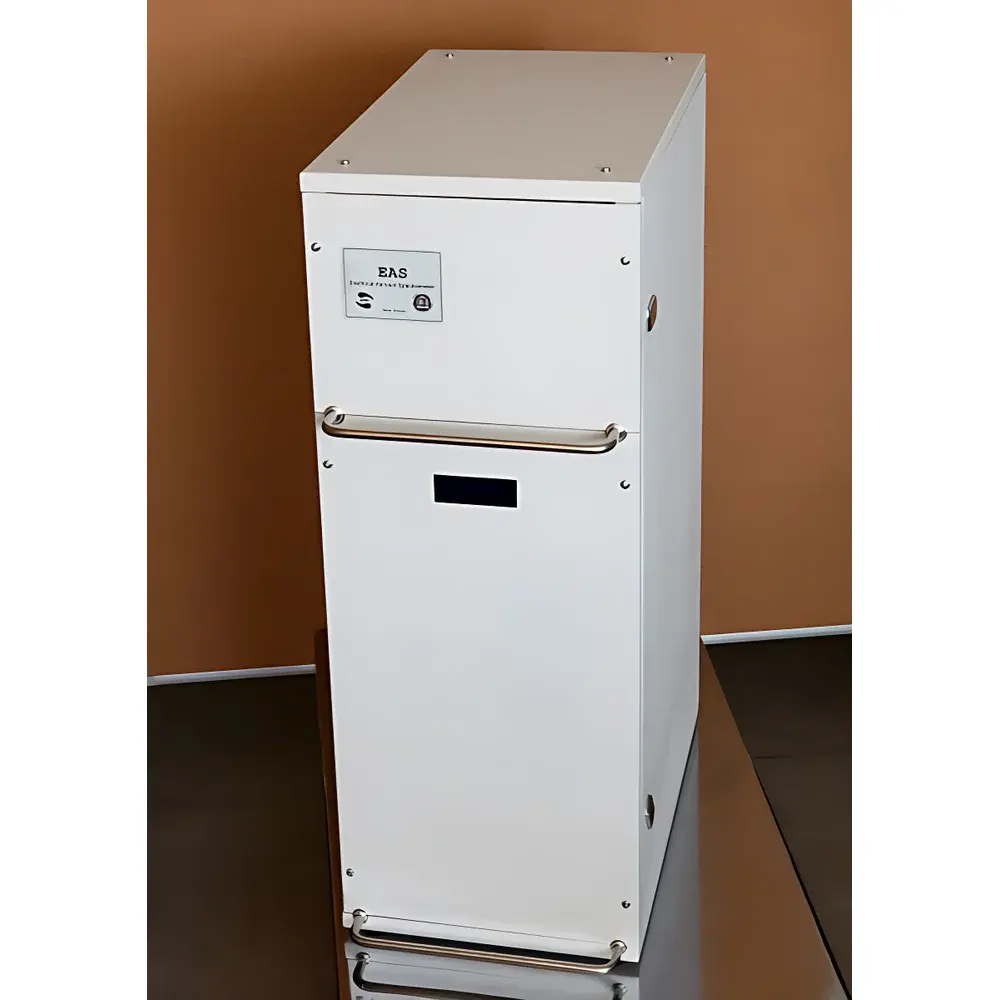
Airel EAS Electrical Aerosol Spectrometer
| Brand | Airel |
|---|---|
| Origin | Estonia |
| Manufacturer Type | Distributor |
| Import Status | Imported |
| Model | EAS |
| Pricing Range | USD 65,000–130,000 (FOB) |
| Operating Principle | Scanning Electrical Mobility Spectrometry (SEMS) |
| Sample Flow Rate | 48 L/min |
| Particle Size Range | 30–10,000 nm |
| Number Concentration Range | 100–1,000,000 particles/L |
| Size Channels | 32 |
| Mass Concentration Output | Not directly measured (derived via conversion using assumed density and shape) |
Overview
The Airel EAS Electrical Aerosol Spectrometer is a high-performance, real-time aerosol sizing instrument engineered for continuous, high-temporal-resolution characterization of airborne particle size distributions. Based on scanning electrical mobility spectrometry (SEMS), the EAS measures particle number concentration as a function of electrical mobility diameter — which correlates closely with aerodynamic and Stokes diameter under standard atmospheric conditions. Developed at the University of Tartu (Estonia), the system integrates a differential mobility analyzer (DMA), a condensation particle counter (CPC), and synchronized scanning electronics to deliver calibrated size-resolved data across three decades of particle diameter (30 nm to 10 µm) in a single measurement cycle. Its design emphasizes long-term unattended operation, making it especially suitable for ambient air quality monitoring networks, atmospheric science field campaigns, and indoor air research where stability, reproducibility, and minimal maintenance are critical operational requirements.
Key Features
- Real-time particle size distribution acquisition with configurable time resolution down to 1 second per full scan
- 32 logarithmically spaced size channels spanning 30 nm to 10,000 nm (10 µm), optimized for atmospheric aerosol dynamics
- Stable 48 L/min sample flow rate maintained via precision mass flow control and pressure-compensated pumping
- No consumables required during extended deployments — validated for continuous operation over multi-month periods
- Integrated Ethernet interface supporting remote access, firmware updates, diagnostic logging, and secure data streaming via TCP/IP or MQTT protocols
- Robust mechanical architecture with temperature-stabilized DMA column and low-noise CPC detection circuitry
- Compliance-ready architecture: supports audit trails, user access levels, and timestamped raw data export for GLP/GMP-aligned workflows
Sample Compatibility & Compliance
The EAS is designed for direct sampling of ambient, indoor, or ducted air streams without pre-separation or dilution (within specified concentration limits). It accommodates particles composed of organic, inorganic, or mixed-phase materials, provided they are electrically chargeable under bipolar diffusion charging (e.g., via soft X-ray or radioactive source). The instrument conforms to ISO 27891:2019 (aerosol measurement — electrical mobility spectrometry) and aligns with key elements of EPA Method PS-1 and EU Directive 2008/50/EC for fine particulate monitoring infrastructure. While not a certified reference method per EN 16450, its traceable calibration protocol — based on NIST-traceable polystyrene latex (PSL) standards and mobility calibration gases — enables quantitative comparison against regulatory-grade instruments in research and validation studies.
Software & Data Management
The EAS operates with Airel’s proprietary SpectraView software suite, available for Windows and Linux platforms. The software provides real-time visualization of dN/dlogDp, surface area, and volume distributions; automated baseline correction; and batch processing of time-series datasets. All raw mobility scan data, including voltage ramp profiles, CPC counts, and flow telemetry, are stored in HDF5 format with embedded metadata (instrument ID, calibration date, operator ID, GPS coordinates if enabled). Export options include CSV, NetCDF, and ASCII-compatible formats compatible with Python (pandas, xarray), MATLAB, and R-based atmospheric analysis pipelines. For regulated environments, optional 21 CFR Part 11-compliant modules provide electronic signatures, role-based permissions, and immutable audit logs — fully supporting FDA, EMA, and ISO 17025 laboratory accreditation requirements.
Applications
- Ambient air quality monitoring: Long-term tracking of nucleation-mode, Aitken-mode, and accumulation-mode particle dynamics in urban, rural, and marine boundary layers
- Indoor air quality assessment: Source apportionment of cooking, cleaning, or printer emissions via temporal size distribution fingerprints
- Filter and scrubber efficiency testing: Real-time evaluation of penetration curves across sub-100 nm ranges using challenge aerosols
- Atmospheric chamber studies: High-frequency response to photochemical aging, coagulation, or hygroscopic growth experiments
- Workplace exposure monitoring: Quantification of ultrafine particle release from nanomaterial handling, welding fumes, or laser ablation processes
- Climate-relevant aerosol research: Correlation of size-resolved number concentrations with CCN activity, optical properties, and volatility measurements
FAQ
What particle diameter metric does the EAS report?
The EAS reports electrical mobility diameter (Dm), which is equivalent to Stokes diameter for spherical, non-porous particles under laminar flow conditions. Conversion to aerodynamic or volume-equivalent diameter requires additional assumptions about particle density and shape.
Does the EAS require radioactive or X-ray charging sources?
Yes — the standard configuration includes a soft X-ray charger (10–20 keV) compliant with IEC 61000-4-3; alternative radioactive 85Kr sources are available upon request for specific regulatory jurisdictions.
Can the EAS measure mass concentration directly?
No — mass concentration (mg/m³) is not measured natively. It may be estimated post-acquisition using size-resolved number concentration, assumed particle density (e.g., 1.8 g/cm³ for ammonium sulfate), and spherical morphology — but such estimates carry significant uncertainty for complex ambient aerosols.
Is calibration traceable to international standards?
Yes — factory calibration uses NIST-traceable PSL standards and certified gas flow meters. Users receive a calibration certificate documenting uncertainty budgets per ISO/IEC 17025 guidelines.
What maintenance intervals are recommended for unattended operation?
No routine consumable replacement is required. Annual verification of DMA voltage linearity, CPC counting efficiency, and flow sensor accuracy is recommended — typically performed onsite by certified service engineers or via remote diagnostics.
Related Products







