
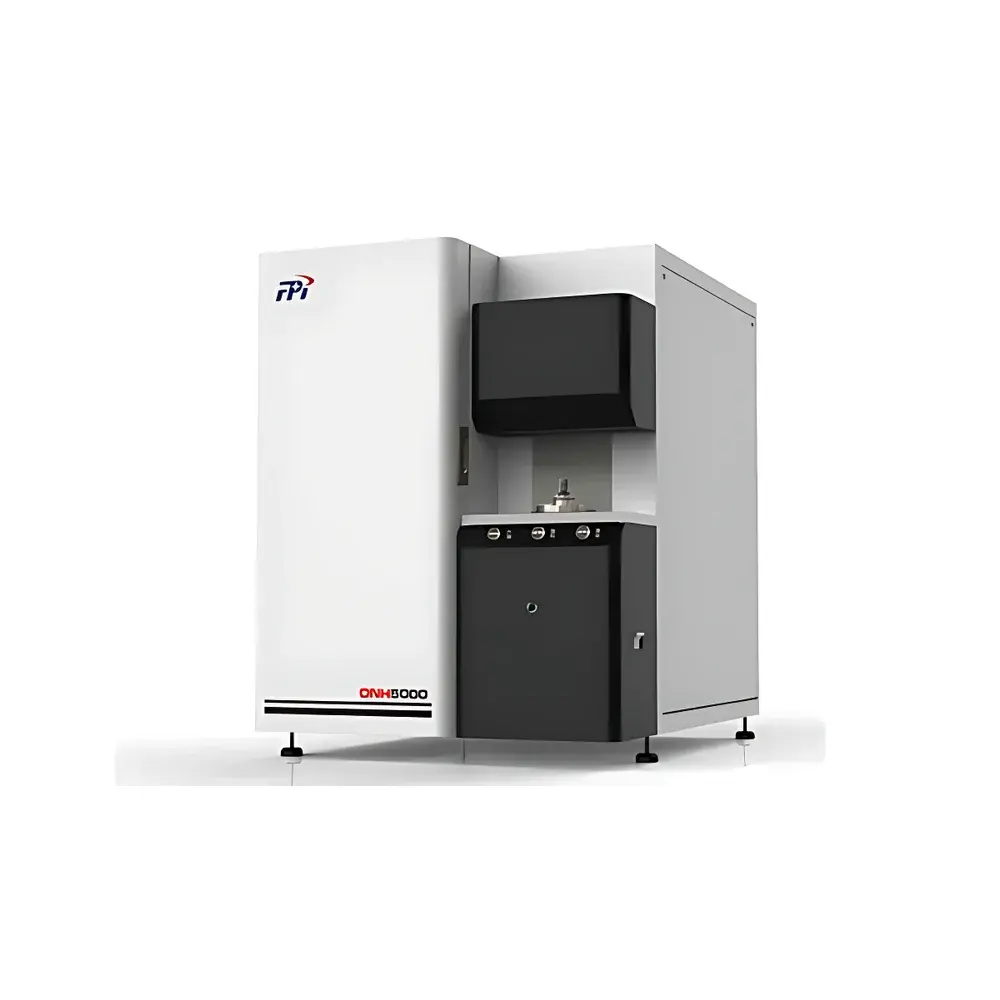
FPI ONH5000 Oxygen-Nitrogen-Hydrogen Elemental Analyzer
| Brand | FPI |
|---|---|
| Origin | Zhejiang, China |
| Model | ONH5000 |
| Power Supply | 8.0 kW Pulse Electrode Furnace |
| Max Furnace Temperature | >3500 °C |
| Detection Principles | Infrared Absorption (O), Thermal Conductivity (N, H) |
| Carrier Gases | He or N₂ |
| Compliance | ASTM E1019, ISO 14284, GB/T 11261–2022, GB/T 20123–2006 |
| Sample Form | Solid metallic & non-metallic materials |
| Measurement Elements | O, N, H (simultaneous or individual) |
Overview
The FPI ONH5000 Oxygen-Nitrogen-Hydrogen Elemental Analyzer is a high-precision, inert-gas fusion-based instrument engineered for quantitative determination of oxygen, nitrogen, and hydrogen in solid materials. It operates on the principle of pulse-heated inert gas fusion followed by selective detection: oxygen is quantified via infrared absorption after catalytic conversion of CO to CO₂; nitrogen and hydrogen are measured simultaneously using a high-stability thermal conductivity detector (TCD). The system employs a digitally controlled 8.0 kW pulse electrode furnace capable of exceeding 3500 °C, enabling complete decomposition of refractory matrices—including steels, superalloys, ceramics, rare-earth compounds, semiconductors, and high-temperature superconductors. Modular architecture ensures functional isolation between furnace control, gas handling, detection, and data acquisition subsystems—minimizing cross-interference and supporting long-term measurement reproducibility under routine laboratory conditions.
Key Features
- Digital closed-loop control of the pulse electrode furnace with programmable heating profiles: constant power, constant current, constant voltage, or ramp-rate modes for optimized sample release kinetics.
- Integrated dual-detection architecture: solid-state infrared sensor with narrow-band optical filters and temperature/pressure/flow compensation for oxygen; high-sensitivity TCD with low-noise tungsten-rhenium filaments and linear calibration across extended concentration ranges for nitrogen and hydrogen.
- Gas management system featuring imported solenoid valves, mass flow controllers, and helium/nitrogen-selectable carrier gas routing—configured with automatic gas curtain protection during sample loading and pressure-regulated standby mode to conserve consumables.
- Modular electronics based on 32-bit RISC processor architecture running uClinux OS, ensuring deterministic real-time control and stable data throughput without drift over extended operation cycles.
- Hermetically sealed, one-piece gas path design with double-axis guided electrode actuation and pneumatic sample drop mechanism—optimized for leak integrity per ISO 10648-2 Class 2 requirements.
Sample Compatibility & Compliance
The ONH5000 is validated for analysis of solid specimens up to 1.0 g (typical), including ferrous and non-ferrous metals, sintered carbides, oxide ceramics, nitride-based semiconductors, and rare-earth permanent magnets. Its analytical performance conforms to international standard test methods including ASTM E1019 (Standard Test Methods for Determination of Carbon, Sulfur, Nitrogen, and Oxygen in Steel, Iron, Nickel, and Cobalt Alloys), ISO 14284 (Steel and Iron — Sampling and Preparation of Samples for Determination of Chemical Composition), and Chinese national standards GB/T 11261–2022 (Determination of Oxygen in Ferrous Metals) and GB/T 20123–2006 (Determination of Nitrogen and Hydrogen in Steel). System validation documentation supports GLP-compliant environments and audit readiness for ISO/IEC 17025-accredited laboratories.
Software & Data Management
The proprietary FPI Analytical Suite provides full instrument control, real-time signal visualization, and automated quantitative calculation per user-defined calibration curves. Software features include multi-point linear and non-linear calibration support, drift correction algorithms, automatic blank subtraction, and batch report generation compliant with FDA 21 CFR Part 11 requirements—including electronic signatures, audit trails, and role-based access control. Raw analog signals from IR and TCD detectors are digitized at 24-bit resolution with synchronized timestamping; all processed results are stored in structured SQLite databases with export options to CSV, PDF, and LIMS-compatible XML formats.
Applications
Typical use cases include quality control of specialty steels (e.g., stainless, tool, and maraging grades) where interstitial O/N/H levels directly affect ductility and weldability; compositional verification of Ti-6Al-4V and other aerospace-grade titanium alloys; purity assessment of silicon carbide and aluminum nitride substrates for power electronics; hydrogen embrittlement risk evaluation in high-strength fasteners; and trace gas impurity profiling in rare-earth magnets used in electric vehicle traction motors. The analyzer also supports R&D workflows in metallurgical process development, powder metallurgy densification studies, and failure analysis of brittle fracture surfaces.
FAQ
What sample forms are compatible with the ONH5000?
Solid metallic and non-metallic samples in chip, turnings, or pressed pellet form—typically 0.1–1.0 g—with maximum dimensions ≤8 mm diameter × 5 mm height. Powders must be pre-compacted to ensure consistent fusion behavior.
Does the system support method transfer from legacy LECO or ELTRA instruments?
Yes—calibration files, method parameters, and report templates can be imported via standardized XML schema; furnace heating profiles and gas flow sequences are fully configurable to match established SOPs.
Is the ONH5000 compliant with regulatory data integrity requirements?
The software implements full 21 CFR Part 11 functionality: electronic signatures with biometric or PKI authentication, immutable audit trails covering all method changes and result modifications, and secure user permission hierarchies.
How often does the infrared detector require recalibration?
Under normal operation with daily blanks and weekly reference checks, the IR module maintains stability for ≥12 months; full recalibration is recommended annually or after major maintenance events such as detector replacement.
Can the instrument operate with both helium and nitrogen carrier gases?
Yes—the gas selection valve is software-controlled; helium is preferred for highest sensitivity in low-level hydrogen analysis, while nitrogen is suitable for routine oxygen/nitrogen testing in cost-sensitive environments.




