
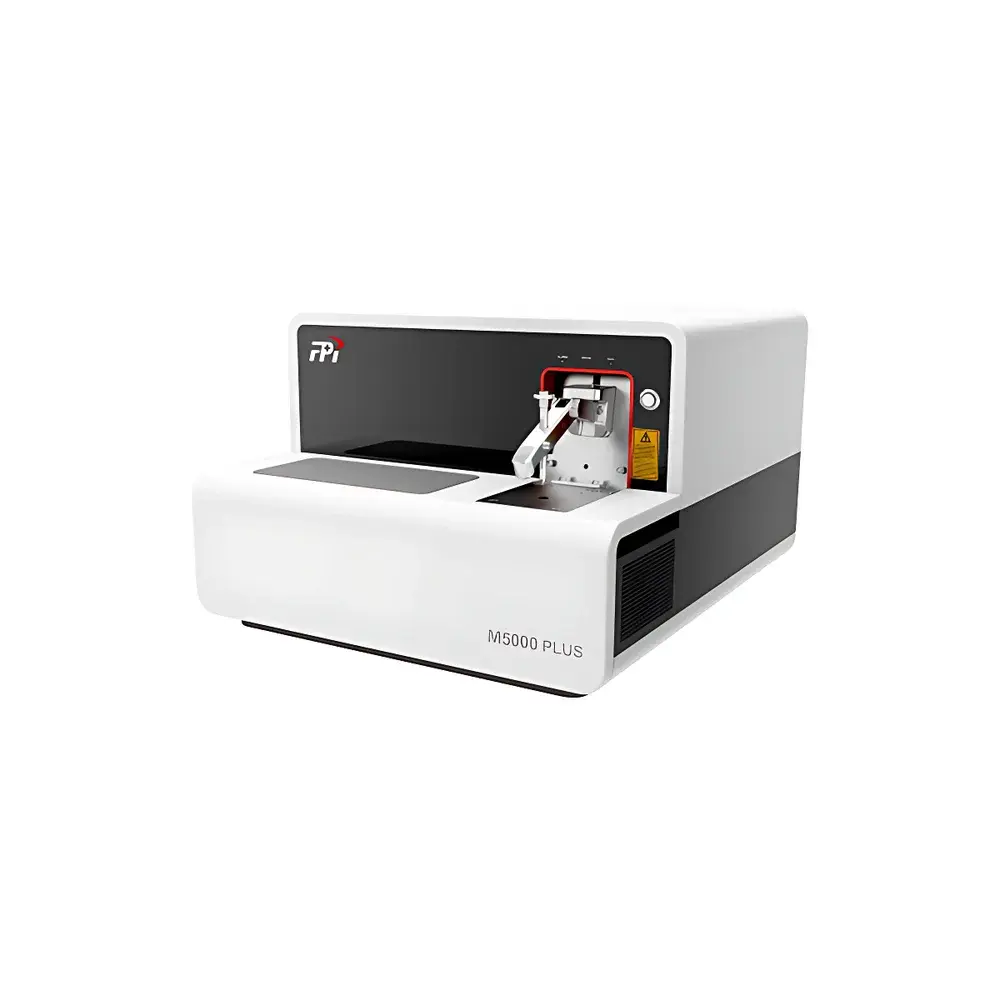
FPI M5000 PLUS Benchtop Spark Optical Emission Spectrometer (OES)
| Brand | FPI |
|---|---|
| Origin | Zhejiang, China |
| Model | M5000 PLUS |
| Instrument Type | Benchtop |
| Excitation Source | Spark |
| Detector Type | Scientific-grade CMOS |
| Wavelength Range | Configurable (UV–VIS, typically 130–800 nm) |
| Optical Design | Dual-chamber with dedicated UV optical path |
| UV Optimization | Uncoated high-quantum-efficiency CMOS for N, C, S, P detection |
| Stability Architecture | Cast aluminum vacuum-sealed spectrometer chamber with 4-stage stress-relief annealing and active temperature stabilization (±0.1 °C) |
| Light Source | Fully digital pulsed spark generator with real-time energy optimization (RTMC) |
| Software Capability | Full-spectrum acquisition, model-free analysis via intelligent calibration curves, remote firmware update & health monitoring |
| Compliance Framework | Designed to support GLP/GMP workflows, ASTM E415, ISO 11573, and GB/T 4336 analytical protocols |
Overview
The FPI M5000 PLUS is a benchtop spark optical emission spectrometer engineered for high-precision elemental analysis of metallic alloys in industrial quality control and materials R&D environments. It operates on the principle of spark-induced plasma excitation: a controlled high-voltage discharge vaporizes and atomizes a micro-volume of solid metal sample, generating excited atoms and ions that emit characteristic line spectra upon relaxation. These emissions are dispersed via a fixed-grating optical system and captured simultaneously across the full spectral range by a scientific-grade back-illuminated CMOS detector. Unlike traditional PMT-based OES systems, the M5000 PLUS leverages pixel-level signal acquisition and advanced noise suppression algorithms—including anti-blooming and dark-current compensation—to deliver quantitative multi-element data with sub-ppm detection limits for key non-metals (N, C, S, P) and trace metals (e.g., B, Sn, As, Pb). Its dual-chamber architecture isolates UV-sensitive optics from visible-light pathways, eliminating cross-talk and enabling stable, reproducible measurement of short-wavelength lines critical for low-Z element quantification.
Key Features
- Scientific-grade CMOS detector with high quantum efficiency in the deep UV (130–190 nm), enabling direct, film-free detection of nitrogen, carbon, sulfur, and phosphorus without supplemental vacuum or purging systems.
- Dual optical chamber design: one optimized for UV transmission (using fused silica optics and low-stray-light mounts), the other for visible/NIR coverage—ensuring broad elemental coverage (Li to U) with consistent resolution (~5 pm at 200 nm).
- Vacuum-sealed, stress-relieved cast aluminum spectrometer housing with four-stage thermal annealing and active temperature stabilization (±0.1 °C over 8 h), minimizing spectral drift and maintaining long-term calibration integrity.
- Real-time Multi-parameter Control (RTMC) digital spark source: dynamically adjusts discharge energy, frequency, and integration time per element group to maximize signal-to-noise ratio and inter-run repeatability (RSD < 1.5% for major alloying elements).
- Full-spectrum acquisition architecture: stores raw intensity data across >100,000 wavelength pixels per shot, supporting retrospective re-analysis, interference correction, and method expansion without hardware modification.
- Integrated argon flow management with multi-orifice purge technology ensures rapid, uniform displacement of atmospheric oxygen and moisture from the spark stand—critical for UV line stability and oxide-layer mitigation.
Sample Compatibility & Compliance
The M5000 PLUS accepts standard 32–40 mm diameter solid metal samples (ferrous and non-ferrous), including as-cast, machined, and polished surfaces. It complies with core international standards for metallurgical spectrochemical analysis, including ASTM E415 (Standard Test Method for Analysis of Steel), ISO 11573 (Metallic materials — Spark discharge atomic emission spectrometry), and Chinese national standard GB/T 4336. Its software architecture supports audit trails, electronic signatures, and instrument qualification documentation aligned with GLP and GMP requirements. While not pre-certified for FDA 21 CFR Part 11, the system’s logging framework—recording all acquisition parameters, calibration events, user actions, and environmental metadata—provides a foundation for laboratory-specific Part 11 validation.
Software & Data Management
FPI SpectraLink v3.x software provides a modular, workflow-driven interface built on a relational database backend. Key capabilities include: intelligent curve generation using machine-learning-assisted interpolation across matrix families (e.g., Al-Si-Cu, Fe-Cr-Ni); automated interference correction via peak deconvolution; customizable reporting templates compliant with ISO/IEC 17025; and secure remote access for firmware updates, diagnostic checks, and predictive maintenance alerts. All spectral data are stored in vendor-neutral HDF5 format with embedded metadata (wavelength calibration, integration time, spark parameters), ensuring long-term archival integrity and third-party tool interoperability (e.g., Python/Pandas, MATLAB).
Applications
The M5000 PLUS serves as a primary analytical tool in foundries, steel mills, aerospace component suppliers, and third-party testing laboratories. Typical use cases include: rapid grade identification and positive material identification (PMI) of stainless steels, aluminum alloys, titanium grades, and superalloys; incoming raw material verification against purchase specifications; process control during ladle metallurgy and continuous casting; failure analysis involving trace impurity mapping (e.g., H, O, N in bearing steels); and R&D studies requiring simultaneous quantification of major, minor, and trace constituents—including light elements traditionally challenging for OES (e.g., carbon in low-alloy steels, nitrogen in duplex stainless steels).
FAQ
Does the M5000 PLUS require vacuum pumping or external gas purging for UV analysis?
No. Its dedicated UV optical path uses uncoated, high-UV-transmission fused silica components and a sealed, argon-purged spark stand—eliminating the need for mechanical vacuum pumps or continuous high-flow argon consumption.
Can new elements or base materials be added after installation without hardware changes?
Yes. Full-spectrum data acquisition enables post-hoc method development: adding new analytes or calibrating for new alloy families requires only reference standards and software configuration—not grating replacement or detector reconfiguration.
What is the typical recalibration interval under routine QC conditions?
With stable environmental conditions and daily standardization checks, recalibration is recommended every 72 operational hours or after 500 sparks—though extended intervals up to 168 h are achievable when supported by internal drift monitoring and RTMC source compensation.
Is the system compatible with LIMS integration?
Yes. SpectraLink supports ASTM E1384-compliant HL7 and ASTM E2500-07 data export formats, and offers configurable ODBC/JDBC connectivity for direct LIMS ingestion of results, metadata, and QC flags.
How does the CMOS detector compare to traditional PMT arrays in terms of linear dynamic range?
The back-illuminated CMOS sensor delivers ≥10⁵:1 linear dynamic range per pixel—exceeding conventional PMT-based systems—enabling accurate quantification of both major constituents (e.g., Fe at 95 wt%) and trace contaminants (e.g., Pb at 0.5 ppm) within a single exposure.




