
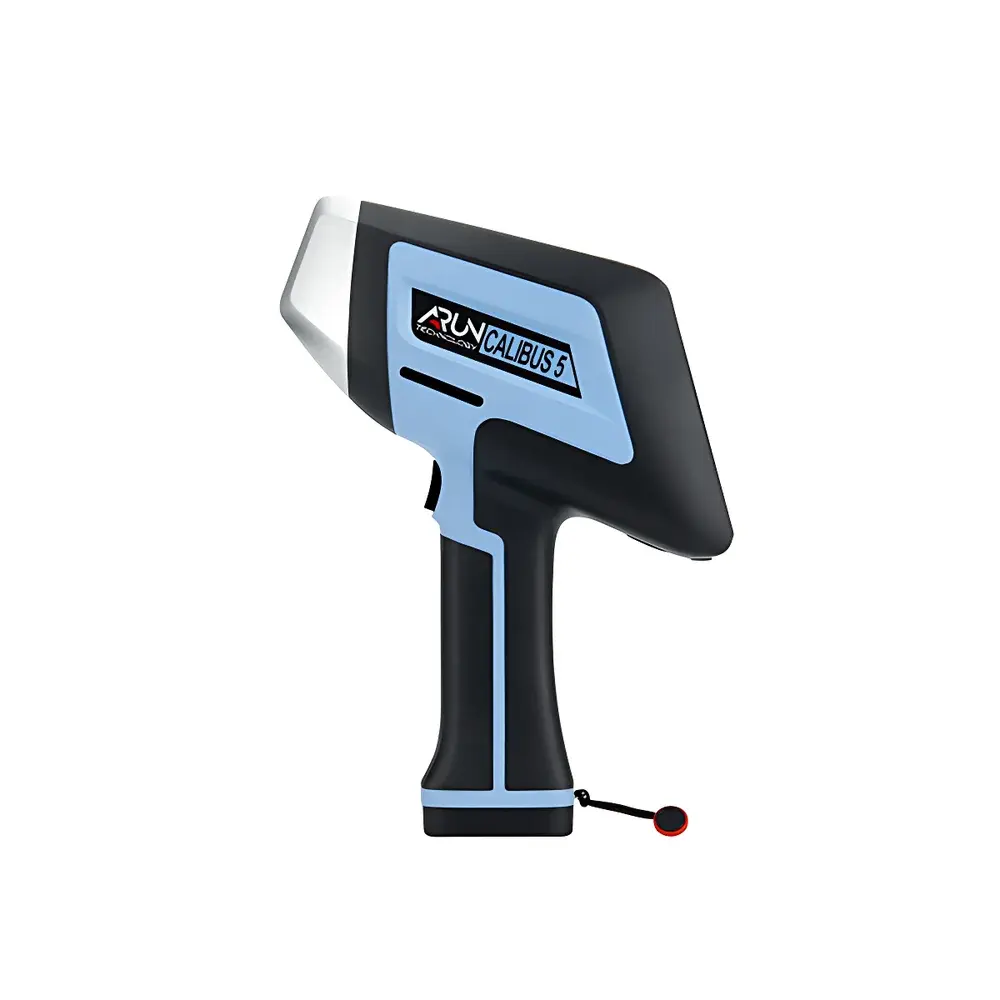
ARUN Calibus 5 Handheld Laser-Induced Breakdown Spectroscopy (LIBS) Analyzer
| Brand | ARUN TECHNOLOGY LTD. |
|---|---|
| Origin | United Kingdom |
| Manufacturer Type | Authorized Distributor |
| Origin Category | Imported |
| Model | Calibus 5 |
| Instrument Type | Handheld |
| Integration | Fully Integrated |
| Laser Energy | 1 mJ (typical, single-pulse) |
| Wavelength Range | 190–700 nm |
| Detector | CMOS Array |
| Laser Pulse Width | Nanosecond-scale |
| Operating Temperature Range | −10 °C to +40 °C |
| Argon Consumption | ~200 analyses per fill |
| Safety Certification | Class 4 Laser Product (IEC 60825-1), No X-ray Emission |
Overview
The ARUN Calibus 5 is a fully integrated, handheld Laser-Induced Breakdown Spectroscopy (LIBS) analyzer engineered for rapid, in-situ elemental analysis of metallic materials in industrial environments. It operates on the fundamental LIBS principle: a high-energy, nanosecond-pulsed laser is focused onto the sample surface, generating a transient microplasma (>10,000 K). The emitted atomic and ionic emission spectra—characteristic of constituent elements—are collected via a triple-optical-chamber spectrometer and resolved by a low-noise CMOS detector. With spectral coverage from 190 nm to 700 nm, the Calibus 5 captures rich line information across more than 30 elements—including historically challenging light elements such as C, Li, Be, B, and Si—enabling quantitative analysis without vacuum or inert gas purging in many cases, and enhanced performance with optional argon flush.
Key Features
- High-repetition-rate, all-solid-state Nd:YAG laser with active thermal stabilization (±0.1 °C PID control) for plasma signal reproducibility and long-term pulse-to-pulse stability.
- Triple-chamber optical design delivering extended spectral range (190–700 nm), improved resolution (<0.1 nm FWHM at 300 nm), and minimized spectral overlap between adjacent emission lines.
- Integrated argon purge system featuring proprietary cyclic refilling technology—no consumable cartridges; one charge supports ≥200 consecutive analyses with consistent signal-to-background ratio.
- Dedicated carbon peak background subtraction algorithm optimized for steel and cast iron grade identification, validated against ISO 11577 and ASTM E2926 reference protocols.
- Onboard high-resolution imaging module (5 MP) enabling precise targeting, micro-area analysis (spot size <100 µm), and automated image-annotated spectral record storage (≥1,000 entries).
- Ruggedized enclosure rated IP54, operational across −10 °C to +40 °C ambient conditions, with thermally compensated optics and real-time spectral drift correction.
Sample Compatibility & Compliance
The Calibus 5 is validated for direct analysis of solid metallic alloys—including Fe-, Al-, Cu-, Ni-, Zn-, Mg-, Ti-, Co-, Pb-, and Sn-based systems—without sample preparation. It extends to metal powders, oxides, and inorganic salts when used with argon flush. All calibration models are derived from >1,000 certified reference materials traceable to NIST SRMs and BAM standards. The instrument complies with IEC 60825-1:2014 (laser safety), RoHS Directive 2011/65/EU, and electromagnetic compatibility per EN 61326-1. Data integrity features—including audit-trail-enabled method logging, user access levels, and timestamped spectral archives—support GLP and GMP-aligned workflows per FDA 21 CFR Part 11 requirements where electronic records are employed.
Software & Data Management
The embedded firmware runs ARUN’s proprietary LIBS-Quant Suite v5.2, incorporating mature algorithms ported from benchtop OES platforms: multi-line selection, continuum background subtraction, matrix interference correction (e.g., Mn–Fe, Cr–Mo overlaps), and real-time spectral registration. Quantitative results are generated via empirical calibration curves built using intensity-ratio normalization and internal standardization. Data export supports CSV, SPC, and XML formats; spectral libraries are editable and expandable. Optional cloud synchronization enables centralized fleet management and remote method deployment across multi-site operations.
Applications
The Calibus 5 serves critical QA/QC and PMI (Positive Material Identification) functions across metallurgy, foundry, aerospace component verification, automotive casting inspection, rail infrastructure maintenance, battery material screening (e.g., Ni–Co–Mn cathodes), and fire investigation (metal residue profiling). Its ability to quantify carbon in stainless steels and tool steels—without spark erosion or vacuum—reduces turnaround time in field-grade verification. In recycling facilities, it enables rapid alloy sorting with <2 s measurement cycle time and repeatability ≤2% RSD for major elements (Fe, Cr, Ni, Al).
FAQ
Does the Calibus 5 require external gas cylinders or consumables?
No—its integrated argon reservoir uses a refillable, pressure-regulated design; no disposable cartridges or external tanks are needed.
Can it quantify carbon in low-alloy steels to ±0.02 wt% accuracy?
Yes—when calibrated against certified steel CRMs and operated with argon flush, typical C quantification uncertainty is ±0.015 wt% (k=2) for concentrations between 0.01–2.0 wt%.
Is spectral data export compatible with third-party chemometric software?
Yes—raw and processed spectra are exportable in standardized SPC format, supporting import into MATLAB, Unscrambler, or Python-based PLS regression pipelines.
How is laser safety ensured during field use?
The system incorporates dual interlock circuits: mechanical shutter activation only upon stable surface contact detection, plus real-time beam path monitoring. It meets Class 4 laser product requirements with mandatory key-switch enable and audible/visual firing indicators.
What regulatory documentation is provided for audit readiness?
Each unit ships with Factory Acceptance Test (FAT) report, traceable calibration certificate, EU Declaration of Conformity, and full software validation package (IQ/OQ documentation available upon request).
Related Products





