
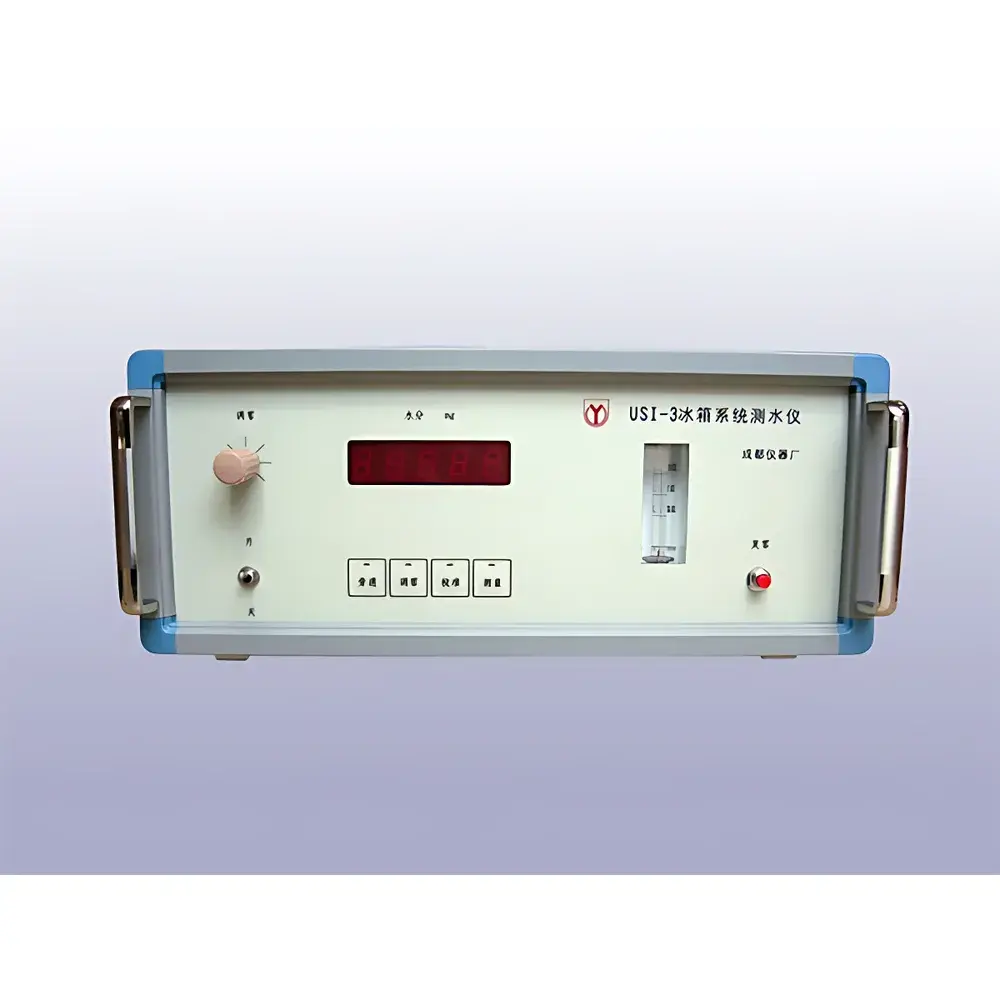
Chengyi USI-3 Refrigeration System Moisture Analyzer
| Brand | Chengyi |
|---|---|
| Origin | Sichuan, China |
| Manufacturer Type | Authorized Distributor |
| Product Category | Domestic Lab-Scale Dew Point Analyzer |
| Model | USI-3 |
| Pricing | Available Upon Request |
| Instrument Principle | Electrolytic (Phosphorus Pentoxide Sensor) |
| Operating Temperature | 5–35 °C |
| Accuracy | ±3% of total water mass |
| Repeatability | ≤1% RSD |
| Measurement Range | 0.0000–99.999 mg H₂O |
| Power Supply | AC 220 ± 22 V, 50–60 Hz or DC 10–45 V (for integrated dryer unit) |
| Carrier Gas | Ultra-Dry Nitrogen (<10 ppmv H₂O), Flow Rate: 70 ± 20 mL/min |
Overview
The Chengyi USI-3 Refrigeration System Moisture Analyzer is a dedicated laboratory-grade electrolytic moisture measurement instrument engineered for quantitative determination of residual water content in sealed refrigeration circuits—including evaporators, condensers, and capillary tubes used in domestic refrigerators, automotive air conditioning systems, and commercial chillers. It operates on the fundamental principle of coulometric Karl Fischer titration adapted to solid-state electrolysis: moisture in the sample gas stream is quantitatively absorbed by a hygroscopic phosphorus pentoxide (P₂O₅) coating inside a custom-wound spiral sensor element. Upon absorption, water reacts irreversibly with P₂O₅ to form phosphoric acid, and the resulting protons are electrochemically oxidized at the anode, generating a current proportional to the molar quantity of H₂O introduced. Total water mass is determined via precise integration of charge (coulombs) over time—adhering to Faraday’s law of electrolysis. This method eliminates reliance on equilibrium-based dew point thermodynamics, enabling direct mass-based quantification with high specificity for water vapor—even in low-concentration, high-flow, or transient system purge conditions.
Key Features
- Integrated P₂O₅-based coulometric sensor with internal spiral winding architecture for enhanced surface area, rapid response (<60 s to 90% of final reading), and minimized memory effect
- Onboard carrier gas flow control with calibrated mass flow meter (70 ± 20 mL/min) and integrated pressure regulation for stable, repeatable sample introduction
- Dual-power capability: AC mains operation (220 V ± 22 V, 50–60 Hz) for benchtop use; optional DC input (10–45 V) for field-deployable configurations with external dry gas generators
- Self-diagnostic calibration verification protocol: users may perform traceable zero-checks and span validation using certified dry nitrogen and known-mass water standards without external equipment
- Rugged aluminum chassis with thermal shielding to maintain sensor stability across ambient temperatures from 5 °C to 35 °C
- No consumable reagents required—only ultra-dry nitrogen (≤10 ppmv H₂O) as carrier gas, reducing operational cost and chemical handling risk
Sample Compatibility & Compliance
The USI-3 is validated for direct analysis of purge gas effluent from evacuated or pressurized refrigeration components. It accommodates standard service port interfaces (¼” SAE flare, 1/8″ NPT) via optional adapter kits. The analyzer meets core requirements for QC/QA in appliance manufacturing per IEC 60335-2-24 (Household Refrigerating Appliances) and supports compliance with ISO 8573-3 (Compressed Air — Part 3: Test Methods for Oil Vapor and Water) when applied to compressed refrigerant recovery streams. While not FDA 21 CFR Part 11–compliant out-of-the-box, its analog output (0–5 V DC) and RS-232 interface enable integration into validated LIMS or MES platforms where electronic record integrity is enforced through external audit trail mechanisms.
Software & Data Management
The USI-3 operates in standalone mode with front-panel LED display and push-button navigation. All measurements are stored internally (up to 256 records) with timestamp, sample ID, ambient temperature, and integrated charge value. Data export is supported via RS-232 serial connection to PC-based terminal software (provided free of charge), which enables CSV export, trend plotting, and batch report generation compliant with GLP documentation standards. No proprietary drivers or cloud services are required—data remains under full user control at all times.
Applications
- Final moisture verification post-evacuation in refrigerator and freezer production lines
- Root-cause analysis of compressor sludge formation or copper plating in HVAC service workshops
- Validation of desiccant filter efficiency during refrigerant reclamation processes
- Quality auditing of hermetic component suppliers (e.g., evaporator coil manufacturers)
- Research into moisture diffusion kinetics through polymer gaskets and elastomeric seals under thermal cycling
- Calibration transfer studies between primary gravimetric standards and field-deployable analyzers
FAQ
What does “electrolytic principle” mean in this context?
It refers to coulometric detection via P₂O₅-coated electrodes: water is chemically trapped and electrolyzed, with total charge consumed directly proportional to moles of H₂O—per Faraday’s law.
Can the USI-3 measure moisture in liquid refrigerants?
No. It is designed exclusively for gas-phase analysis of purge or evacuation effluent. Direct liquid injection would damage the sensor.
Is routine recalibration required?
Annual verification against NIST-traceable water standards is recommended. Built-in zero-check and two-point span verification allow daily operational checks without external tools.
Does it comply with ASTM E1064 or ISO 12972?
While not certified to those standards, its measurement uncertainty (±3%) and repeatability (≤1% RSD) fall within the performance envelope specified for Class II electrolytic analyzers per ISO 12972 Annex B.
What maintenance is needed beyond sensor replacement?
Annual inspection of gas path seals, flow meter calibration, and P₂O₅ sensor replacement every 18–24 months (depending on cumulative water load). No optical alignment or firmware updates are required.




