
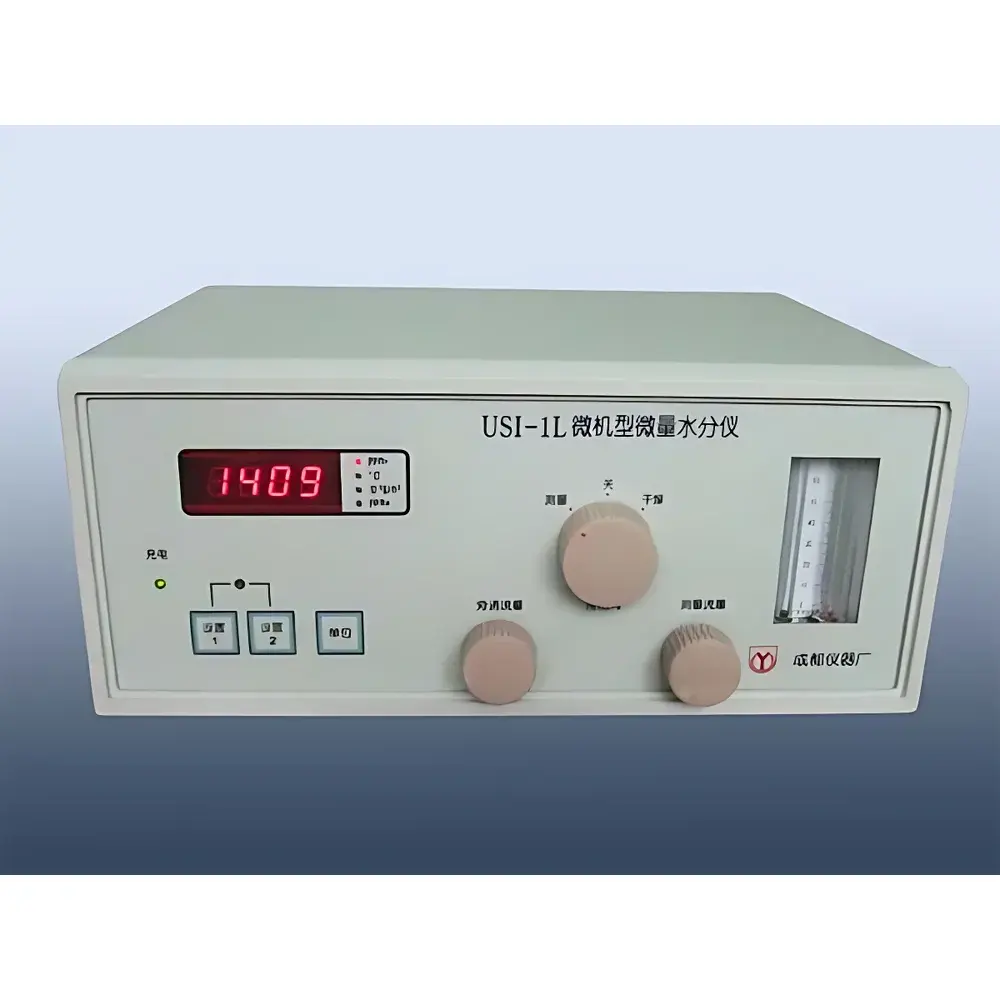
scchengyi USI-1AB P2O5 Electrolytic Trace Moisture Analyzer
| Brand | scchengyi |
|---|---|
| Origin | Sichuan, China |
| Manufacturer Type | Authorized Distributor |
| Product Category | Domestic |
| Model | USI-1AB |
| Product Type | Online Dew Point Moisture Analyzer |
| Measurement Principle | Phosphorus Pentoxide (P₂O₅) Electrolytic Method |
| Operating Temperature | 5–40 °C (ambient) |
| Supply Gas Pressure | <100 kPa |
| Accuracy | ±5% of reading |
| Repeatability | <0.08 µL/L at sample moisture ≤260 µL/L |
| Range | 0–1000 µL/L (ppmv) |
| Response Time (t₆₃) | ≤3 min |
| Output Signals | 0–10 mV and 4–20 mA |
| Power Supply | AC 220 V ±10%, 50–60 Hz |
| Sample Flow Rate | 100 mL/min (measurement), 1 L/min (bypass) |
| Dimensions | 380 × 300 × 170 mm |
| Weight | 6.5 kg |
Overview
The scchengyi USI-1AB is a high-stability online trace moisture analyzer engineered for continuous, real-time monitoring of water vapor concentration in industrial process gases—particularly in applications demanding sub-ppmv-level detection accuracy. It operates on the well-established phosphorus pentoxide (P₂O₅) electrolytic principle: moisture in the sampled gas stream is quantitatively absorbed by a hygroscopic P₂O₅ film deposited on a spiral-wound electrode assembly, and subsequently electrolyzed at a controlled DC voltage. The resulting electrolysis current is directly proportional to the mass flow rate of water molecules, enabling precise, linear measurement of moisture content in volumetric units (µL/L or ppmv). This method offers inherent zero-drift suppression, high long-term stability, and immunity to common interferents such as hydrocarbons, CO₂, and inert gases—making it especially suitable for SF₆-insulated electrical equipment, semiconductor purge lines, natural gas dehydration monitoring, and high-purity nitrogen/hydrogen supply systems.
Key Features
- Spiral-loop P₂O₅ electrolytic sensor with internal winding architecture—optimized for uniform film deposition, enhanced surface area utilization, and minimized thermal gradient effects.
- Auto-ranging analog circuitry ensures optimal signal-to-noise ratio across the full 0–1000 µL/L measurement span without manual gain adjustment.
- Dual-output capability: isolated 0–10 mV analog output and industry-standard 4–20 mA current loop, both simultaneously active and independently scalable.
- Integrated rechargeable battery module enables temporary operation during power interruption or portable drying mode (e.g., sensor regeneration or field calibration verification).
- LED digital display with selectable units: volumetric moisture (µL/L), dew point temperature (°C at ambient pressure), mass-based concentration (µg/g, referenced to SF₆), or absolute humidity (g/m³).
- Onboard baseline subtraction function—supports automatic or manual zero correction, baseline value storage, and editable offset compensation for drift management under stable operating conditions.
Sample Compatibility & Compliance
The USI-1AB is designed for non-corrosive, non-condensing gas streams with particulate filtration (≤1 µm recommended) and oil-free conditioning. Compatible media include SF₆, N₂, H₂, Ar, He, O₂, compressed air, and natural gas (with appropriate pre-treatment for hydrocarbon removal). It complies with IEC 60068-2 environmental testing standards for operational temperature (5–40 °C) and mechanical robustness. While not certified to ATEX or IECEx, its low-power design (<15 W nominal) and absence of ignition sources permit safe use in Zone 2/Class I, Division 2 environments when installed per local electrical codes. Data integrity protocols align with GLP/GMP documentation requirements: all calibration events, zero adjustments, and configuration changes are timestamped and retainable via optional RS232 logging (no FDA 21 CFR Part 11 compliance out-of-box; audit trail functionality requires external SCADA integration).
Software & Data Management
The USI-1AB supports optional RS232 serial interface (ASCII protocol) for bidirectional communication with host PLCs, DCS systems, or PC-based data acquisition platforms. Communication software (provided separately) enables remote parameter configuration, real-time data streaming, historical trend export (CSV), and automated report generation—including calibration logs and alarm event summaries. Optional thermal printer module delivers hard-copy records of measurement snapshots, zero checks, or system diagnostics. All firmware updates are performed via standard UART interface using vendor-provided utility tools—no proprietary drivers required. Configuration parameters (e.g., unit selection, analog scaling, alarm thresholds) persist through power cycles and retain factory defaults unless explicitly modified.
Applications
- Condition monitoring of SF₆ gas in high-voltage circuit breakers, GIS, and transformers per IEEE C37.122 and IEC 62271-1.
- Moisture control in semiconductor fabrication tool purge gases (N₂, Ar) to prevent oxide layer defects and chamber contamination.
- Quality assurance in medical oxygen production and cryogenic air separation plants per ISO 8573-1 Class 2 purity specifications.
- Dehydration validation in natural gas transmission pipelines prior to LNG liquefaction or pipeline injection.
- Process validation for vacuum drying ovens, glove boxes, and dry-room environments in lithium-ion battery manufacturing.
FAQ
What is the maximum allowable sample gas pressure for the USI-1AB?
The instrument requires inlet pressure below 100 kPa (absolute or gauge, depending on installation configuration); higher pressures must be reduced via calibrated pressure regulator and filtered inline.
Can the USI-1AB measure dew point directly at elevated pressures?
No—it calculates dew point from µL/L readings assuming atmospheric reference pressure (101.325 kPa); for pressurized systems, optional pressure-compensated dew point calculation requires external pressure input and custom firmware mapping.
Is sensor replacement user-serviceable?
Yes—the P₂O₅ sensor cartridge is field-replaceable using standard torx tools; full recalibration with NIST-traceable moisture standards is mandatory post-replacement.
Does the analyzer support automatic temperature compensation?
Yes—built-in thermistor continuously monitors sensor head temperature and applies algorithmic correction to maintain accuracy across the 5–40 °C ambient range.
What maintenance intervals are recommended for routine operation?
Sensor cleaning every 6 months (isopropyl alcohol wipe), annual full calibration verification, and desiccant cartridge replacement every 2 years—or sooner if baseline drift exceeds 0.1 µL/L/hour.





