
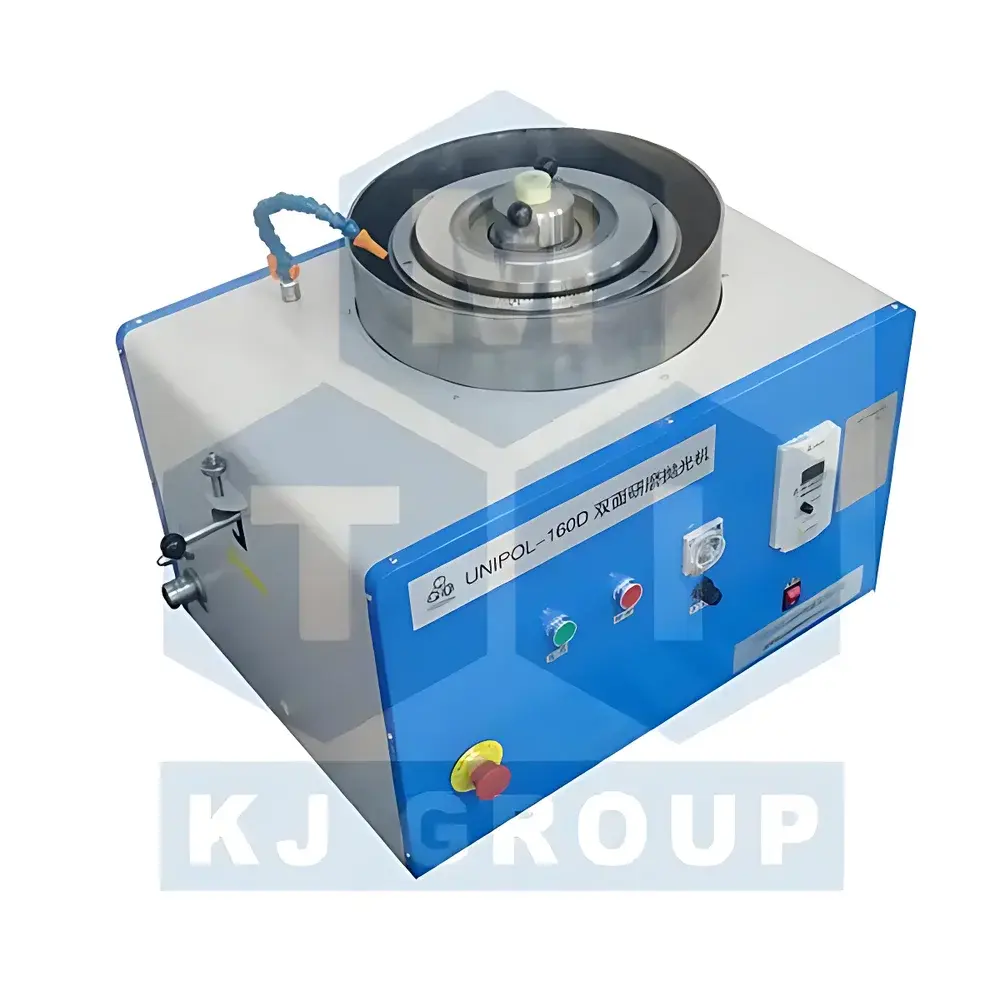
Hefei Kejing UNIPOL-160D Dual-Side Lapping and Polishing Machine
| Brand | Hefei Kejing |
|---|---|
| Origin | Anhui, China |
| Model | UNIPOL-160D |
| Power Supply | 220 V, 50 Hz |
| Rated Power | 550 W |
| Platen Diameter | 225 mm |
| Platen Speed | 0–72 rpm (infinitely variable, manual frequency adjustment) |
| Max Sample Diameter | Φ50 mm |
| Max Sample Thickness | ≤15 mm |
| Upper Platen Mass | 3.5 kg |
| Dimensions (L×W×H) | 650 × 500 × 580 mm |
| Net Weight | 80 kg |
| Capacity | Simultaneous dual-side processing of up to four Φ2-inch wafers |
Overview
The Hefei Kejing UNIPOL-160D Dual-Side Lapping and Polishing Machine is an engineered solution for high-precision, parallel surface conditioning of rigid, flat substrates in research and pilot-scale semiconductor, optoelectronic, and advanced ceramic manufacturing environments. It operates on the principle of planetary dual-side lapping—where relative motion between upper and lower platens, combined with controlled rotation of a central sun gear and carrier gears, generates uniform shear and compressive forces across both faces of the sample. This kinematic architecture ensures minimal thickness variation (<±0.5 µm across Φ50 mm), excellent parallelism, and repeatable material removal rates—critical for preparing single-crystal wafers (Si, Ge, quartz, sapphire), optical glasses, technical ceramics, and metallic foils prior to epitaxy, bonding, or metrology.
Key Features
- Three-axis independent motion control via worm-gear reduction motor and precision gear train—enabling differential rotational speeds and counter-rotating platen configurations for optimized stock removal and surface planarity.
- Infinitely variable platen speed (0–72 rpm) achieved through manual frequency adjustment of the integrated AC inverter—allowing fine-tuned process optimization for brittle vs. ductile materials.
- Dual-function capability: configurable for coarse lapping (using diamond-impregnated or alumina-based slurries) and fine polishing (with colloidal silica, ceria, or polyurethane-based pads) without mechanical reconfiguration.
- Robust cast-iron frame with vibration-damped base design minimizes runout and maintains sub-micron runout stability over extended operation cycles.
- Modular carrier gear system supports interchangeable load-bearing planetary gears—facilitating rapid adaptation to varying wafer sizes (standard Φ2″/Φ50 mm; custom apertures available upon request).
- Integrated counterweight ring assembly ensures dynamic balance during high-speed planetary rotation, reducing bearing wear and extending service life beyond 10,000 operational hours under routine maintenance.
Sample Compatibility & Compliance
The UNIPOL-160D accommodates rigid, non-flexible disc-shaped specimens with diameters up to Φ50 mm and thicknesses ≤15 mm—including silicon, germanium, fused quartz, sapphire (Al₂O₃), lithium niobate, alumina, zirconia, borosilicate glass, stainless steel, and copper alloys. Its mechanical design conforms to ISO 2768-mK general tolerances for machine tool components and meets CE machinery directive essential health and safety requirements (2006/42/EC) when operated within specified electrical and environmental parameters (ambient temperature: 10–35 °C; humidity: <80% RH non-condensing). While not certified for GMP production lines, its reproducible kinematics and documented process parameters support GLP-aligned R&D workflows and pre-qualification studies compliant with ASTM F1935 (Standard Guide for Wafer Lapping and Polishing Processes) and SEMI F26 (Specification for Silicon Wafer Surface Quality).
Software & Data Management
The UNIPOL-160D is a manually operated, analog-controlled instrument with no embedded microprocessor or digital interface. Process parameters—including platen speed, slurry flow rate (if externally metered), dwell time, and applied load—are recorded manually in laboratory notebooks or electronic lab notebooks (ELNs) per institutional SOPs. For traceability in regulated environments, users are advised to integrate external data loggers for voltage/current monitoring or use time-stamped video documentation (included in standard delivery) for audit-ready process verification. The absence of network connectivity or firmware eliminates cybersecurity concerns and simplifies validation under FDA 21 CFR Part 11 Annex 11 frameworks where paper-based or ELN-anchored records serve as primary evidence.
Applications
- Pre-thinning and final polishing of Si, Ge, and III-V compound semiconductor wafers for heteroepitaxial growth.
- Double-sided planarization of optical-grade quartz and sapphire substrates used in UV lithography masks and laser cavity windows.
- Surface preparation of ceramic insulators (e.g., AlN, BeO) for high-power RF packaging and thermal management substrates.
- Controlled thickness reduction of metal foils (Cu, Ni, Mo) for flexible electronics substrate development.
- R&D-scale fabrication of bonded SOI (Silicon-on-Insulator) and glass-to-silicon hybrid wafers requiring nanometer-level thickness uniformity.
- Teaching laboratories: Demonstrating principles of abrasive wear mechanics, Preston’s equation, and deterministic material removal in solid-state physics and materials engineering curricula.
FAQ
What types of abrasives and slurries are compatible with the UNIPOL-160D?
Standard configurations support water-based slurries containing alumina (Al₂O₃), silicon carbide (SiC), diamond (0.1–10 µm), and colloidal silica (10–50 nm), as well as oil-based diamond pastes. Slurry delivery is gravity-fed or manually dosed; optional peristaltic pump integration is available.
Can the machine handle non-circular samples?
No—the planetary gear carrier system requires symmetrical, rotationally stable geometry. Rectangular or irregular shapes must be mounted in custom-machined circular carriers to ensure balanced loading and avoid eccentric vibration.
Is vacuum chucking or adhesive mounting supported?
The standard configuration uses mechanical clamping via carrier gear bores and weight-based retention. Vacuum chucks or wax-bonding fixtures are not included but may be retrofitted with third-party adapters meeting ISO 15744 mechanical interface standards.
What maintenance intervals are recommended?
Lubrication of worm-gear reducer every 500 operating hours; inspection of platen flatness (optical interferometry) annually or after 2,000 cycles; replacement of worn carrier gears based on visual wear assessment or measured runout deviation exceeding 2 µm peak-to-valley.
Does the system include calibration certification?
No factory calibration certificate is supplied. Users are responsible for periodic verification of platen speed (tachometer), rotational symmetry (dial indicator), and dimensional accuracy (calibrated micrometers) in accordance with internal QA protocols or ISO/IEC 17025-accredited procedures.



