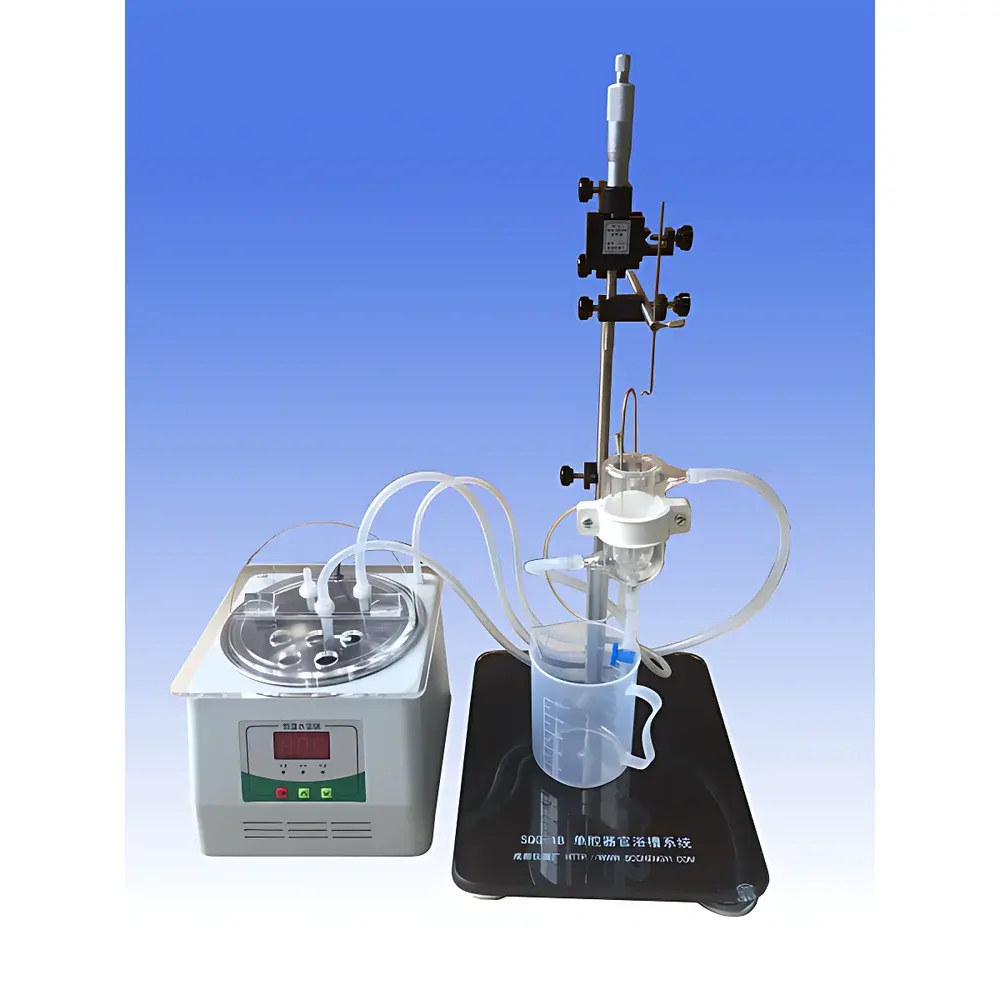
SQG-1 Isolated Tissue/Organ and Smooth Muscle Thermostatic Bath System
| Brand | SCChengyi |
|---|---|
| Origin | Sichuan, China |
| Manufacturer Type | Authorized Distributor |
| Country of Origin | China |
| Model | SQG-1 |
| Pricing | Upon Request |
| Temperature Range | Ambient to 100°C |
| Max Heating Power | 350 W |
| Warm-up Time (Ambient → 38°C) | <10 min |
| Operating Voltage | AC 220 V, 50 Hz |
| Temperature Control Accuracy | ≤0.1°C |
| Display Resolution | 0.1°C |
| Dual Display | Actual & Set Temperature |
| Bath Capacity | 20 mL (±1 mL precision) |
| Preheating Rack | Holds five 20 mL glass tubes + accommodates ≥200 mL auxiliary reservoir |
| Modular Bath Design | Detachable for cleaning or replacement |
| External Circulation & Gas Supply Unit | Decoupled from bath chamber to eliminate pump-induced vibration |
| Adjustable Gas Flow Rate | Compatible with ambient air or externally supplied O₂ |
| Integrated Tissue Suspension Assembly | One-dimensional precision micrometer stage with synchronized transducer–tissue movement |
| Leakage Protection | 10 mA residual-current device |
| Waste Collection | Dedicated waste reservoir included |
Overview
The SQG-1 Isolated Tissue/Organ and Smooth Muscle Thermostatic Bath System is an engineered platform for ex vivo physiological experimentation requiring precise thermal regulation, mechanical stability, and gas-controlled microenvironments. Designed in accordance with standard pharmacological and contractility assay protocols—including those referenced in ISO 10993-5 (biological evaluation of medical devices), USP (analytical instrument qualification), and GLP-compliant tissue bath workflows—the system supports quantitative assessment of smooth muscle tone, vascular reactivity, intestinal motility, and cardiac papillary muscle function. Its core architecture separates thermal management, gas delivery, and mechanical actuation into physically isolated subsystems to minimize cross-talk interference—particularly critical when measuring low-amplitude force signals (<1 mN) using strain-gauge or capacitive transducers. The bath operates on the principle of forced-convection thermostatic control, utilizing a high-efficiency external circulation loop and PID-regulated heating element to maintain temperature uniformity within ±0.1°C across the working volume.
Key Features
- Thermal Performance: Achieves stable setpoint control from ambient to 100°C with ≤0.1°C accuracy and 0.1°C display resolution; reaches physiological temperature (38°C) in under 10 minutes from ambient conditions.
- Vibration-Isolated Architecture: External circulation pump and gas supply unit are mechanically decoupled from the bath chamber, eliminating transmission of mechanical noise to tissue specimens during force measurement.
- Modular Bath Design: The 20 mL quartz-glass bath vessel is fully detachable for sterilization, cleaning, or replacement—supporting compliance with lab-specific decontamination SOPs.
- Gas Flexibility: Dual-mode gas delivery allows seamless switching between compressed air and externally sourced medical-grade oxygen, with fine-adjustable flow control calibrated for tissue-level O₂ saturation without bubble-induced shear stress.
- Mechanical Integrity: Integrated one-dimensional micrometer stage enables sub-millimeter vertical positioning of tissue hooks and force transducers; synchronized movement ensures zero relative displacement during tissue length adjustment—preventing unintended mechanical trauma.
- Safety Compliance: Equipped with a 10 mA residual-current circuit breaker meeting IEC 61000-4-5 surge immunity and EN 61010-1 safety requirements for laboratory electrical equipment.
Sample Compatibility & Compliance
The SQG-1 accommodates a broad range of excised biological preparations including rat aortic rings, guinea pig ileum segments, mouse tracheal strips, and human saphenous vein explants. Its 20 mL bath volume (±1 mL volumetric tolerance) conforms to standard organ bath dimensions specified in ASTM E2917-20 (Standard Guide for In Vitro Pharmacological Assays). The quartz-glass construction ensures optical clarity for concurrent video-based morphometric analysis and resistance to chemical degradation from common assay buffers (e.g., Krebs-Henseleit, Tyrode’s, HEPES-buffered saline). All wetted components comply with USP Class VI biocompatibility standards. System documentation—including calibration records, installation qualification (IQ), and operational qualification (OQ) templates—is provided to support 21 CFR Part 11–aligned electronic record retention where paired with compliant data acquisition software.
Software & Data Management
While the SQG-1 operates as a hardware platform without embedded firmware or proprietary software, its analog output interfaces (±5 V DC, BNC) are compatible with industry-standard data acquisition systems including ADInstruments PowerLab, BIOPAC MP160, and National Instruments DAQmx platforms. All analog signals—temperature feedback, transducer voltage, and gas flow status—are electrically isolated to prevent ground-loop artifacts. The system supports time-synchronized logging of thermal setpoints, actual bath temperature, and force output at sampling rates up to 1 kHz when integrated with appropriate digitizers. Audit trails, user access logs, and electronic signature capabilities are implemented at the host acquisition software level—not within the SQG-1 itself—ensuring alignment with FDA 21 CFR Part 11 requirements for regulated preclinical studies.
Applications
- Concentration-response profiling of vasoactive agents (e.g., norepinephrine, acetylcholine, sodium nitroprusside) in isolated arterial rings.
- Functional characterization of G-protein-coupled receptor (GPCR) agonism/antagonism in gastrointestinal smooth muscle.
- Evaluation of ion channel modulators (e.g., Ca²⁺, K⁺, Cl⁻ channel blockers) on contractile kinetics.
- Assessment of endothelial-dependent and -independent relaxation mechanisms.
- Validation of novel therapeutic peptides or biologics in ex vivo disease models (e.g., hypertension, asthma, irritable bowel syndrome).
- Teaching laboratories for undergraduate and graduate pharmacology curricula requiring reproducible, hands-on organ bath methodology.
FAQ
Can the SQG-1 be used with non-standard bath volumes?
Yes—the modular design permits substitution of custom-machined bath vessels, provided thermal mass and circulation dynamics remain within the 350 W heater’s stabilization envelope.
Is the system compatible with CO₂-enriched gas mixtures?
The gas inlet accepts any non-corrosive, non-condensing gas or mixture; however, CO₂ requires downstream humidification and pH monitoring to avoid acidification of bicarbonate-buffered solutions.
Does the micrometer stage support lateral (X/Y) adjustment?
No—the stage provides only vertical (Z-axis) translation with 10 µm resolution; horizontal alignment must be performed during initial mechanical setup.
What maintenance intervals are recommended for the circulation pump?
Silicone tubing should be replaced every 6 months under continuous operation; pump motor bearings require no scheduled lubrication but should be inspected annually for audible wear.
Can the system be integrated into a multi-bath array for parallel testing?
Yes—each unit operates independently with isolated power, gas, and fluid paths; synchronization of temperature setpoints and data acquisition is managed externally via host software.
Related Products