
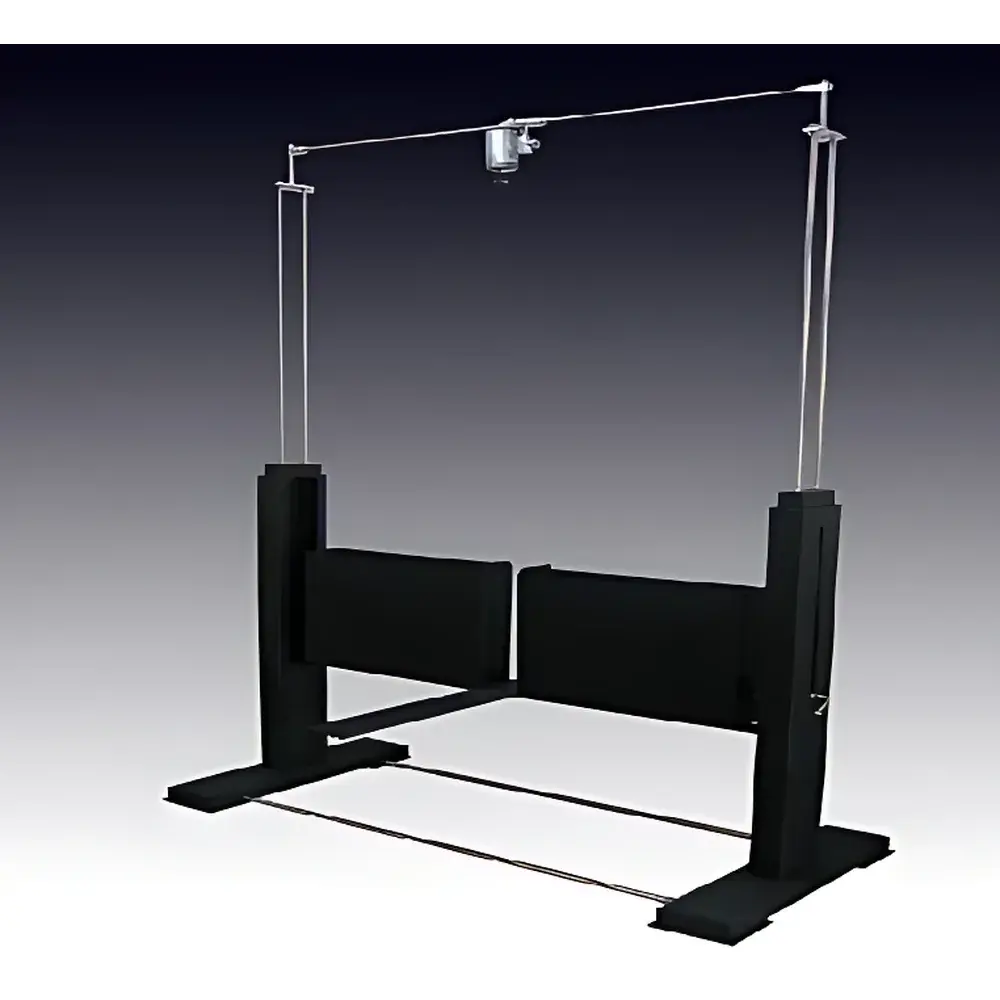
MSZ-1 Elevated Plus Maze Video Tracking System
| Origin | Sichuan, China |
|---|---|
| Manufacturer Type | Distributor |
| Origin Category | Domestic |
| Model | MSZ-1 |
| Pricing | Upon Request |
Overview
The MSZ-1 Elevated Plus Maze (EPM) Video Tracking System is a purpose-built behavioral phenotyping platform engineered for objective, high-fidelity quantification of anxiety-like behavior in rodent models. Based on the well-validated ethological paradigm of the elevated plus maze—comprising two open arms and two enclosed arms elevated 400 mm above ground—the system leverages computer vision–driven motion tracking to resolve conflict-driven exploratory behavior: the natural aversion to height and open spaces versus innate neophilic drive. This conflict manifests as reduced time and entries into open arms under baseline conditions; anxiolytic compounds reliably increase open-arm exploration, while anxiogenic agents suppress it. The MSZ-1 implements real-time, frame-by-frame video analysis without requiring animal marking or dye application, enabling longitudinal, non-invasive assessment across repeated trials. Its architecture supports standardized experimental execution aligned with NIH guidelines for preclinical behavioral neuroscience and adheres to principles of reproducibility emphasized in the ARRIVE 2.0 framework.
Key Features
- Full-automation via high-resolution (640 × 480) color video capture at optimized frame rates, eliminating observer bias and inter-rater variability inherent in manual scoring.
- Robust background subtraction and adaptive contrast-based segmentation—no animal staining or fur-color constraints—ensuring reliable tracking across diverse strains (C57BL/6, BALB/c, Sprague-Dawley, Wistar).
- Stainless-steel EPM arena (arm length: 500 mm; arm width: 100 mm; wall height: 400 mm; total support height: 2.6 m) compliant with IACUC-recommended structural specifications for rigidity, stability, and light-diffusion uniformity.
- Integrated software calibration suite with auto-alignment tools—eliminates manual camera positioning and ensures consistent pixel-to-millimeter mapping across installations.
- Proprietary trajectory reconstruction algorithm optimized for low-latency processing and resistance to occlusion artifacts, shadow interference, and ambient lighting fluctuations.
- Modular software architecture supporting future integration of complementary behavioral modules (e.g., forced swim test, open field, light-dark box) via standardized API hooks.
- Export functionality generating CSV-formatted datasets compatible with statistical platforms including R, Python (Pandas), SPSS, SAS, and GraphPad Prism.
Sample Compatibility & Compliance
The MSZ-1 is validated for use with adult mice (20–30 g) and rats (200–350 g). Arm dimensions and elevation conform to published EPM protocols (Lister, 1987; Pellow et al., 1985) and are referenced in FDA draft guidance for nonclinical behavioral pharmacology studies. All hardware components meet ISO 9001 manufacturing traceability standards. Software design incorporates audit-trail logging (user ID, timestamp, parameter edits, export events) to support GLP-compliant data integrity requirements. While not certified for clinical diagnostics, the system meets essential functional criteria for research-grade instrumentation under ISO/IEC 17025 Annex A.3 for measurement uncertainty management.
Software & Data Management
The bundled analysis software provides synchronized visualization of raw video, heatmaps, path trajectories, and real-time metric overlays. It computes over 40 validated behavioral endpoints—including open-arm time ratio (%), open-arm entry frequency, center zone transitions, and per-arm depth-of-entry metrics—with sub-second temporal resolution. All parameters are user-configurable (e.g., dwell threshold, movement velocity cutoff, arm boundary definitions). Data files include embedded metadata (animal ID, trial date, operator, environmental conditions) and support version-controlled archiving. Exported CSV files contain full coordinate time-series (x,y,t), enabling custom kinematic analyses (e.g., velocity variance, acceleration bursts, thigmotaxis index). The system supports Windows 10/11 (64-bit) and requires no proprietary runtime environments.
Applications
The MSZ-1 serves as a core tool in academic and industrial neuroscience laboratories conducting translational research in affective disorders. Primary applications include: preclinical screening of novel anxiolytics and anxiogenics; mechanistic studies of GABAA, CRF, and serotonergic pathways; genetic model validation (e.g., knockout/knockin lines); chronic stress paradigms (e.g., social defeat, restraint); developmental neurotoxicology assessments; and pharmacokinetic–pharmacodynamic correlation studies. It is routinely employed in departments of pharmacology, psychiatry, neurobiology, and toxicology—and integrated into graduate curricula for teaching experimental design, statistical power analysis, and behavioral assay standardization.
FAQ
What species and strains are supported?
The system is optimized for Mus musculus (mice) and Rattus norvegicus (rats), including common inbred (C57BL/6J, DBA/2), outbred (CD-1, Sprague-Dawley), and transgenic lines. Strain-specific calibration presets are included.
Is FDA 21 CFR Part 11 compliance available?
The base software includes audit-trail logging and electronic signature placeholders; full Part 11 compliance (e.g., biometric authentication, encrypted storage) can be implemented via optional validated configuration packages for regulated environments.
Can the system integrate with existing lab infrastructure?
Yes—CSV exports enable direct ingestion into LIMS, ELN, or institutional data lakes. Hardware supports GigE Vision-compatible cameras for future upgrade paths.
What maintenance is required?
No routine calibration is needed. Stainless-steel surfaces require only periodic ethanol wipe-downs. Software updates are delivered via secure HTTPS portal with versioned release notes.
Is technical support available internationally?
Yes—remote desktop assistance, protocol consultation, and on-site installation services are available under annual support contracts, with documentation provided in English.
Related Products




