
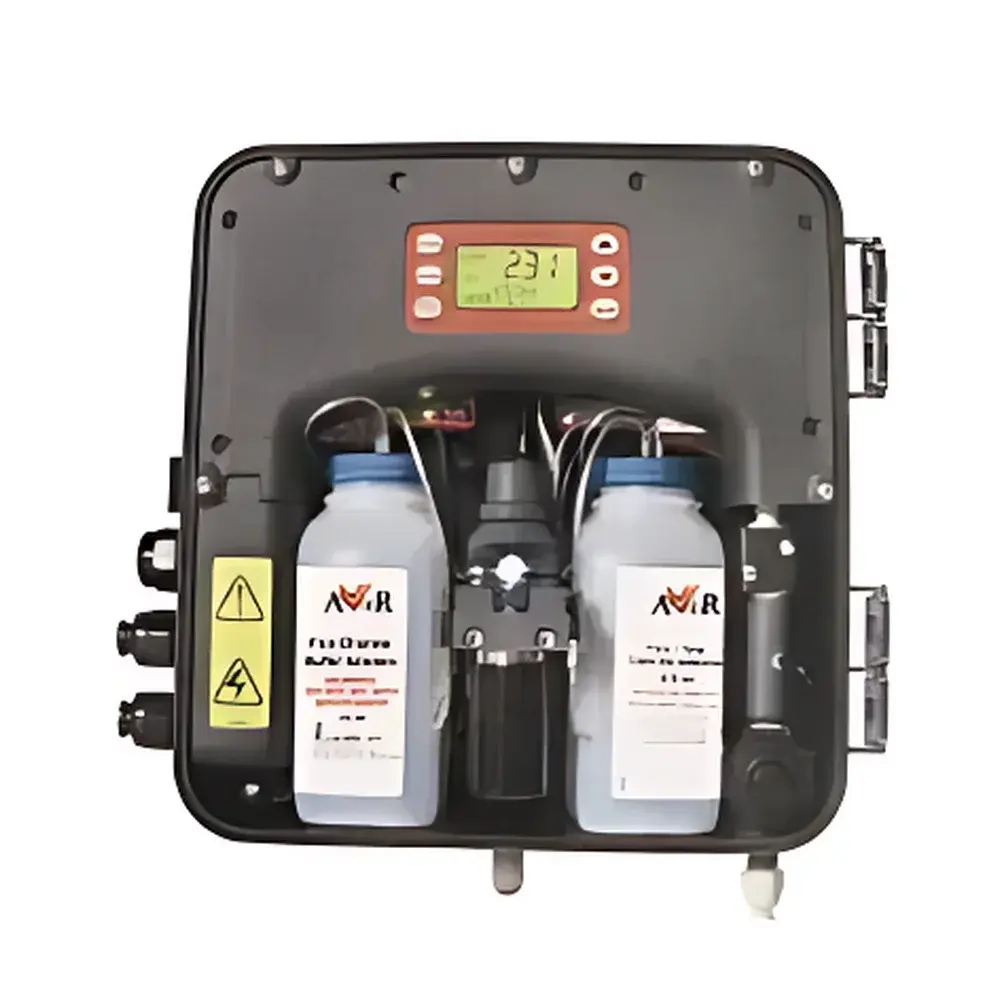
AVVOR 9000 Residual Chlorine and Chlorine Dioxide Online Analyzer
| Brand | AVVOR |
|---|---|
| Origin | Canada |
| Model | AVVOR 9000 |
| Measurement Range | 0–10 mg/L Cl₂ |
| Cycle Time | 110 s–10 min (adjustable) |
| Accuracy | ±5% or ±0.03 mg/L Cl₂ (0–6 mg/L) |
| Resolution | 0.01 mg/L |
| Method | EPA-approved DPD colorimetric analysis for free chlorine and total chlorine |
| Output | 4–20 mA analog + RS-485 with Modbus RTU protocol |
| Alarms | Two user-configurable concentration-based digital alarms |
| Operating Temperature | 5–40 °C |
| Inlet Pressure | 5–150 psi |
| Enclosure Rating | NEMA 4X / IP66 |
| Housing Material | ABS plastic |
| Power Supply | 100–240 V AC, auto-ranging, 47–63 Hz |
| Certifications | CE, UL, CSA, ETL, ETLc |
| Dimensions (L×W×H) | 41 × 41 × 26 cm |
| Weight | 3.6 kg |
Overview
The AVVOR 9000 Residual Chlorine and Chlorine Dioxide Online Analyzer is a fully automated, microprocessor-controlled instrument engineered for continuous, real-time monitoring of free chlorine, total chlorine, and chlorine dioxide concentrations in potable water, wastewater effluent, cooling towers, and industrial process streams. It implements the U.S. Environmental Protection Agency (EPA)-recognized DPD (N,N-diethyl-p-phenylenediamine) colorimetric method—a standardized wet-chemistry technique that ensures regulatory compliance and analytical traceability in public water systems. Unlike electrochemical or amperometric sensors subject to drift and membrane fouling, the AVVOR 9000 performs discrete batch analysis with optical detection at 515 nm, delivering high reproducibility and minimal interferences from turbidity, pH shifts, or oxidant cross-sensitivity. Its modular fluidic architecture enables stable operation over extended unattended intervals—up to 30 days between maintenance cycles—while maintaining calibration integrity through internal reference checks and reagent blank compensation.
Key Features
- True EPA-compliant DPD photometric analysis for free chlorine, total chlorine, and chlorine dioxide—validated per EPA Method 334.0 and Standard Methods 4500-Cl G
- Adjustable measurement cycle time (110 seconds to 10 minutes) to match process dynamics and regulatory reporting frequency requirements
- Dual independent alarm outputs configurable as high/low thresholds or deviation-based triggers—compatible with PLCs, SCADA systems, and chlorination dosing controllers
- Integrated 4–20 mA current loop output with HART-compatible signal conditioning and isolated RS-485 interface supporting Modbus RTU protocol for seamless integration into industrial automation networks
- NEMA 4X / IP66-rated ABS enclosure rated for outdoor and harsh indoor environments—including exposure to humidity, dust, and incidental water spray
- Low reagent consumption design (≤2 mL per analysis cycle) reduces operational cost and minimizes hazardous waste generation
- Auto-ranging power supply (100–240 V AC, 47–63 Hz) ensures global deployment readiness without voltage conversion hardware
Sample Compatibility & Compliance
The AVVOR 9000 accepts raw or filtered water samples within an inlet pressure range of 5–150 psi and operates reliably across a temperature window of 5–40 °C. It is validated for use with municipal drinking water (per NSF/ANSI 61), secondary-treated wastewater, recirculating cooling water, and food-grade process water. Regulatory alignment includes full conformance with U.S. EPA Safe Drinking Water Act (SDWA) monitoring protocols, EU Drinking Water Directive (2020/2184) Annex I parameters, and ISO 9001-certified manufacturing practices. All firmware and data handling routines comply with GLP principles, including audit-trail logging of calibration events, alarm activations, and method parameter changes—supporting FDA 21 CFR Part 11 readiness when deployed in regulated pharmaceutical or beverage production facilities.
Software & Data Management
The analyzer operates autonomously via embedded firmware with no external PC dependency. Configuration, calibration, and diagnostic functions are accessible through a local LCD interface with intuitive menu navigation. All measurement data—including timestamped concentration values, alarm status, reagent usage logs, and system health diagnostics—are stored internally for ≥30 days and retrievable via Modbus register mapping. When integrated into supervisory control systems, the device supports scheduled data polling, event-driven alarm forwarding, and remote firmware updates using secure serial communication protocols. Optional cloud gateway modules enable encrypted MQTT-based telemetry to centralized water management platforms, facilitating predictive maintenance scheduling and regulatory submission workflows.
Applications
- Continuous compliance monitoring at drinking water treatment plant final disinfection points and distribution system entry points
- Real-time feedback control of sodium hypochlorite or chlorine gas dosing systems in municipal and industrial applications
- Verification of residual biocide levels in HVAC cooling towers to prevent Legionella pneumophila proliferation
- Process water quality assurance in semiconductor fabrication, pharmaceutical manufacturing, and dairy processing lines
- Effluent monitoring prior to discharge to surface waters under NPDES permit conditions
- Research and validation studies requiring traceable, method-defined chlorine quantification in bench-scale and pilot-plant systems
FAQ
Does the AVVOR 9000 support both free chlorine and total chlorine measurement in a single instrument?
Yes—the analyzer automatically executes sequential DPD reactions (DPD-1 for free chlorine; DPD-3 with potassium iodide addition for total chlorine) within the same flow cell, eliminating manual reagent switching or dual-instrument setups.
Is routine calibration required, and how often?
A two-point calibration (zero and span) is recommended every 7 days for critical applications; however, built-in reagent blank correction and optical reference tracking extend calibration stability to 14–30 days under controlled conditions.
Can the unit operate on battery backup or solar power?
The standard unit requires AC mains power; however, optional DC power interface kits (12–24 V DC input) are available for off-grid or mobile deployment scenarios.
What sample filtration is necessary before analysis?
A 50 µm inline filter is recommended upstream of the analyzer to prevent particulate clogging of solenoid valves and the optical flow cell—no additional pretreatment is required for typical clarified water matrices.
How does the system handle chlorine dioxide interference during free chlorine measurement?
The DPD-1 reaction is selective for free chlorine; chlorine dioxide is measured separately using a proprietary reduction step prior to DPD-1 addition, ensuring orthogonal quantification without cross-talk.







