
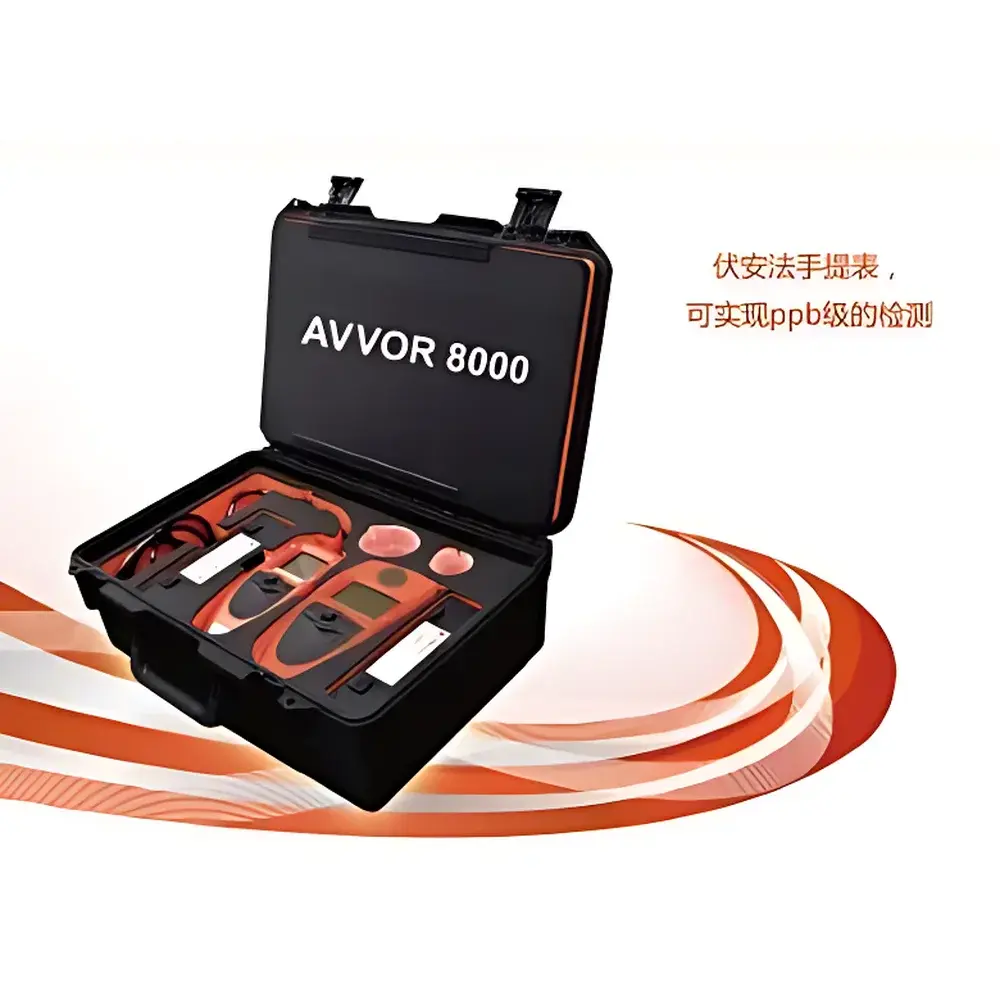
AVVOR 8000 HM-2 Portable Heavy Metals Analyzer
| Brand | AVVOR |
|---|---|
| Origin | Canada |
| Model | 8000 HM-2 |
| Instrument Type | Portable |
| Detection Principle | Anodic Stripping Voltammetry (ASV) |
| Target Analytes | Hg, Cd, Pb, Cu, Zn, Ni, Cr(VI), As, Mn, Fe, Al, B |
| Detection Time | ≤30 min per sample |
| Accuracy | ±0.5% of reading |
| Resolution | 0.5 ppb (for Hg) |
| IP Rating | IP68 |
| Power Options | Rechargeable Li-ion battery / AC adapter / 12 V DC (cigarette lighter socket) |
| Data Storage | Internal timestamped logging |
| Display | Backlit LCD with touch keypad |
| Connectivity | USB for PC data upload |
| Language Support | Multilingual (English, French, Spanish, German, Chinese) |
Overview
The AVVOR 8000 HM-2 Portable Heavy Metals Analyzer is an engineered field-deployable instrument designed for on-site quantification of twelve priority heavy metals in aqueous matrices—including drinking water, surface water, wastewater, and leachates. It employs dual complementary analytical modalities: anodic stripping voltammetry (ASV) for trace-level electrochemical detection (ppb range), and spectrophotometry for higher-concentration species (ppm range). This hybrid architecture eliminates the need for laboratory-based atomic absorption spectroscopy (AAS) or inductively coupled plasma mass spectrometry (ICP-MS) in routine surveillance, while maintaining metrological integrity aligned with EPA Method 7000B and ISO 11969 for ASV-based metal analysis. The system’s core measurement principle relies on controlled electrodeposition of target metal ions onto a mercury-film or bismuth-film working electrode, followed by oxidative stripping under precisely regulated potential sweeps. Resulting current peaks are linearly proportional to analyte concentration, enabling direct calibration against NIST-traceable standard solutions.
Key Features
- Dual handheld analyzer units—electrochemical and photometric—operating independently or synchronously to expand dynamic range from sub-ppb to ppm levels across all 12 target elements.
- IP68-rated immersion probe with integrated three-electrode ASV cell (working, reference, counter), built-in magnetic stirrer, and temperature sensor (±0.2 °C accuracy).
- Modular electrode architecture: push-fit disposable or reusable electrodes (Hg, Bi, Au, or carbon-based) with automatic electrode recognition; no manual polishing or conditioning required.
- Self-leveling sample cuvette system with pre-loaded buffer tablets—enabling standardized matrix adjustment without pipetting or volumetric glassware.
- Onboard data logger with time/date stamping, capable of storing >10,000 test records; exportable via USB in CSV or XML format compliant with LIMS integration protocols.
- Backlit graphical LCD with intuitive touch keypad and step-by-step visual guidance—designed for operators with minimal analytical training.
- Multi-power operation: 8-hour continuous runtime on rechargeable lithium-ion battery; optional AC mains or vehicle 12 V DC input for extended deployments.
Sample Compatibility & Compliance
The AVVOR 8000 HM-2 is validated for use with raw and filtered natural waters, treated effluents, groundwater, and industrial process streams (pH 4–9, turbidity <100 NTU, chloride <5,000 mg/L). Sample pretreatment is limited to filtration (0.45 µm) where particulates exceed regulatory thresholds—no acid digestion, dilution, or chelation is required for routine screening. The instrument complies with ASTM D3559 (lead), ASTM D3597 (cadmium), and ISO 8692 (zinc) for electrochemical water testing. All firmware and data handling routines support audit trails and electronic signatures in accordance with FDA 21 CFR Part 11 requirements when used in GLP/GMP-regulated environmental monitoring programs.
Software & Data Management
Data acquisition and reporting are managed through embedded firmware—not external PC software—ensuring operational independence in remote or low-connectivity environments. Each measurement includes metadata: operator ID, GPS coordinates (optional external module), ambient temperature, probe immersion depth, and electrode lot number. Exported datasets conform to ASTM E1447 and ISO/IEC 17025 data formatting standards. Optional desktop software (AVVOR DataLink v3.2) enables statistical trend analysis, method validation reports (LOD/LOQ, recovery, repeatability), and automated generation of EPA Form 3320-1-compliant certificates.
Applications
- Regulatory compliance monitoring for municipal water utilities under the U.S. Safe Drinking Water Act (SDWA) and EU Drinking Water Directive (2020/2184).
- Rapid site assessment during brownfield redevelopment, mining tailings inspections, or post-spill emergency response.
- Process control in electroplating, semiconductor manufacturing, and pharmaceutical wastewater treatment plants.
- Agricultural runoff surveillance for Cd and As accumulation in irrigation sources.
- Educational field labs and undergraduate environmental chemistry courses requiring hands-on electroanalytical instrumentation.
FAQ
What metals does the AVVOR 8000 HM-2 detect, and at what detection limits?
It quantifies Al, As, B, Cd, Cr(VI), Cu, Fe, Hg, Mn, Ni, Pb, and Zn. Typical ASV detection limits range from 0.05–0.5 ppb depending on element and matrix; spectrophotometric mode extends upper range to 5 ppm.
Is calibration traceable to national standards?
Yes—calibration solutions are certified to NIST SRM 3198 (multi-element aqueous standards) and include full uncertainty budgets per ISO/IEC 17025 Annex A.
Can the instrument be used in seawater or high-salinity samples?
With optional chloride compensation firmware update and Bi-film electrode configuration, it achieves reliable performance up to 35,000 mg/L Cl⁻.
Does it meet requirements for regulatory submission?
When operated under documented SOPs with calibrated electrodes and logged QC checks (blanks, spikes, duplicates), data are admissible for Tier 1 screening under EPA Region 10 Field Screening Guidance and Environment Canada’s National Guidelines for Metal Testing.
How often must electrodes be replaced?
Mercury-film electrodes are single-use per analysis sequence; bismuth-film and gold electrodes support ≥200 measurements with factory-certified performance retention.
Related Products







