
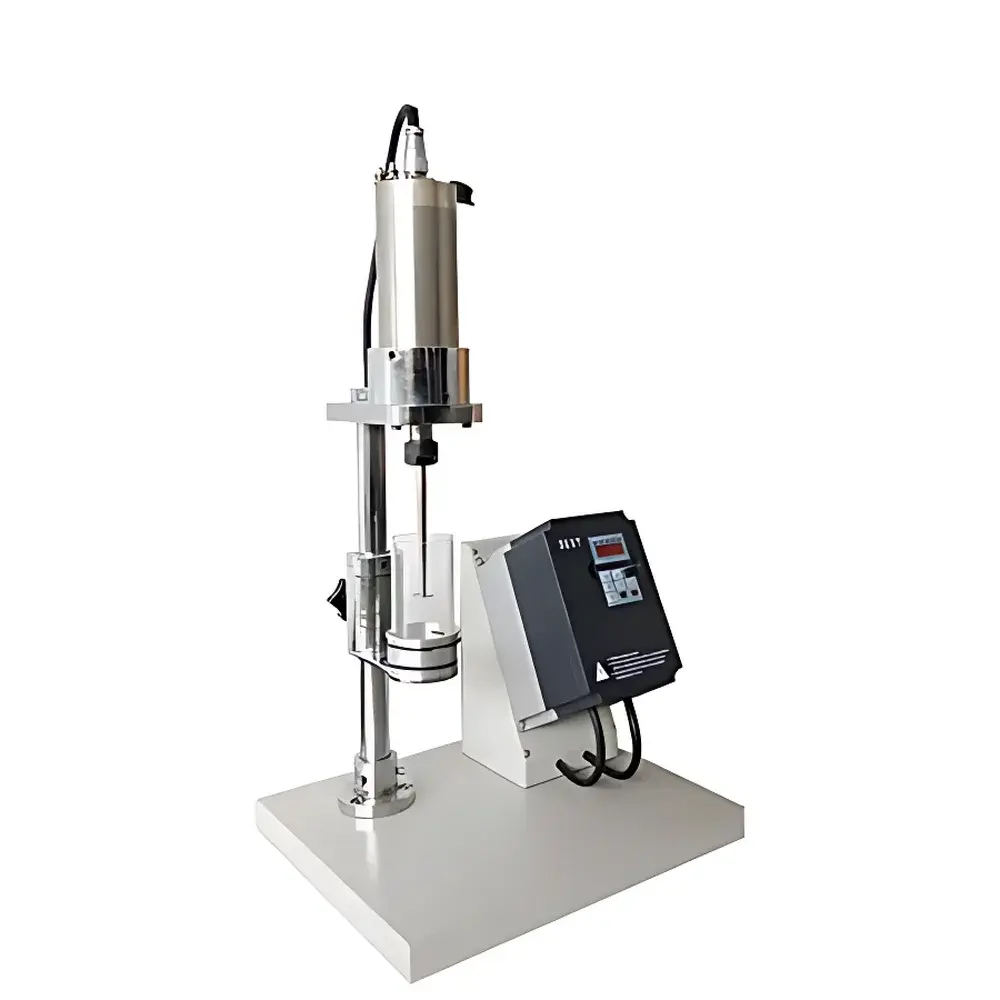
Product Name: Pinzhichuangsi XR-14-2 High-Speed Mechanical Stability Tester for Latex
| Key Parameters | Brand: Pinzhichuangsi |
|---|---|
| Origin | Beijing, China |
| Model | XR-14-2 |
| Speed Range | 2000–20,000 rpm |
| Nominal Test Speed | 14,000 ± 200 rpm |
| Speed Accuracy | ≤0.1% |
| Resolution | 1 rpm |
| Display | LED |
| Power Supply | 220 VAC, 50 Hz, 2000 VA |
| Dimensions (W×D×H) | 400 × 350 × 740 mm |
| Net Weight | ~30 kg |
| Operating Environment | 10–40 °C, <85% RH |
| Continuous Operation | ≥60 min |
| Stirring Disk (Natural Latex) | Ø20.83 ± 0.03 mm × 1.57 ± 0.05 mm |
| Stirring Disk (Synthetic Latex) | Ø36.12 ± 0.03 mm × 1.58 ± 0.05 mm |
| Sample Container | Height 130 ± 2 mm, ID 58 ± 2 mm |
| Compliance | ISO 35 |
Overview
The Pinzhichuangsi XR-14-2 High-Speed Mechanical Stability Tester is a precision-engineered instrument designed specifically for quantifying the mechanical stability of natural and synthetic latex dispersions under standardized high-shear conditions. It operates on the principle of controlled high-speed agitation—applying defined rotational shear stress to latex samples using calibrated stirring disks—thereby inducing destabilization mechanisms such as coagulation, flocculation, or phase separation. The time-to-coagulation (or viscosity breakpoint) under fixed rotational parameters serves as the primary stability metric, directly correlating with colloidal robustness and process suitability in downstream applications including dipped goods manufacturing, foam production, and adhesive formulation. Engineered for reproducibility and long-term operational integrity, the XR-14-2 adheres strictly to ISO 35:2017 (“Rubber — Natural rubber — Determination of mechanical stability of centrifuged field latex”), ensuring methodological consistency across laboratories and regulatory submissions.
Key Features
- Precision Variable-Frequency Drive System: Utilizes closed-loop negative feedback control architecture to maintain target rotational speed within ±200 rpm at 14,000 rpm, with real-time load compensation—critical for consistent shear history across variable sample viscosities.
- High-Torque, Dynamically Balanced Motor: Industrial-grade motor rated for continuous operation at up to 20,000 rpm; shaft runout ≤0.25 mm at nominal test speed, verified per ISO 1940-1 G2.5 balance grade.
- Interchangeable Stirring Disks: Two disk geometries supplied—optimized for natural latex (Ø20.83 ± 0.03 mm, t = 1.57 ± 0.05 mm) and synthetic latex (Ø36.12 ± 0.03 mm, t = 1.58 ± 0.05 mm)—ensuring compliance with ISO 35’s geometry-dependent shear profile requirements.
- ISO-Compliant Sample Holder Assembly: Rigid yet flexible mounting system with vertical cup positioning via fixed-height limit sleeve and upper locating block; eliminates operator-induced alignment variability and ensures repeatable gap distance between disk bottom and container base.
- Robust Mechanical Architecture: Low-center-of-gravity frame with reinforced steel chassis and vibration-damped base; designed to withstand prolonged high-RPM operation without structural creep or resonance amplification.
- Intuitive Local Interface: High-contrast LED display showing real-time RPM, elapsed test time, and system status—no external PC required for routine testing.
Sample Compatibility & Compliance
The XR-14-2 is validated for use with aqueous colloidal dispersions of natural rubber latex (NRL), styrene-butadiene rubber (SBR), nitrile rubber (NBR), and chloroprene (CR) lattices. Its mechanical configuration satisfies all physical and procedural specifications outlined in ISO 35, including disk dimensional tolerances, container geometry, rotational speed accuracy, and environmental operating limits (10–40 °C, <85% RH). While not inherently GLP/GMP-certified, the instrument’s design supports audit-ready workflows: stable speed output enables traceable shear rate application, and its fixed mechanical setup minimizes inter-operator variability—key prerequisites for data acceptance under ASTM D1076, ISO 2000:2014 (rubber testing standards), and internal QC protocols aligned with ICH Q5C stability guidelines for biopolymer-based materials.
Software & Data Management
The XR-14-2 operates as a standalone benchtop instrument with embedded firmware controlling motor dynamics, speed regulation, and display logic. It does not include proprietary software or network connectivity. However, its analog/digital signal outputs (optional upon request) are compatible with third-party data acquisition systems compliant with IEEE 11073 or Modbus RTU protocols—enabling integration into LIMS environments supporting 21 CFR Part 11-compliant electronic records. For laboratories requiring full audit trails, manual logbook entries synchronized with stopwatch-timed coagulation observations remain the standard practice, fully consistent with ISO/IEC 17025:2017 clause 7.7 on result reporting and record retention.
Applications
- Quality control of field latex and preserved concentrate batches prior to compounding or shipment.
- R&D evaluation of stabilizer efficacy (e.g., ammonia, sodium caseinate, surfactants) under accelerated shear stress.
- Batch-to-batch consistency verification for medical glove manufacturers subject to ASTM D3577 and ISO 10282.
- Stability benchmarking of bio-based synthetic lattices developed for sustainable coatings and adhesives.
- Root-cause analysis of premature coagulation in dipping tanks—correlating lab-scale mechanical stability with production-line failure modes.
FAQ
Does the XR-14-2 meet ISO 35:2017 requirements for mechanical stability testing?
Yes—the instrument fulfills all mandatory physical, geometric, and performance criteria specified in ISO 35:2017, including disk dimensions, container specifications, speed tolerance, and environmental operating range.
Can the same stirring disk be used for both natural and synthetic latex?
No—ISO 35 mandates distinct disk geometries to generate appropriate shear profiles for each latex type. The XR-14-2 ships with two certified disks, labeled and dimensionally verified per clause 6.2 of the standard.
Is calibration certification included with the instrument?
A factory-issued calibration report covering speed accuracy (±200 rpm at 14,000 rpm) and dimensional verification of disks and container is provided. Traceable recalibration services are available through authorized Pinzhichuangsi service centers.
What maintenance is required to ensure long-term speed accuracy?
Annual verification of motor balance, bearing wear, and encoder linearity is recommended. The variable-frequency drive firmware includes self-diagnostic routines accessible via service mode.
Can the instrument operate continuously for extended stability studies beyond 60 minutes?
The system is rated for ≥60 minutes at nominal speed. Extended runs beyond this duration require thermal monitoring of motor housing temperature and are not covered under warranty unless pre-approved by technical support.





