
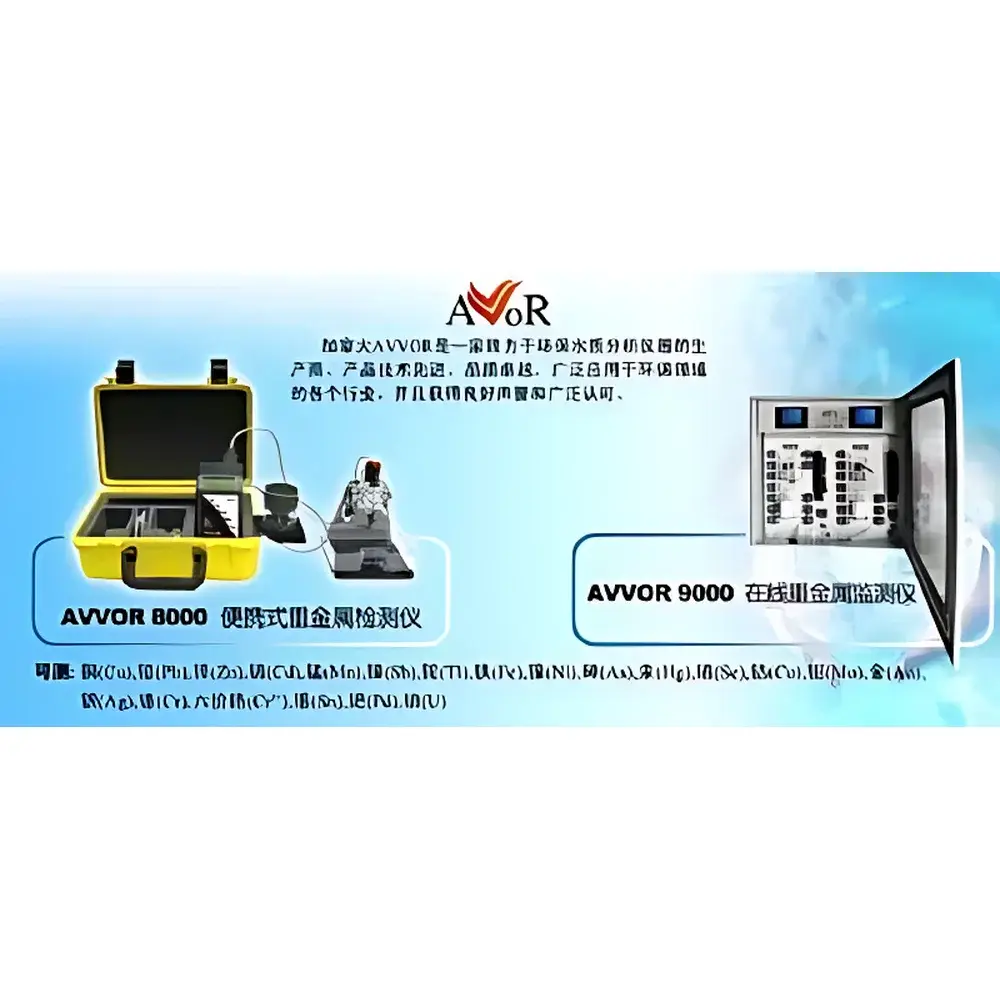
AVVOR 8000 & 9000 Heavy Metal Water Analyzers (Anodic Stripping Voltammetry-Based)
| Brand | AVVOR |
|---|---|
| Origin | Canada |
| Model | AVVOR 8000 (Portable) & AVVOR 9000 (Online) |
| Detection Principle | Anodic Stripping Voltammetry (ASV) |
| Compliance | US EPA Methods 7063, 7472, 1001 |
| Electrode Options | Gold, Mercury-film, Bismuth-film, Bare Carbon |
| Measurable Elements (8000) | Cu, Pb, Zn, Cd, Mn, Sb, Tl, Fe, Ni, As, Hg, Se, Co, Mo, Au, Ag, Cr, Pd, Sn |
| Measurable Elements (9000) | Cu, Pb, Zn, Cd, Mn, Sb, Sb³⁺, Tl, Fe, Ni, As, Hg, Se, Cr, Cr⁶⁺, Co, Mo, Au, Ag, Pd, U |
| Detection Limit | Sub-ppb (ng/L) range for most metals |
| Output Interfaces | Dual 4–20 mA analog outputs (9000), RS-232/RS-485, optional wireless telemetry |
| Software | PC-based control & data logging with audit trail, GLP-compliant reporting |
| Enclosure Rating | IP67 (8000), NEMA 4X / IP66 (9000) |
| Power | Rechargeable Li-ion battery (8000) |
Overview
The AVVOR 8000 and AVVOR 9000 Heavy Metal Water Analyzers are electrochemical instrumentation platforms engineered for trace-level quantification of dissolved heavy metal ions in aqueous matrices. Both systems implement anodic stripping voltammetry (ASV)—a well-established, standardized potentiostatic technique endorsed by the U.S. Environmental Protection Agency (EPA), ASTM International, DIN, ISO, and AOAC for regulatory compliance and environmental monitoring. ASV enables selective pre-concentration of target metal cations onto a working electrode surface under controlled potential, followed by oxidative stripping and current measurement—yielding high sensitivity (sub-part-per-trillion detection limits), multi-element capability, and minimal matrix interference. The AVVOR 8000 serves as a field-deployable, battery-powered analyzer for rapid on-site screening and laboratory validation, while the AVVOR 9000 is a modular, rack-mounted online analyzer designed for unattended, continuous monitoring in municipal water intakes, industrial effluent streams, wastewater treatment plants, and surface water networks. Neither instrument requires hazardous mercury vapor lamps, compressed gases, or complex optical alignment—reducing operational overhead and enhancing safety in regulated environments.
Key Features
- Sub-ppb (ng/L) detection sensitivity for 20+ regulated metals—including As, Cd, Cr⁶⁺, Cu, Hg, Pb, Zn, and U—validated per EPA Methods 7063 (As), 7472 (Hg), and 1001 (Pb)
- Modular electrode architecture: interchangeable gold, mercury-film, bismuth-film, and bare carbon working electrodes optimized for specific analytes and redox potentials
- AVVOR 8000: Fully portable design with IP67-rated housing, integrated touchscreen display, rechargeable lithium-ion battery (≥12 h runtime), and USB/Bluetooth connectivity
- AVVOR 9000: Dual-module configuration support (up to 10 simultaneous metals), automatic sample filtration, pH adjustment, and UV digestion modules (optional), with built-in calibration verification and drift compensation
- Robust signal processing: digital lock-in amplification, background subtraction, and peak deconvolution algorithms ensure reproducibility across variable conductivity and organic load conditions
- Comprehensive I/O: Eight programmable 4–20 mA analog outputs, dual RS-232/RS-485 ports, Modbus RTU/TCP support, and optional LoRaWAN or cellular telemetry for SCADA integration
Sample Compatibility & Compliance
The AVVOR analyzers accommodate raw and pretreated liquid samples including drinking water, groundwater, surface water, seawater, municipal wastewater, industrial process streams, and leachates. For solid-phase matrices (soil, sediment, food, or biological tissue), acid digestion or chelate-assisted extraction is required prior to analysis—protocols aligned with EPA SW-846 Method 3050B and ISO 11466. All measurement protocols comply with Good Laboratory Practice (GLP) and support 21 CFR Part 11–compliant electronic records when used with validated software. The AVVOR 9000’s automated calibration sequence includes standard addition and multi-point verification, generating timestamped audit trails with operator ID, reagent lot numbers, and environmental metadata. Both instruments meet NEMA 4X and IP66/IP67 ingress protection standards, enabling deployment in humid, dusty, or splash-prone locations without degradation in performance or data integrity.
Software & Data Management
AVVOR Control Suite is a Windows-based application supporting method development, real-time visualization, statistical trend analysis, and automated report generation. It provides full traceability: every measurement event logs electrode history, electrolyte batch ID, calibration curve parameters, and raw voltammogram files (.vlt). Data export formats include CSV, PDF, XML, and SQL-compatible tables compatible with LIMS and enterprise analytics platforms. The software enforces role-based access control (RBAC), electronic signatures, and configurable retention policies—meeting requirements for ISO/IEC 17025 accreditation and EPA-approved data submission workflows. Remote firmware updates and diagnostic telemetry are supported via secure HTTPS or TLS-enabled MQTT channels, ensuring long-term maintainability without on-site technician visits.
Applications
- Regulatory compliance monitoring for EPA Clean Water Act (CWA) and Safe Drinking Water Act (SDWA) parameters
- Early-warning detection at drinking water intakes for toxic metals such as lead, arsenic, and hexavalent chromium
- Industrial effluent monitoring in electroplating, mining, semiconductor fabrication, and pharmaceutical manufacturing
- Research applications in aquatic toxicology, biogeochemical cycling studies, and microplastic-associated metal leaching assays
- Field validation of passive samplers (e.g., DGT devices) and comparison against ICP-MS reference methods
- Soil and food safety screening following EPA Region 4 and EU Commission Regulation (EC) No 1881/2006 thresholds
FAQ
What regulatory methods does the AVVOR system validate against?
US EPA Methods 7063 (arsenic), 7472 (mercury), 1001 (lead), ASTM D3557-95 (cadmium), DIN 38406-16 (Zn, Cd, Pb, Cu, Tl, Ni, Co), ISO 6636-1 (zinc in produce), and Standard Methods 3130 (voltammetric metals analysis).
Can the AVVOR 9000 measure hexavalent chromium (Cr⁶⁺) independently from total chromium?
Yes—the AVVOR 9000 employs differential pulse ASV with selective electrode conditioning and pH-controlled speciation, enabling direct Cr⁶⁺ quantification without derivatization or separation columns.
Is method validation support available for laboratory accreditation?
Yes—AVVOR provides full validation packages including limit of detection (LOD), limit of quantitation (LOQ), precision/repeatability studies, spike recovery data, and inter-laboratory comparison reports aligned with ISO/IEC 17025 Clause 7.2.2.
How often does the system require recalibration during continuous operation?
The AVVOR 9000 performs automated zero/span checks every 2–4 hours and full multi-point calibration every 24–72 hours, configurable per site-specific QA/QC protocols.
Are consumables proprietary or third-party compatible?
Electrolytes and standard solutions follow ASTM-grade specifications; electrodes are replaceable OEM components with documented shelf life and performance certification—no vendor lock-in for calibration standards or supporting reagents.







