
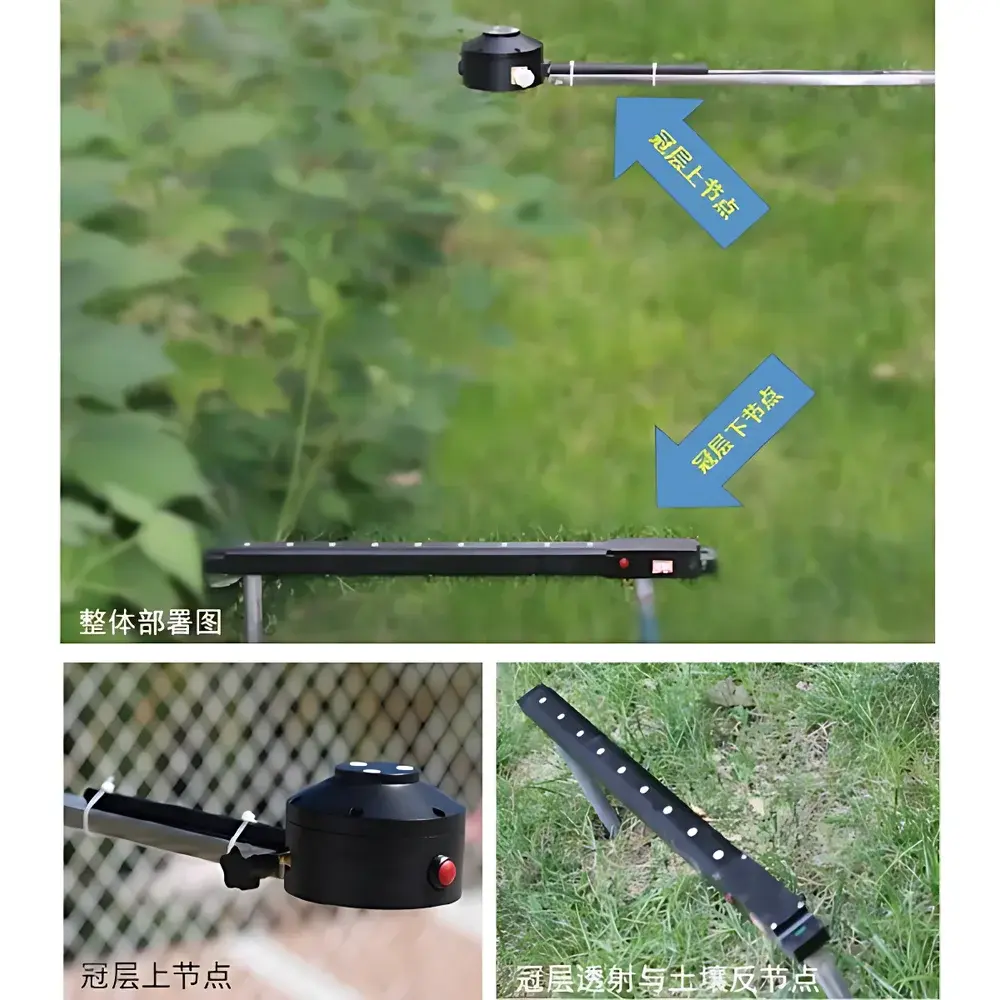
PARNet Photosynthetically Active Radiation (PAR) Monitoring System
| Origin | Beijing, China |
|---|---|
| Manufacturer Type | Authorized Distributor |
| Origin Category | Domestic (China-made) |
| Model | PARNet |
| Pricing | Available Upon Request |
Overview
The PARNet Photosynthetically Active Radiation (PAR) Monitoring System is an integrated field-deployable instrumentation platform engineered for high-temporal-resolution, multi-point measurement of the Fraction of Absorbed Photosynthetically Active Radiation (FAPAR). Operating within the 400–700 nm spectral band—the biologically active portion of solar radiation driving photosynthesis—PARNet implements a distributed sensor architecture grounded in calibrated quantum photometry. Unlike single-point PAR meters, PARNet captures spatial heterogeneity across vegetation canopies by synchronously acquiring irradiance data from up to nine discrete locations. Its core measurement principle relies on spectrally flat, cosine-corrected silicon photodiodes with digital signal conditioning, enabling accurate incident PAR quantification under variable solar zenith angles and diffuse/direct light conditions. Designed for long-term unattended operation in agro-ecological and remote sensing validation contexts, PARNet delivers traceable, time-stamped radiometric data aligned with FAO and CEOS protocols for ground-truthing satellite-derived FAPAR products.
Key Features
- Distributed multi-node architecture supporting simultaneous acquisition from up to 9 spatially separated FAPAR sensor units
- High-fidelity cosine response correction (±3% deviation up to 80° incidence angle), validated per ISO 9060:2018 Class C requirements
- Integrated wireless telemetry using LoRaWAN or NB-IoT modules, enabling low-power, wide-area transmission over distances exceeding 5 km in open terrain
- Onboard data logging with internal SD card storage (up to 32 GB) and real-time clock synchronization for temporal integrity
- Low-power consumption design (< 15 mW average in sleep mode), compatible with solar-rechargeable battery systems for multi-month deployments
- Modular hardware interface supporting firmware updates and sensor calibration coefficient injection via secure OTA protocol
Sample Compatibility & Compliance
PARNet is optimized for continuous monitoring above, within, and below natural and managed vegetation canopies—including croplands, grasslands, forests, and controlled-environment agriculture facilities. Sensor units are IP67-rated for outdoor exposure and operate reliably across −20 °C to +60 °C ambient temperatures. The system adheres to internationally recognized radiometric standards: spectral responsivity conforms to the CIE photopic luminosity function weighting curve (normalized to PAR quantum yield), while calibration traceability follows NIM (National Institute of Metrology, China) protocols. Data output formats comply with CF (Climate and Forecast) Metadata Conventions v1.8, facilitating ingestion into FAO WaPOR, NASA LP DAAC, and ESA Climate Change Initiative workflows. For regulatory alignment, PARNet supports audit-ready metadata tagging required under GLP-compliant field trials (OECD Series on Principles of Good Laboratory Practice).
Software & Data Management
The PARNet Control & Acquisition Software (v3.2+) provides cross-platform (Windows/macOS/Linux) configuration, real-time visualization, and batch processing of time-series PAR and derived FAPAR datasets. It includes built-in algorithms for calculating instantaneous and daily-integrated FAPAR using concurrent downward-upward irradiance pairs and user-defined leaf area index (LAI) inputs. All raw and processed data are stored in NetCDF-4 format with embedded CF-compliant attributes, including sensor serial numbers, calibration dates, GPS coordinates, and environmental context tags. The software enforces role-based access control and maintains full audit trails per FDA 21 CFR Part 11 requirements when deployed in regulated agricultural research environments. Export options include CSV, JSON, and direct API integration with cloud platforms such as AWS IoT Core and Google Cloud IoT Core.
Applications
- Ground validation of satellite-based FAPAR products (e.g., MODIS, Sentinel-3 OLCI, PROBA-V) for uncertainty quantification and algorithm refinement
- Long-term phenological monitoring of canopy development, senescence, and stress responses in climate change impact studies
- Calibration and scaling of ecosystem process models (e.g., BEPS, GLOPEM, LPJ-GUESS) requiring spatially explicit PAR absorption estimates
- Optimization of precision irrigation and fertilization strategies through real-time canopy light-use efficiency (LUE) diagnostics
- Supporting FAO’s Hand-in-Hand Initiative and UN SDG Indicator 15.3.1 (Land Degradation Neutrality) via standardized biophysical parameter reporting
FAQ
What spectral range does PARNet measure, and how is spectral fidelity ensured?
PARNet measures photon flux density (μmol·m⁻²·s⁻¹) across 400–700 nm using silicon photodiodes with optical bandpass filters and factory-applied quantum efficiency correction curves.
How does PARNet differentiate between incident and absorbed PAR for FAPAR calculation?
FAPAR is computed from paired measurements: downward PAR above canopy and upward PAR reflected beneath canopy, combined with optional LAI input; no assumptions about leaf optical properties are required.
Is PARNet compliant with international remote sensing validation frameworks?
Yes—PARNet deployment protocols align with CEOS/LPV (Land Product Validation) guidelines and are referenced in the GEOGLAM Crop Monitor methodology documentation.
Can PARNet data be integrated with third-party modeling tools like RHESSys or APSIM?
Yes—via NetCDF export with CF metadata, enabling direct ingestion into R (ncdf4), Python (xarray/netCDF4), and MATLAB (netcdf) scientific computing environments.
What is the typical calibration interval recommended for field-deployed PARNet sensors?
Annual recalibration against a NIM-traceable reference quantum sensor is recommended; onboard stability monitoring logs drift trends to support extended calibration intervals where justified by QA/QC records.




