
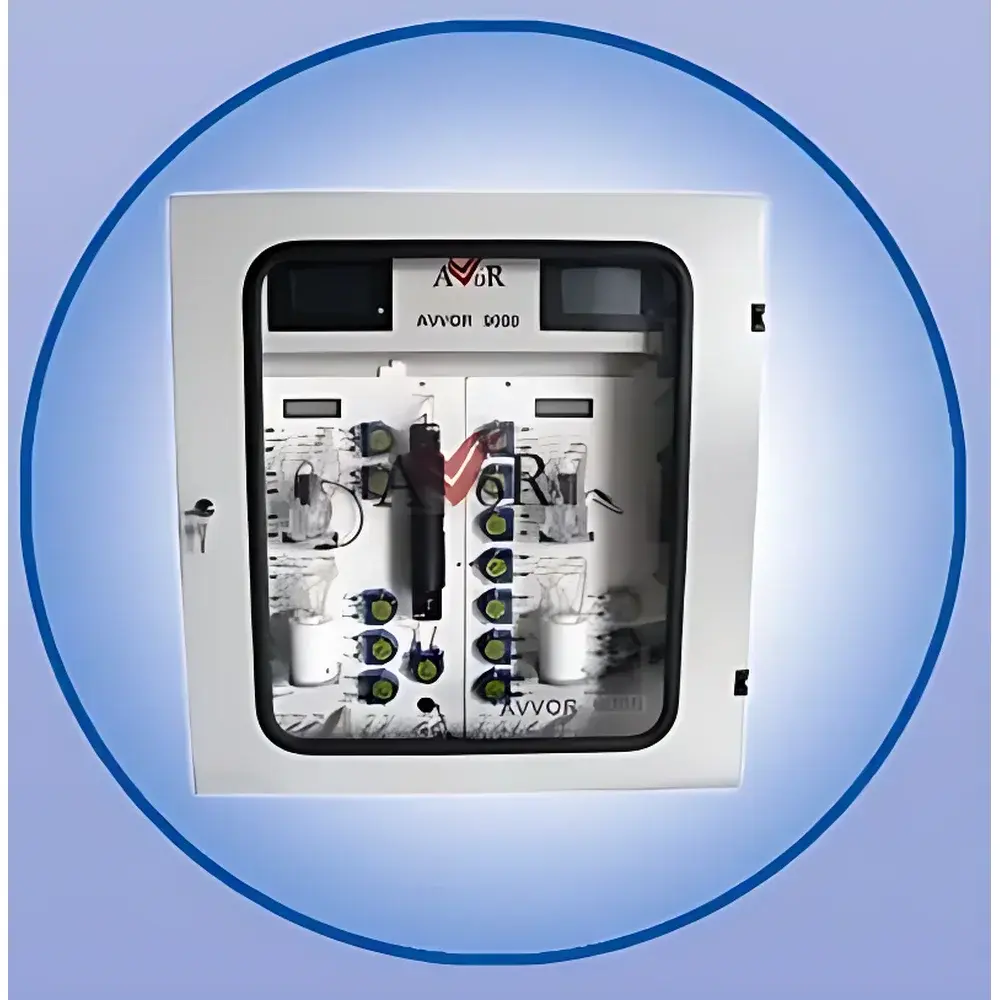
AVVOR 9000 Online Heavy Metal Analyzer
| Brand | AVVOR |
|---|---|
| Origin | Canada |
| Model | AVVOR 9000 |
| Measurement Principle | Anodic Stripping Voltammetry (ASV) |
| Detectable Elements | Cu, Pb, Zn, Cd, Mn, Sb, Tl, Fe, Ni, As, Hg, Se, Co, Mo, Au, Ag, Cr, Cr(VI), Sn, Pd, U |
| Electrode Options | Gold, Mercury-Film, Bismuth-Film, Bare Carbon |
| Max. Simultaneous Channels | 2 modules × 5 elements each |
| Output Interfaces | 8 × 4–20 mA analog outputs, RS-485, RS-232 |
| Compliance | Designed for EPA Method 200.8, ISO 11969, and ASTM D3559/D3590 compatibility |
| Environmental Rating | IP65 enclosure with humidity-resistant internal architecture |
| Calibration | Automated on-board standard addition and multi-point calibration routines |
Overview
The AVVOR 9000 Online Heavy Metal Analyzer is an industrial-grade electrochemical instrument engineered for continuous, real-time quantification of trace heavy metal ions in aqueous matrices. It operates on the internationally standardized principle of Anodic Stripping Voltammetry (ASV), a highly sensitive potentiometric technique widely accepted by regulatory agencies including the U.S. EPA (Method 200.8), ISO (ISO 11969), and ASTM (D3559, D3590). In ASV, target metal ions are first pre-concentrated onto a working electrode surface via controlled cathodic deposition under optimized electrolyte and potential conditions. Following a defined equilibration period, a linear or staircase anodic potential sweep is applied, causing oxidative dissolution of the deposited metals. The resulting current peaks—each uniquely associated with a specific redox potential—are analyzed to determine elemental identity and concentration with sub-ppb detection capability. This method delivers high selectivity in complex environmental samples, minimizing interferences from organic matter, suspended solids, and competing ions when coupled with integrated sample pretreatment (e.g., UV digestion, filtration, pH stabilization).
Key Features
- Modular dual-channel architecture: Supports up to two independent ASV measurement modules, enabling concurrent monitoring of up to ten distinct heavy metals across different electrochemical windows.
- Electrode flexibility: Interchangeable working electrodes—including gold, mercury-film, bismuth-film, and bare carbon—allow optimization for specific analytes (e.g., Hg/As/Se on gold; Zn/Cd/Pb/Cu on mercury-film; Cr(VI)/Ni/Co on carbon).
- Automated operational integrity: Built-in self-diagnostic routines monitor electrode health, reagent consumption, flow integrity, and temperature stability; triggers audible/visual alarms and log entries upon deviation from set thresholds.
- Robust signal interfacing: Eight configurable 4–20 mA analog outputs support direct integration with SCADA, DCS, or PLC systems; RS-485 (Modbus RTU) and RS-232 interfaces enable bidirectional data exchange and remote firmware updates.
- Environmental resilience: IP65-rated sealed enclosure with internal desiccant management and condensation-resistant PCB layout ensures reliable operation in outdoor wastewater outfalls, industrial effluent channels, and remote monitoring stations.
- Regulatory-ready data handling: Timestamped measurement records include raw voltammograms, peak identification metadata, calibration history, and system status flags—structured for auditability under GLP/GMP and EPA-compliant data retention protocols.
Sample Compatibility & Compliance
The AVVOR 9000 is validated for use with raw and treated water streams including municipal wastewater effluents, industrial process discharges, surface water (rivers, lakes), groundwater, drinking water sources, and seawater (with salinity compensation). Integrated sample conditioning—comprising particulate filtration (5 µm), UV/persulfate oxidation for organic matrix degradation, and programmable pH adjustment—ensures consistent electrochemical response across variable sample matrices. Instrument performance meets the precision and accuracy requirements outlined in EPA Method 200.8 for laboratory validation and field-deployed ASV systems. While not certified as a Class I medical device or FDA 21 CFR Part 11–compliant system out-of-the-box, its data logging architecture supports configuration for Part 11–aligned audit trails when deployed within validated laboratory information management systems (LIMS).
Software & Data Management
The embedded firmware provides intuitive web-based configuration via Ethernet or optional Wi-Fi module. Users define measurement sequences, electrode selection per channel, deposition time, scan rate, and calibration frequency through a secure HTTPS interface. All voltammetric scans are stored locally on industrial-grade microSD card (up to 32 GB) with automatic rollover and timestamped compression. Export formats include CSV (for Excel/Python analysis), PDF reports (with embedded peak plots), and XML (for LIMS ingestion). Optional cloud synchronization enables centralized fleet monitoring, predictive maintenance alerts based on electrode wear metrics, and over-the-air security patches compliant with IEC 62443-3-3 cybersecurity standards.
Applications
- Real-time compliance monitoring at NPDES discharge points and industrial pretreatment facilities.
- Early-warning detection of heavy metal leaching in landfill leachate collection systems.
- Process control in electroplating, mining tailings management, and battery recycling operations.
- Drinking water safety surveillance at intake points and distribution network nodes.
- Research-grade speciation studies (e.g., Cr(III) vs. Cr(VI)) when paired with selective electrode chemistries and post-acquisition deconvolution algorithms.
- Marine environmental monitoring programs requiring low-detection-limit trace metal profiling in estuarine and coastal zones.
FAQ
What sample pretreatment is required prior to analysis?
Minimal pretreatment is needed for clear, low-turbidity samples. For wastewater or surface water, integrated 5 µm filtration and UV/persulfate oxidation are recommended to remove organics and colloidal interference.
Can the AVVOR 9000 measure hexavalent chromium (Cr(VI)) independently from total chromium?
Yes—using a bare carbon working electrode and optimized deposition potential, Cr(VI) is selectively reduced and stripped without interference from Cr(III); total Cr requires separate acid digestion and reduction step.
How often does the system require recalibration?
Factory-recommended interval is every 72 hours for critical applications; automated standard addition calibration can be scheduled daily or triggered by drift detection algorithms.
Is remote diagnostics supported?
Yes—via embedded Modbus TCP or optional cellular gateway, enabling real-time access to voltage logs, electrode impedance spectra, and flow sensor diagnostics.
Does the instrument comply with ISO/IEC 17025 requirements for accredited testing laboratories?
While the analyzer itself is not accredited, its documented measurement uncertainty, traceable calibration standards (NIST-traceable CRM solutions), and full audit trail functionality support ISO/IEC 17025 method validation when implemented within an accredited lab’s quality system.
Related Products







