
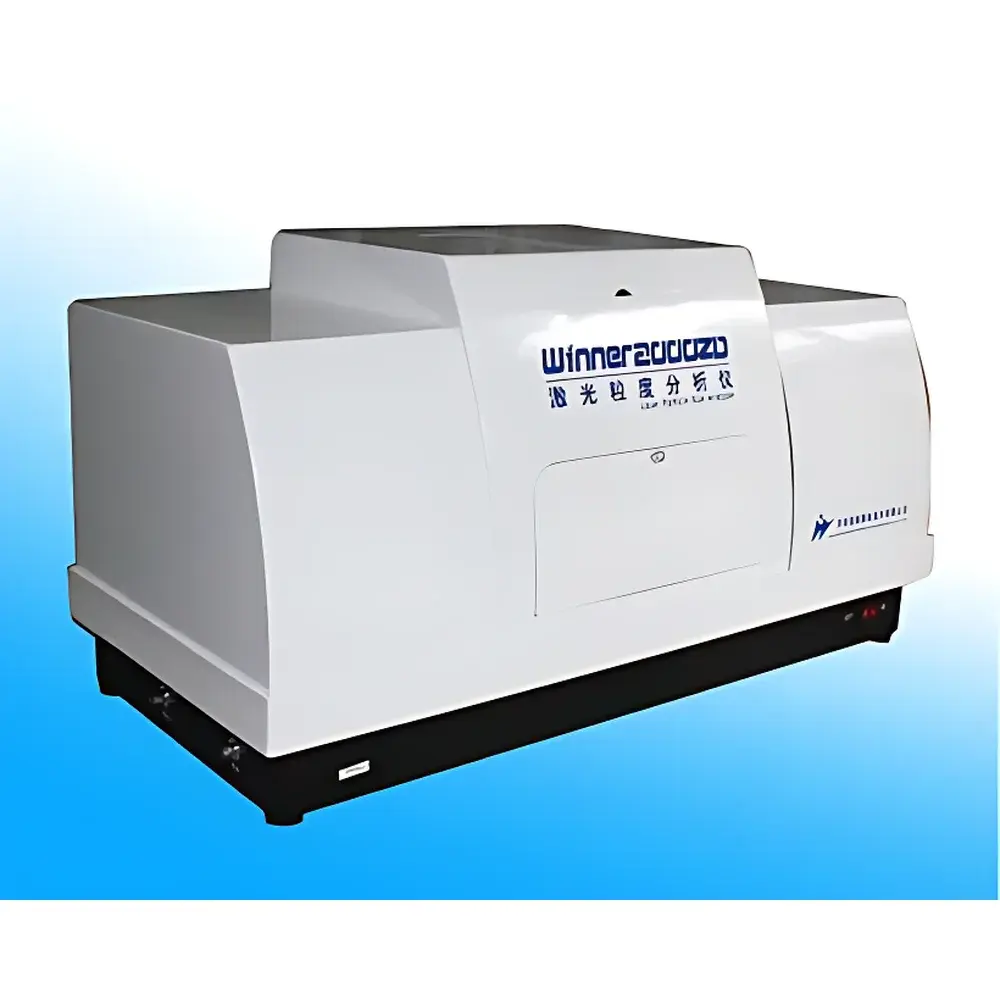
English Product Name
| Brand | Jinan Winner |
|---|---|
| Origin | Shandong, China |
| Manufacturer Type | Direct Manufacturer |
| Model | Winner2000ZDE |
| Dispersion Method | Wet Dispersion |
| Measurement Range | 0.1–300 µm |
| Repeatability | <0.5% (D50 of NIST-traceable standard reference material) |
| Measurement Time | <2 min per run |
| Laser Source | He-Ne, λ = 632.8 nm, output power >2 mW, lifetime >25,000 h |
| Detector Channels | 39 |
| Standards Compliance | ISO 13320:2020, GB/T 19077–2016, Q/0100JWN001–2013 |
| Ultrasonic Dispersion | 40 kHz, 35 W, adjustable duration ≥1 s |
| Stirring Speed | 0–3000 rpm (continuously adjustable) |
| Circulation Flow Rate | 8 L/min |
| Sample Cell Volume | 350 mL |
| Dimensions | 860 × 360 × 440 mm |
| Weight | 40 kg |
Overview
The Winner2000ZDE is a fully automated laser diffraction particle size analyzer engineered for high-precision, high-reproducibility measurement of dry or wet-dispersed particulate systems across a broad dynamic range (0.1–300 µm). It operates on Mie scattering theory, with optical design based on patented convergent beam Fourier transform optics — a configuration that eliminates aperture limitations on large-angle scattered light and minimizes focal length to enhance resolution, particularly in the submicron region. Unlike conventional parallel-beam systems, this architecture improves signal-to-noise ratio and angular detection fidelity, enabling robust quantification of polydisperse samples without manual range switching. The instrument integrates an internalized wet dispersion module, eliminating external tubing and associated sedimentation artifacts, and supports standardized compliance with ISO 13320:2020 (Laser diffraction methods for particle size analysis), GB/T 19077–2016 (Chinese national standard equivalent), and relevant sections of ASTM E799 and USP . Its core function is to deliver traceable, method-robust particle size distribution (PSD) data for quality control, formulation development, and fundamental materials research.
Key Features
- Fully automated optical alignment system using a four-phase hybrid stepper motor, achieving micron-level positional repeatability and real-time beam centering correction — eliminating operator-dependent alignment drift and ensuring long-term optical stability.
- Integrated wet dispersion unit with synchronized ultrasonication (40 kHz, 35 W), variable-speed mechanical stirring (0–3000 rpm), and closed-loop circulation (8 L/min flow rate), all housed within the main chassis to prevent particle settling, agglomeration, or flow-induced segregation.
- 39-channel high-sensitivity photodiode array detector optimized for angular resolution across forward and side-scatter regions, supporting accurate deconvolution of complex, multimodal distributions.
- Proprietary non-negative, unconstrained inverse algorithm for PSD reconstruction — avoids bias introduced by pre-assumed distribution models (e.g., log-normal or Rosin-Rammler), delivering empirically grounded size distributions essential for R&D and regulatory submissions.
- Intelligent test sequence automation: one-click initiation triggers programmable sample introduction, dispersion optimization, measurement acquisition, and auto-cleaning — reducing operator intervention and minimizing inter-run variability.
- Modular software interface supporting dual operational modes: manual mode for method development and troubleshooting; automatic mode for routine QC testing — both governed by identical underlying calibration and data processing logic.
Sample Compatibility & Compliance
The Winner2000ZDE accommodates a wide spectrum of industrial and research-grade particulates, including but not limited to cement clinker, ceramic powders, pharmaceutical actives and excipients, pigment dispersions, catalysts, coal-water slurries, mineral fillers (e.g., calcium carbonate, kaolin), metal and non-metallic powders, biological particles (cells, spores), and food-grade additives. All measurements adhere to ISO 13320:2020 requirements for instrument validation, including linearity verification, sensitivity assessment, and repeatability evaluation using certified reference materials (e.g., NIST SRM 1963 or equivalent). The system supports GLP-compliant workflows through audit-trail-enabled software logging, user-access controls, and electronic signature readiness — aligning with FDA 21 CFR Part 11 principles where configured with appropriate IT infrastructure. Regulatory documentation packages (IQ/OQ/PQ templates, calibration records, uncertainty budgets) are available upon request.
Software & Data Management
The embedded analysis software provides comprehensive post-acquisition capabilities compliant with scientific and industrial reporting standards. It supports multiple distribution models — free-form inversion, Rosin-Rammler, log-normal, and sieve-based grading — with optional volume-weighted, number-weighted, or surface-area-weighted statistical outputs. Comparative analysis tools enable overlay and statistical evaluation of up to 32 datasets, facilitating batch-to-batch consistency checks, process change impact assessment, and stability monitoring. Customizable reporting exports include editable Word and Excel formats, publication-ready BMP images, and plain-text ASCII files compatible with LIMS integration. Language localization includes English and Chinese interfaces, with API support for third-party language packs. Raw scatter intensity data (I(θ)) and intermediate matrix solutions are accessible for advanced modeling or external validation. All software modules undergo annual version-controlled release cycles with documented change logs and backward-compatible data file handling.
Applications
This analyzer serves critical roles across regulated and non-regulated environments: in pharmaceutical manufacturing, it verifies granule homogeneity prior to tableting and monitors nanoparticle drug carrier size stability; in cement and ceramics R&D, it correlates fineness with hydration kinetics and sintering behavior; in coatings and ink development, it ensures pigment dispersion integrity affecting gloss, opacity, and rheology; in environmental labs, it characterizes airborne particulate matter (PM₁₀, PM₂.₅ analogs) and sediment suspensions; and in academic materials science, its unconstrained inversion capability enables validation of novel synthesis protocols against theoretical nucleation-growth models. Its <2-minute cycle time and low sample consumption (<10 mL with optional micro-cell) further support high-throughput screening and precious-sample applications.
FAQ
What standards does the Winner2000ZDE comply with?
It meets ISO 13320:2020, GB/T 19077–2016, and Q/0100JWN001–2013. Optional documentation supports ASTM E799, USP , and EU Pharmacopoeia 2.9.32 compliance verification.
Can the instrument measure nanoparticles below 0.1 µm?
No — the validated lower limit is 0.1 µm under standard wet dispersion conditions. Sub-100 nm analysis requires complementary techniques such as DLS or TEM.
Is the software compliant with FDA 21 CFR Part 11?
Yes — when deployed on validated Windows OS platforms with domain authentication, electronic signatures, and audit-trail logging enabled, it satisfies core Part 11 requirements for electronic records and signatures.
Does the system support external LIMS integration?
Yes — via CSV/Excel export, ODBC connectivity, and configurable RESTful API endpoints for bidirectional data exchange with laboratory information management systems.
How is instrument calibration maintained?
Calibration uses NIST-traceable polystyrene latex standards (e.g., 10 µm and 100 µm). The software includes guided calibration routines, drift monitoring, and automatic warning prompts when deviation exceeds ±0.3% D50 tolerance.



