
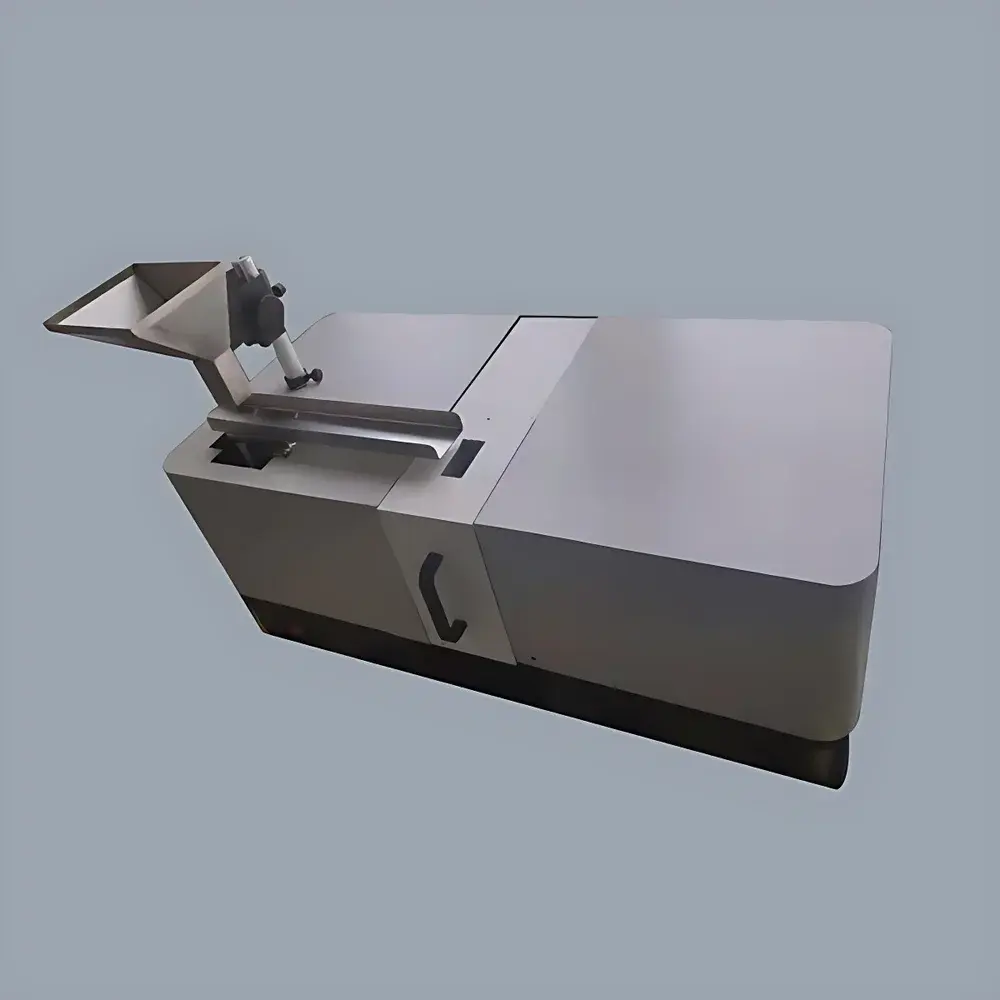
Winner300D Pro Image-Based Particle Size and Shape Analyzer by Jinan Winner
| Brand | Jinan Winner |
|---|---|
| Origin | Shandong, China |
| Manufacturer Type | Direct Manufacturer |
| Country of Origin | China |
| Model | Winner300D Pro |
| Price Range | USD 1,400 – 42,000 (FOB) |
| Application Sector | Petrochemical Industry |
| Instrument Type | Dynamic Imaging Analyzer |
| Number of Lenses | 4 (including 0.3× and 1× telecentric objectives) |
| Measurement Range | 10–10,000 µm |
| Dispersion Method | Air Jet Dispersion + Free-Fall Feeding + Ultrasonic Separation |
| Image Resolution | 3000 × 2000 pixels |
| Measured Morphological Parameters | Sphericity, Circularity, Roundness, Aspect Ratio |
| Accuracy Error | <3% |
| Repeatability Error | <3% |
| Particle Analysis Throughput | >1,000,000 particles/min |
| CCD Sensor | 1/1.8-inch format, 39 fps |
| Illumination | High-Brightness LED Parallel Planar Light Source |
| Feeding Mechanism | Electromagnetic Vibratory Feeder with Digital Speed Control |
Overview
The Winner300D Pro is a high-throughput, dynamic image-based particle size and shape analyzer engineered for precision characterization of dry particulate materials across an exceptionally broad size range—from fine dusts (≥10 µm) to coarse granules (up to 10,000 µm). Unlike static microscopy or laser diffraction systems, the Winner300D Pro employs real-time digital imaging under controlled illumination to capture morphologically resolved particle silhouettes during transit through the optical field. Its dual dispersion architecture—integrating compressed-air jet dispersion for sub-75 µm fines and gravity-driven free-fall feeding for larger particles—ensures representative sampling without agglomeration bias or sedimentation artifacts. The system leverages telecentric optics and parallel planar LED illumination to minimize perspective distortion and shadowing, enabling traceable, metrologically sound 2D projection measurements compliant with ISO 9276-6 (representation of particle shape and morphology) and ASTM E2457 (standard practice for measuring particle shape using digital imaging).
Key Features
- Dual-mode dispersion: Air-jet dispersion for fine powders (<75 µm) and vibration-controlled free-fall feeding for coarse particles (>75 µm), ensuring optimal separation and minimal attrition.
- Multi-lens optical module: Includes 0.3× and 1× high-resolution telecentric lenses, enabling seamless magnification switching without refocusing—critical for multi-scale analysis within a single run.
- Ultrasonic separation auxiliary: Integrated ultrasonic module de-agglomerates fine fractions and facilitates stratified sampling of bimodal distributions prior to imaging.
- Real-time imaging engine: 1/1.8-inch CMOS sensor operating at 39 frames per second with native 3000 × 2000 pixel resolution delivers >1 million particle measurements per minute with sub-pixel edge detection.
- Automated image processing suite: 12 dedicated algorithms—including adaptive thresholding, watershed-based de-clustering, boundary completion, hollow-region filling, and edge smoothing—ensure robust segmentation across heterogeneous samples.
- Digital vibratory feeder: Electromagnetically driven, speed-adjustable feed mechanism ensures consistent mass flow rate and reproducible particle presentation across repeated analyses.
Sample Compatibility & Compliance
The Winner300D Pro is validated for dry, non-cohesive, and moderately cohesive powders used in petrochemical catalysis, mineral processing, pharmaceutical excipients, and ceramic raw materials. It supports compliance with GLP and GMP workflows via audit-trail-enabled software logging (user actions, parameter changes, calibration events). All morphological descriptors—including sphericity (S = π1/2·A1/2/P), circularity (C = 4πA/P²), roundness (R = rmax/rmin), and aspect ratio (AR = L/W)—are computed following ISO 9276-6 definitions. The system’s measurement uncertainty (<3% accuracy and repeatability) meets the performance criteria outlined in USP <429> for particle characterization in solid dosage forms and aligns with ASTM D7803 for industrial catalyst particle evaluation.
Software & Data Management
The proprietary WinPA software implements a task-centric workflow architecture supporting full traceability from acquisition to reporting. Key capabilities include: real-time video and still-image capture with time-stamped metadata; on-the-fly scale calibration using certified stage micrometers; parametric measurement tools (length, perimeter, polygonal ROI, angular orientation); batch image processing with memory-efficient streaming—enabling analysis of unlimited image sets without RAM constraints. Data export supports CSV, Excel, and XML formats compatible with LIMS integration. Report templates are fully customizable: users define output parameters (e.g., number-weighted vs. volume-weighted distributions), statistical diameters (Xnl, Xsv, Xlv), and graphical representations (histograms, scatter plots, contour maps). All reports embed original annotated images with embedded scale bars and measurement overlays—suitable for regulatory submissions and peer-reviewed publication.
Applications
- Petrochemical catalyst grading: Quantifying attrition resistance via sphericity and surface roughness metrics correlated with fluidized-bed reactor performance.
- Mineral beneficiation: Classifying crushed ore particles by aspect ratio and roundness to predict grinding energy requirements and flotation response.
- Pharmaceutical powder flowability assessment: Correlating circularity and convexity indices with Hausner ratio and Carr index for QC release testing.
- Ceramic green-body uniformity: Detecting agglomerates and irregular fragments in spray-dried zirconia or alumina powders prior to sintering.
- Recycled aggregate quality control: Differentiating natural gravel morphology from crushed concrete debris using multi-parameter clustering (AR + roundness + convexity).
FAQ
What dispersion methods does the Winner300D Pro support?
It combines compressed-air jet dispersion (for fine particles ≤75 µm), gravity-fed free-fall feeding (for coarse particles ≥75 µm), and optional ultrasonic pre-treatment for de-agglomeration.
Can the system comply with FDA 21 CFR Part 11 requirements?
Yes—the WinPA software supports user authentication, electronic signatures, and full audit trails for all analytical steps, meeting core Part 11 criteria for regulated environments.
Is calibration traceable to NIST standards?
Scale calibration uses NIST-traceable stage micrometers; optical alignment and resolution verification follow ISO 10110-5 procedures.
How is particle adhesion addressed during imaging?
The air-jet dispersion velocity is adjustable (0.5–4 bar), and the ultrasonic module operates at 40 kHz to disrupt weak van der Waals bonds prior to feeding.
Does the software support automated report generation for ISO/ASTM-compliant documentation?
Yes—predefined templates cover ISO 9276-2 (size distribution), ISO 9276-6 (shape), and ASTM E2457 (morphology), with editable headers, footers, and institutional branding.



