
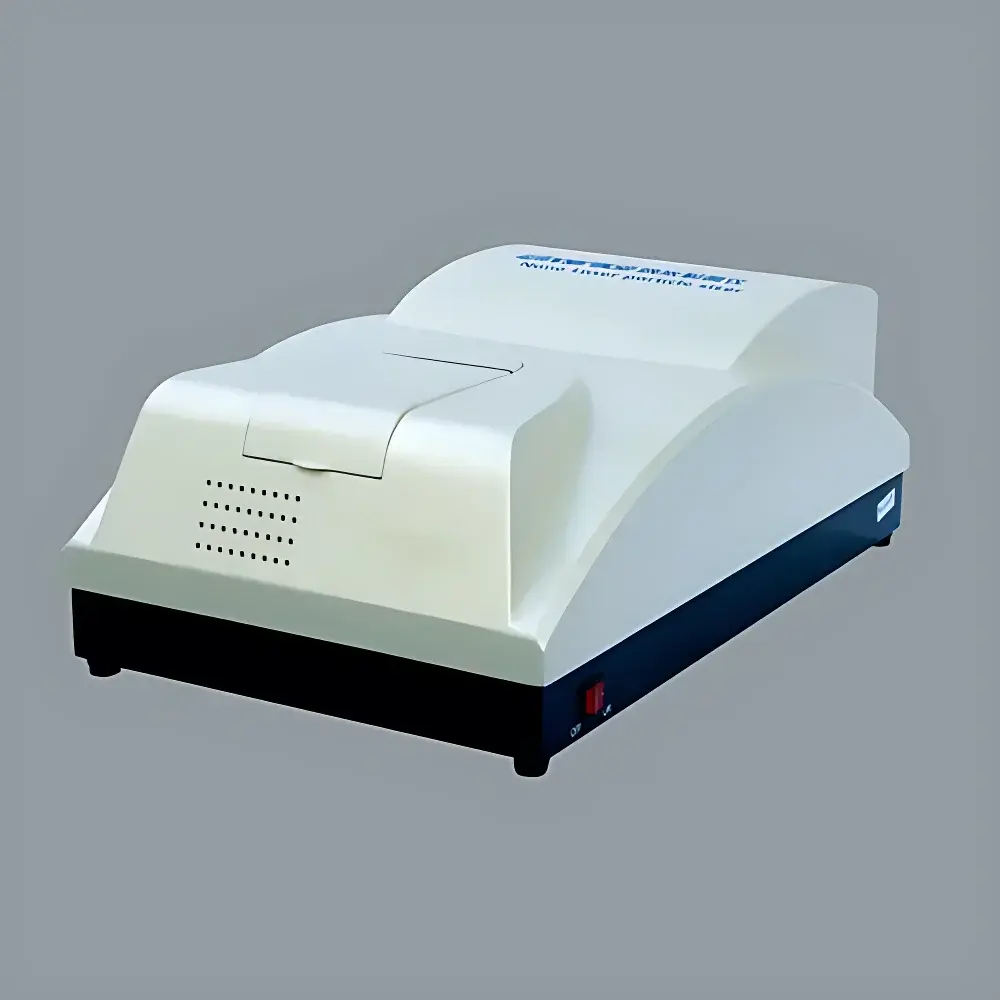
Jinan Winner Winner802 Photon Correlation Nanoparticle Size Analyzer
| Brand | Jinan Winner |
|---|---|
| Origin | Shandong, China |
| Manufacturer Type | Direct Manufacturer |
| Model | 802 |
| Price Range | USD 14,000–28,000 (FOB) |
| Particle Size Range | 1–10,000 nm |
| Repeatability | ≤1% (D50 of NIST-traceable standard reference material) |
| Temperature Control Range | 5–90 °C |
| Temperature Stability | ±0.1 °C |
| Light Scattering Angle | 90° |
| Detection Method | Dynamic Light Scattering (DLS) |
| Sample Volume | 1–4 mL |
| Sample Concentration Range | 0.1–100 mg/L |
| Laser Source | Adjustable-power 532 nm semiconductor laser (1–40 mW) |
| Detector | Hamamatsu photomultiplier tube (PMT) |
| Correlator | CR256 digital autocorrelator (256 channels, 100 ns–10 ms delay resolution) |
| Measurement Time | <5 minutes per run |
| Compliance | GB/T 19627–2005, GB/T 29022–2012, ISO 13321:1996, ISO 22412:2008 |
Overview
The Jinan Winner Winner802 Photon Correlation Nanoparticle Size Analyzer is a precision instrument engineered for high-resolution particle sizing in the nanoscale regime (1–10,000 nm). It operates on the physical principle of Dynamic Light Scattering (DLS), also known as photon correlation spectroscopy (PCS), which quantifies the Brownian motion of colloidal particles suspended in liquid media. As particles undergo thermal diffusion, scattered light intensity fluctuates temporally; these fluctuations are captured by a high-sensitivity Hamamatsu photomultiplier tube and processed via the proprietary CR256 digital autocorrelator. The resulting intensity autocorrelation function is fitted using cumulant analysis and converted to hydrodynamic diameter via the Stokes–Einstein equation—enabling accurate, model-independent determination of mean particle size (Z-average), polydispersity index (PdI), and size distribution profiles. Designed for research-grade reproducibility and regulatory-compliant operation, the Winner802 meets international standards including ISO 22412:2008 and GB/T 29022–2012, making it suitable for QC laboratories, materials R&D centers, and pharmaceutical formulation development where traceable, repeatable nanoscale characterization is required.
Key Features
- High-fidelity DLS detection enabled by a thermoelectrically stabilized 532 nm semiconductor laser (adjustable output: 1–40 mW) and ultra-low-noise Hamamatsu PMT detector
- CR256 digital autocorrelator with 256 correlation channels, 100 ns–10 ms programmable delay resolution, and real-time data acquisition at up to 10 kHz sampling rate
- Integrated Peltier-based temperature control system delivering ±0.1 °C stability across 5–90 °C—critical for minimizing viscosity-induced bias in diffusion coefficient calculation
- Fiber-optic light path architecture ensuring mechanical robustness, reduced alignment drift, and immunity to ambient vibration and stray light interference
- Standard 90° scattering geometry optimized for aqueous and low-viscosity organic dispersions, with compatibility for disposable or reusable quartz cuvettes (10 × 10 × 40 mm, 1–4 mL volume)
- Automated measurement sequence with <5-minute turnaround time per sample, supporting batch processing and unattended operation
Sample Compatibility & Compliance
The Winner802 is validated for use with a broad spectrum of nanoscale colloids, including metal oxides (e.g., TiO₂, SiO₂), polymeric nanoparticles, liposomes, protein aggregates, quantum dots, carbon nanotubes, pigment dispersions, and nanoemulsions. Sample concentration tolerance spans 0.1–100 mg/L, accommodating both dilute biological samples and concentrated industrial formulations. All measurements adhere to ISO 22412:2008 requirements for instrument calibration, validation, and reporting—including mandatory reporting of Z-average, PdI, and baseline-corrected autocorrelation decay. The system supports GLP-compliant workflows through timestamped raw correlation data export, audit trail-capable software logging, and full traceability to NIST-traceable polystyrene latex standards (e.g., NIST SRM 1963). While not FDA 21 CFR Part 11–certified out-of-the-box, the instrument’s data structure and metadata schema align with Part 11 readiness when deployed with validated third-party LIMS integration.
Software & Data Management
The embedded Windows-based control software provides intuitive workflow management—from sample loading and parameter setup to real-time correlation curve visualization and post-acquisition analysis. Key analytical modules include multi-exponential fitting, CONTIN regularization for broad distributions, and overlay comparison of sequential runs. Raw autocorrelation data (.dat) and processed reports (.pdf/.xlsx) are stored with full metadata: temperature setpoint, laser power, count rate, acquisition duration, and instrument serial number. Export formats comply with ASTM E2917 and ISO/IEC 17025 documentation requirements. Software updates are delivered via secure HTTPS portal, and firmware revisions maintain backward compatibility with historical datasets—ensuring long-term data integrity across instrument lifecycles.
Applications
- Quality control of nanoparticle drug delivery systems (liposomes, micelles, polymeric NPs) per USP and ICH Q5A guidelines
- Stability assessment of nanosuspensions under accelerated temperature stress (e.g., 40 °C/75% RH)
- In-process monitoring of nanoprecipitation, emulsification, and surface functionalization reactions
- Characterization of catalyst nanoparticles, battery electrode slurries, and conductive inks
- Aggregation kinetics studies of monoclonal antibodies and recombinant proteins under varying pH/salt conditions
- Regulatory submission support for nanomaterial safety dossiers (OECD Test No. 125, REACH Annex VII)
FAQ
What standards does the Winner802 comply with?
It conforms to ISO 22412:2008, ISO 13321:1996, GB/T 29022–2012, and GB/T 19627–2005 for DLS instrumentation, measurement protocol, and data reporting.
Can the Winner802 measure zeta potential?
No—zeta potential measurement is not supported. The Winner802 is dedicated exclusively to hydrodynamic size analysis via DLS.
Is the CR256 correlator upgradeable to higher channel counts?
The CR256 is a fixed-architecture correlator; channel count and delay resolution are hardware-defined and non-upgradable in-field.
What sample volume is required for reliable measurement?
Minimum usable volume is 1 mL in standard 10 × 10 × 40 mm quartz cuvettes; optimal signal-to-noise ratio is achieved at 2–3 mL.
Does the system support automated dilution or sample changer integration?
No built-in autosampler or dilution module is included; however, the RS-232 and Ethernet interfaces enable third-party robotic integration via custom API scripting.



