
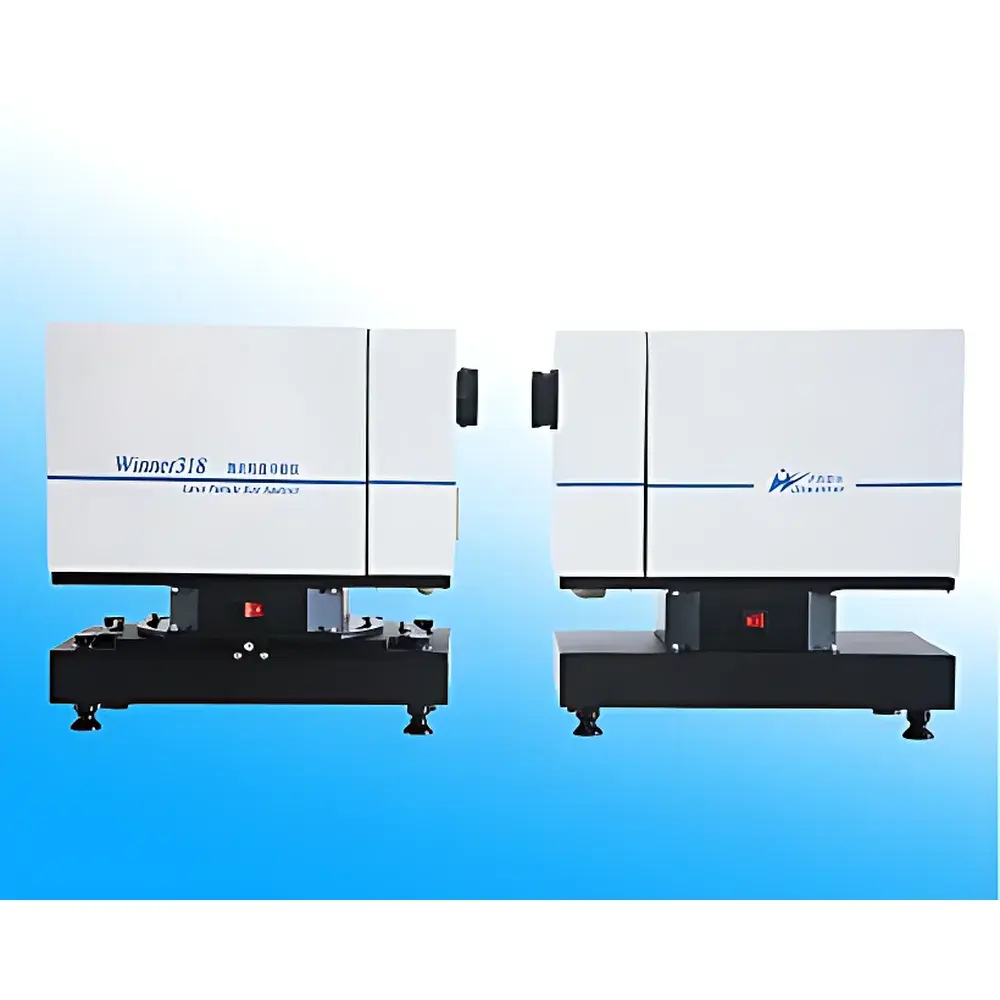
Jinan Winner Winner318 Industrial Spray Laser Particle Size Analyzer
| Brand | Jinan Winner |
|---|---|
| Origin | Shandong, China |
| Manufacturer Type | Direct Manufacturer |
| Product Category | Domestic |
| Model | Winner 318 |
| Price Range | USD 14,000–21,000 |
| Dispersion Method | Dry & Wet Dispersion |
| Instrument Type | Laboratory Laser Diffraction Particle Size Analyzer |
| Measurement Range | 4.6–2000 µm |
| Repeatability | <1% (D50 of NIST-traceable standard reference material) |
| Measurement Time | 10–120 s |
| Optical Principle | Fraunhofer Diffraction |
| Laser Source | LD-pumped solid-state laser, λ = 532 nm, P > 40 mW |
| Detector Channels | 60 |
| Compliance | ISO 13320:2020, GB/T 19077–2016, Q/0100JWN001–2013 |
| Measurement Zone Length | Adjustable from 1 to 10 m |
| Optical Alignment | 3-axis motorized micrometer stage (±20 mm translation, ±20 mm vertical lift, ±20° rotation) |
| Lens Protection | Dual-air-curtain system |
| Dimensions (L×W×H) | 500 × 254 × 520 mm (main unit) |
| Weight | 45 kg + 23 kg |
| Software | WinPAS v5.x with real-time spatial mapping, multi-scattering correction, and cross-sectional distribution analysis |
Overview
The Jinan Winner Winner318 Industrial Spray Laser Particle Size Analyzer is a high-flexibility, open-beam laser diffraction instrument engineered for quantitative characterization of spray droplets in dynamic, unconfined environments. Based on the Fraunhofer diffraction theory—validated under ISO 13320:2020 for coarse and broad-distribution aerosols—the system employs a collimated 532 nm green laser (P > 40 mW) and a 60-channel silicon photodiode array to resolve particle size distributions across an exceptionally wide range: 4.6 µm to 2000 µm. Unlike conventional closed-cell laser diffraction analyzers, the Winner318 features a modular, split-unit architecture enabling field-deployable installation with adjustable measurement path lengths (1–10 m), making it suitable for real-world spray characterization where optical access and spatial constraints vary significantly—from fire suppression nozzles to agricultural spray booms and aerospace fuel injectors.
Key Features
- Open-path optical configuration with fully adjustable measurement zone (1–10 m), supporting in-situ or near-field spray diagnostics without sample containment.
- Dual-air-curtain lens protection system that actively isolates the front optical element from droplet deposition, ensuring long-term optical stability and reducing maintenance frequency in high-humidity or high-concentration spray environments.
- Three-axis motorized alignment stage (±20 mm X/Y translation, ±20 mm Z lift, ±20° rotational fine-tuning) enabling rapid, repeatable optical centering—even after transport or repositioning.
- Real-time spatial mapping capability: software synchronizes nozzle position data with particle size acquisition to generate height- and cross-section-resolved droplet distribution profiles (e.g., D10/D50/D90 vs. axial distance).
- Multi-scattering automatic correction algorithm compliant with ISO 13320 Annex B, enabling accurate sizing across variable spray densities without manual attenuation or dilution.
- Modular detector and laser units facilitate integration into OEM spray test benches or automated qualification rigs under controlled environmental enclosures.
Sample Compatibility & Compliance
The Winner318 is validated for liquid-phase sprays generated by pressure-swirl, air-assist, ultrasonic, and rotary atomizers. It accommodates transient and steady-state spray regimes typical in fire suppression systems (NFPA 14/15), agrochemical application research (EPA OPPTS 850.4400), aviation fuel injector development (SAE ARP4774), and pharmaceutical metered-dose inhaler (MDI) formulation screening (USP ). Its measurement protocol adheres to ISO 13320:2020 (laser diffraction particle sizing), GB/T 19077–2016 (Chinese national standard equivalent), and internal validation against NIST-traceable glass microsphere standards (e.g., NIST SRM 1963). Repeatability of <1% RSD (D50) meets GLP-aligned instrument performance verification requirements for routine QC testing.
Software & Data Management
WinPAS v5.x provides a deterministic, audit-ready workflow for spray analysis. All measurements are timestamped and logged with full metadata—including laser power, ambient temperature/humidity (via optional sensor input), detector gain, and spatial coordinates. The software supports FDA 21 CFR Part 11–compliant user authentication, electronic signatures, and immutable audit trails when deployed in regulated environments. Export formats include CSV (for statistical process control), XML (for LIMS integration), and vector-based SVG reports suitable for technical documentation and regulatory submissions. Batch processing mode enables automated comparison of multiple spray configurations against pass/fail thresholds defined per application-specific specifications.
Applications
- Fire suppression system validation: Quantifying droplet Sauter mean diameter (SMD) and span index across nozzle arrays under high-pressure flow conditions.
- Agricultural spray drift assessment: Mapping lateral and vertical droplet size gradients to optimize adjuvant selection and boom height calibration.
- Aerospace combustion research: Characterizing fuel atomization quality upstream of combustor liners to correlate Dv50 with ignition delay and soot formation.
- Pharmaceutical inhaler development: Measuring emitted dose particle size distribution (PSD) in aerodynamic particle sizer (APS)-compatible setups per USP .
- Industrial spray drying and granulation: Monitoring droplet size evolution during atomization to predict powder morphology and residual moisture content.
FAQ
Is the Winner318 suitable for measuring sub-5 µm droplets commonly found in medical nebulizers?
No. The lower detection limit is 4.6 µm under standard operating conditions; for sub-micron aerosol analysis, a Mie-theory-based instrument with He–Ne laser (632.8 nm) and enhanced scattering sensitivity is recommended.
Can the system be integrated into an automated production line for real-time spray QC?
Yes. The Ethernet-enabled controller supports Modbus TCP and OPC UA protocols, allowing synchronization with PLCs and MES systems for closed-loop feedback control of nozzle pressure or flow rate.
Does the dual-air-curtain system require compressed air with specific dew point or filtration grade?
It operates optimally with clean, oil-free compressed air at 0.4–0.6 MPa and ISO 8573-1 Class 3 particulate filtration; integrated desiccant filters are available as optional accessories.
How is traceability maintained for regulatory submissions?
Each instrument ships with a factory calibration certificate referencing NIST SRM 1963 and includes built-in wavelength and alignment verification routines per ISO/IEC 17025 clause 6.5.2.
What environmental conditions are supported during operation?
Ambient operating range: 10–35 °C, 30–80% RH non-condensing; IP54-rated enclosure options are available for semi-outdoor deployment in hangars or field test sites.



