
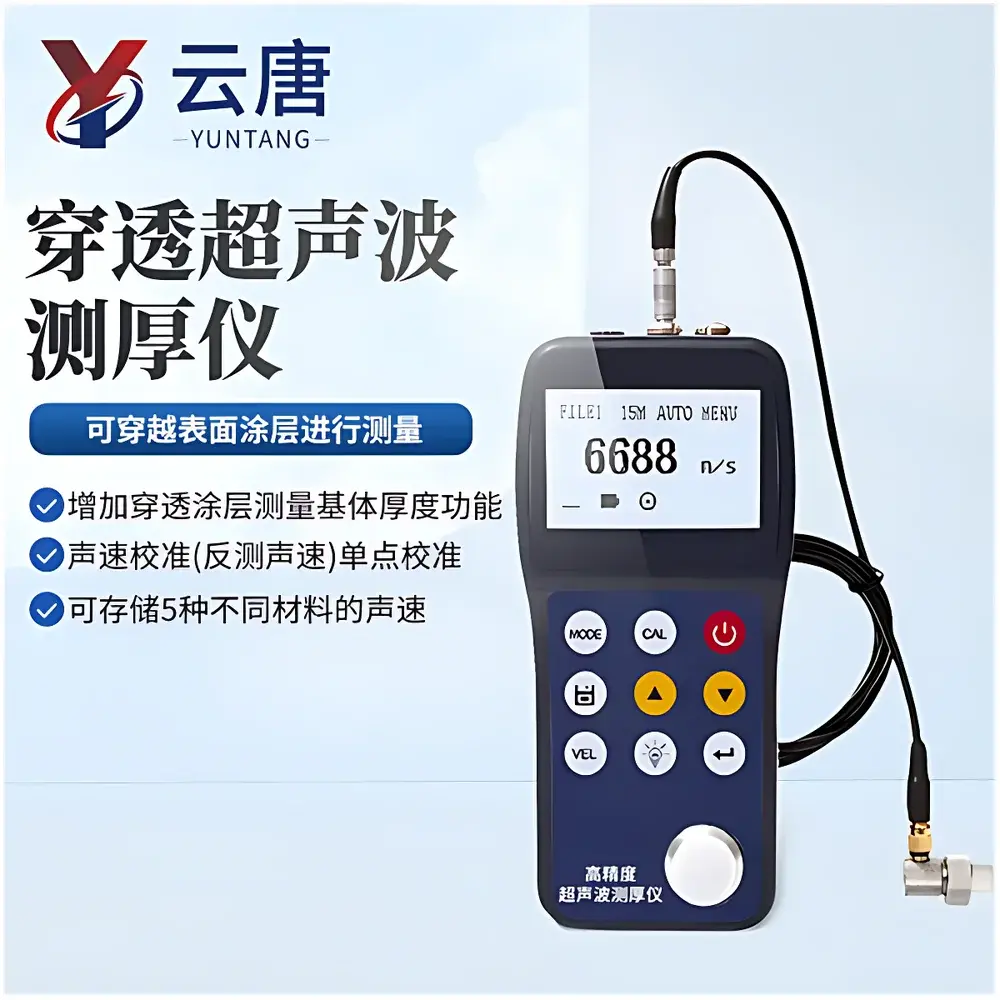
Yuntang YT-UC750 Through-Coating Ultrasonic Thickness Gauge
| Brand | Yuntang |
|---|---|
| Origin | Shandong, China |
| Manufacturer Type | OEM Manufacturer |
| Model | YT-UC750 |
| Measurement Range | 0.15–300 mm (steel) |
| Resolution | 0.001 mm (0.15–100 mm), 0.01 mm (100–300 mm) |
| Display | 128×64 LCD with LED backlight |
| Accuracy | ±0.005 mm (<5 mm), ±0.01 mm (5–20 mm), ±0.1 mm (20–300 mm) |
| Sound Velocity Range | 1000–9999 m/s |
| Operating Temperature | –10°C to +50°C (optional –20°C) |
| Power Supply | 2 × AA 1.5 V alkaline batteries (up to 200 h operation without backlight) |
| Auto-Shutdown | After 5 min inactivity |
| Data Storage | 500 readings |
| Probe Types | Single-crystal (e.g., 15 MHz), dual-element (5 MHz, 7 MHz), optional 4 mm single-crystal, 2 MHz high-penetration, and 7 MHz small-diameter probes |
| Coating-Tolerant Mode | Yes (echo-to-echo & pulse-echo) |
| Calibration Modes | Zero calibration on test block, sound velocity inversion (reverse calibration), single-point calibration |
| Units | mm / inch switchable |
| Alarms & Delta Mode | Configurable |
| Dimensions | 153 × 67 × 26 mm |
| Weight | 220 g |
Overview
The Yuntang YT-UC750 Through-Coating Ultrasonic Thickness Gauge is an industrial-grade, portable ultrasonic thickness measurement instrument engineered for precision, repeatability, and field robustness. It operates on the pulse-echo and echo-to-echo principles of ultrasonic time-of-flight (TOF) measurement. A high-frequency acoustic pulse is generated by a piezoelectric transducer, transmitted through the test material via couplant, reflected at the back surface (or internal interface), and received by the same or adjacent element. The instrument calculates thickness using the formula t = (v × Δt) / 2, where v is the calibrated sound velocity in the material and Δt is the measured round-trip transit time. Unlike conventional pulse-echo gauges, the YT-UC750 supports both standard bottom-echo and coating-compensated echo-to-echo modes—enabling accurate measurement of base metal thickness beneath non-metallic coatings (e.g., paint, enamel, plastic, or corrosion products) without requiring coating removal. This capability is critical for in-service inspection of pipelines, pressure vessels, storage tanks, and structural components in regulated environments.
Key Features
- Through-coating measurement capability using dual-mode echo evaluation (pulse-echo for thick sections; echo-to-echo for thin or coated materials)
- High-resolution display with 0.001 mm resolution in the 0.15–100 mm range, optimized for thin-wall applications including tubing, sheet metal, and aerospace skins
- Dual-element probe compatibility (5 MHz and 7 MHz) for enhanced near-surface resolution and improved signal-to-noise ratio in coarse-grained or attenuative materials
- Integrated zero-calibration function: automatic probe delay compensation performed directly on standard calibration blocks
- Sound velocity inversion mode: derive material-specific sound velocity from a known thickness sample—essential for unknown or heterogeneous alloys
- Five-user-defined sound velocity memory slots for rapid switching between common engineering materials (e.g., carbon steel, stainless steel, aluminum, copper, cast iron)
- Configurable upper/lower thickness alarms and delta-mode deviation tracking for QA/QC process control
- LED-backlit monochrome LCD (128 × 64 pixels) ensuring legibility in low-light or confined-space conditions (e.g., boiler interiors, offshore platforms)
- Low-power architecture supporting up to 200 hours of continuous operation on two AA alkaline cells; auto-shutdown after 5 minutes of inactivity
- Compact ergonomic housing (153 × 67 × 26 mm, 220 g) designed for one-handed operation in tight access areas
Sample Compatibility & Compliance
The YT-UC750 is validated for use on homogeneous, isotropic, ultrasonically conductive materials—including ferrous and non-ferrous metals (carbon steel, stainless steel, aluminum, copper, brass, titanium, nickel alloys), thermoplastics (PVC, acrylic, polyethylene), ceramics, glass, fiberglass composites, and epoxy-coated substrates. It is not suitable for highly attenuative, porous, or laminated structures (e.g., wood, concrete, rubber-insulated pipes) where ultrasonic energy scatters or dissipates excessively. While the instrument itself does not carry CE, UKCA, or FDA certification, its measurement methodology aligns with established non-destructive testing standards including ASTM E797/E1065 (Standard Practice for Measuring Thickness by Manual Ultrasonic Pulse-Echo Contact Method) and ISO 2400 (Ultrasonics — Calibration Block for Thickness Gauges). Its data logging and user-configurable alarm thresholds support implementation within GLP/GMP-aligned QA workflows when paired with documented calibration procedures and traceable reference standards.
Software & Data Management
The YT-UC750 features embedded firmware supporting local data capture and recall without external software dependency. All measurements are timestamped and stored in non-volatile memory (500-point capacity). Users may review, sort, and export datasets via optional USB data cable (sold separately), enabling integration into Excel-based reporting or LIMS environments. The device supports configurable data tagging via material ID selection prior to measurement, facilitating batch traceability. Although it lacks native 21 CFR Part 11 compliance features (e.g., electronic signatures, audit trails), its deterministic measurement algorithm, stable calibration memory, and manual record-keeping compatibility make it suitable for pre-qualification stages and routine maintenance inspections under ISO 9001 or API RP 570 frameworks.
Applications
- In-service wall thickness monitoring of carbon steel and stainless-steel piping systems in petrochemical refineries and chemical processing plants
- Corrosion mapping of aboveground storage tank floors and shell courses during turnaround inspections
- Quality assurance of rolled sheet, extruded profiles, and forged components during incoming material verification
- Aerospace structural health monitoring: skin thickness verification on aluminum airframes and titanium engine housings
- Marine vessel hull integrity assessment, including underwater hull plating and ballast tank internals
- Power generation: boiler tube thickness screening and turbine casing wall evaluation
- Manufacturing process control for cold-rolled strip, drawn tubing, and clad metal plates
FAQ
What is the minimum measurable thickness for steel?
The YT-UC750 achieves a minimum detectable thickness of 0.15 mm in steel using the 15 MHz single-crystal probe in pulse-echo mode.
Can the instrument measure through paint or epoxy coatings?
Yes—the echo-to-echo mode compensates for coating thickness, allowing direct measurement of substrate metal thickness without coating removal.
How is sound velocity calibrated for an unknown alloy?
Use the reverse calibration (sound velocity inversion) function: enter a known thickness value, then adjust velocity until the reading matches—resulting velocity is stored for future use.
Is probe replacement standardized?
The YT-UC750 accepts industry-standard BNC-connected ultrasonic probes; Yuntang-supplied dual-element 5 MHz and 7 MHz probes are optimized for coupling stability and near-field resolution.
Does the gauge support temperature compensation?
No built-in temperature sensor is included; however, users may manually adjust sound velocity based on published temperature-dependent velocity curves for critical applications.



