
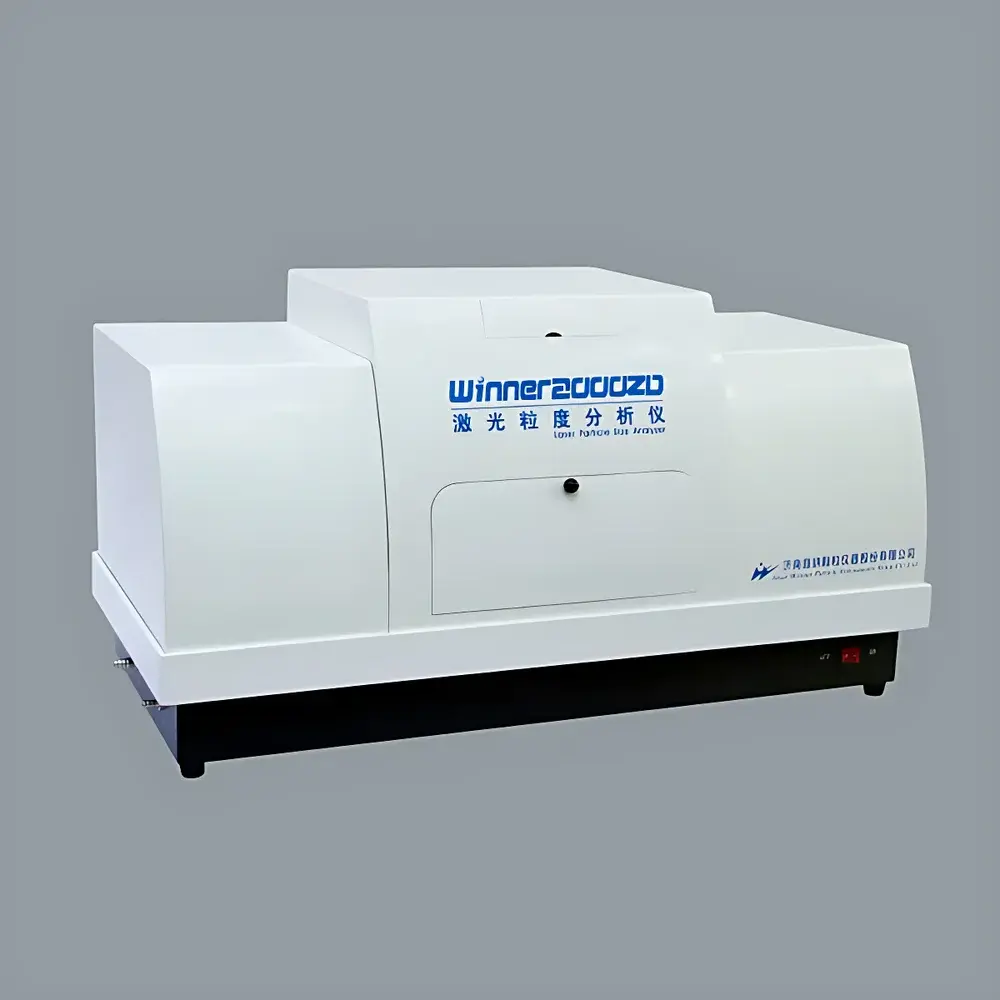
Winner2000ZD Intelligent Wet-Dispersion Laser Particle Size Analyzer
| Brand | Jinan Winner |
|---|---|
| Origin | Shandong, China |
| Manufacturer Type | Direct Manufacturer |
| Regional Origin | Domestic (China) |
| Model | Winner2000ZD |
| Price Range | USD 0–15,000 |
| Dispersion Method | Wet Dispersion |
| Instrument Type | Laboratory Laser Diffraction Particle Size Analyzer |
| Measurement Range | 0.1–40 µm / 0.6–120 µm / 1–300 µm |
| Repeatability | <0.5% (D50 of NIST-traceable standard reference material) |
| Measurement Time | <120 s per run |
Overview
The Winner2000ZD Intelligent Wet-Dispersion Laser Particle Size Analyzer is a precision laboratory instrument engineered for high-resolution particle size distribution (PSD) analysis of solid particulates suspended in liquid media. It operates on the principle of laser diffraction—specifically, Mie scattering theory combined with Fraunhofer approximation—enabling quantitative determination of volume-weighted particle size distributions across three configurable measurement ranges. Its optical architecture features a convergent-beam Fourier transform design, eliminating aperture-induced angular truncation and significantly enhancing sensitivity to submicron particles down to 0.1 µm. The system integrates a fully enclosed, self-contained wet dispersion module—including programmable ultrasonication, variable-speed mechanical stirring, controlled circulation flow, and automated drainage—ensuring uniform de-agglomeration and stable suspension prior to optical interrogation. All optical alignment is performed automatically via a four-phase hybrid stepper motor-driven centering mechanism, achieving micron-level positional stability and eliminating manual alignment drift—a critical requirement for long-term reproducibility in regulated environments.
Key Features
- Triple-range optical detection system supporting simultaneous or sequential measurement modes: 0.1–40 µm (high-resolution fine mode), 0.6–120 µm (general-purpose mode), and 1–300 µm (coarse-mode configuration)
- 76-channel annular photodetector array with optimized angular coverage and signal-to-noise ratio for robust inversion accuracy
- Unconstrained free-fitting algorithm for PSD reconstruction—no pre-assumed distribution function (e.g., log-normal or Rosin-Rammler), enabling faithful representation of multimodal or skewed populations
- Fully automated workflow: one-click “Auto Test” initiates dispersion conditioning, optical alignment, data acquisition, and report generation without operator intervention
- Patented integrated wet dispersion unit (CN Patent No. ZL.2010 1 0533181.6) featuring independent control of ultrasonic power (0–60 W at 40 kHz), stirrer speed (0–3000 rpm), and recirculation flow rate (up to 8 L/min)
- Compliant optical path design with Class II laser source (λ = 639 nm, P > 2 mW) meeting IEC 60825-1 safety requirements
Sample Compatibility & Compliance
The Winner2000ZD is validated for aqueous and organic suspensions of insoluble solids including metal/non-metal powders, ceramic precursors, pharmaceutical excipients, mineral fillers (e.g., calcium carbonate, kaolin), carbon-based materials (graphite, CNTs), agrochemical formulations, and colloidal dispersions. Sample volumes range from 10 mL (micro-cell option) to 350 mL (standard cell), accommodating both R&D-scale screening and routine QC batch verification. The instrument conforms to ISO 13320:2009 (Particle size analysis — Laser diffraction methods), GB/T 19077–2016 (Chinese national standard equivalent), and supports traceability to NIST SRM® reference materials. While not inherently 21 CFR Part 11-compliant out-of-the-box, audit trail logging, user access controls, and electronic signature readiness can be implemented via optional software modules aligned with GLP/GMP documentation practices.
Software & Data Management
The embedded Windows-based analysis software provides intuitive GUI navigation, real-time scatter pattern visualization, and customizable reporting templates compliant with ASTM E29-23 rounding conventions. Raw intensity data are stored in vendor-neutral ASCII format; processed results include D10, D50, D90, span, specific surface area (SSA), and volume/mass distribution histograms. Batch processing, statistical comparison across runs, and export to CSV, PDF, or Excel formats are supported. Optional network deployment enables centralized data archiving on secure internal servers, facilitating departmental calibration tracking and instrument usage logs required under ISO/IEC 17025 accreditation frameworks.
Applications
This analyzer serves as a core characterization tool in quality control laboratories across diverse sectors: catalyst development (pore structure correlation), battery electrode slurry homogeneity assessment, pigment dispersion stability evaluation in coatings, inhalable fraction analysis for dry powder inhalers (DPIs), granulation endpoint monitoring in wet granulation processes, and sedimentation behavior modeling in environmental colloid studies. Its adaptability to low-volume micro-cells makes it suitable for precious or hazardous samples requiring minimal exposure—such as nanotoxicology suspensions or radioactive particulate standards.
FAQ
What sample preparation steps are required before measurement?
Minimal preparation is needed: add sample to dispersant (water or compatible solvent), load into the circulation system, and initiate Auto Test. The instrument handles degassing, ultrasonication, stirring, and stabilization autonomously.
Can the Winner2000ZD measure nanoparticles below 100 nm?
Yes—the 0.1–40 µm range is optimized for submicron detection using enhanced forward-scatter collection and Mie theory correction; however, accurate sizing below 100 nm requires refractive index input and validation against TEM or DLS for each material system.
Is third-party calibration verification supported?
Yes—built-in calibration routines accept certified reference materials (e.g., NIST SRM 1963, ISO 13320 Annex B standards); full calibration reports with uncertainty budgets can be generated per ISO/IEC 17025 requirements.
How is data integrity maintained during extended operation?
The system logs all critical parameters—including laser power, detector baseline, temperature drift, and dispersion settings—with timestamped metadata, enabling forensic review during internal audits or regulatory inspections.



