
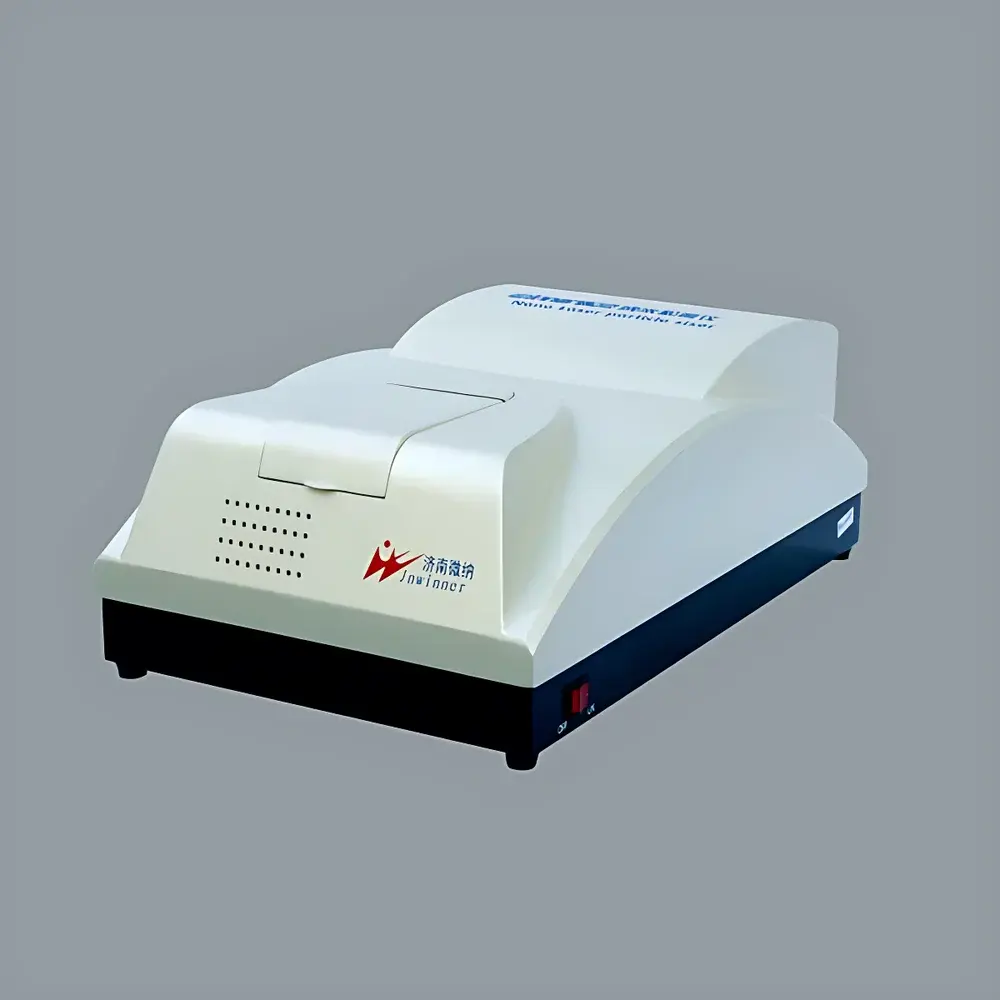
Winner802 Nanoparticle Size Analyzer by Jinan Winner
| Brand | Jinan Winner |
|---|---|
| Origin | Shandong, China |
| Manufacturer Type | Direct Manufacturer |
| Product Category | Domestic |
| Model | Winner802 |
| Price Range | USD 21,000–28,000 (FOB) |
| Dispersion Method | Wet Dispersion |
| Instrument Type | Laboratory Dynamic Light Scattering (DLS) Analyzer |
| Measurement Range | 1–10,000 nm (sample-dependent) |
| Repeatability | <1% RSD (D50 of NIST-traceable standard reference material) |
| Measurement Time | <2 min per run |
| Laser Source | 532 nm semiconductor laser, 30 mW output power |
| Detection Angle | 90° |
| Detector | Hamamatsu photomultiplier tube (PMT) |
| Correlator | CR256 digital autocorrelator (256 channels, 100 ns–10 ms delay resolution) |
| Sample Cell | Rectangular quartz cuvette (10 × 10 × 40 mm, 1–4 mL volume) |
| Temperature Control | Semiconductor-based Peltier system, ±0.1 °C stability |
| Operating Temperature Range | 5–40 °C |
| Sample Concentration Range | 0.1–100 mg/mL (matrix- and particle-dependent) |
| Compliance Standards | GB/T 19627–2005, GB/T 29022–2012, ISO 13321:1996, ISO 22412:2008 |
Overview
The Winner802 Nanoparticle Size Analyzer is a laboratory-grade dynamic light scattering (DLS) instrument engineered for precise, non-invasive characterization of colloidal nanoparticles in liquid dispersion. Based on the fundamental principles of Brownian motion and photon correlation spectroscopy, the system measures temporal fluctuations in scattered laser intensity at 90° to derive the intensity autocorrelation function. Through application of the Stokes–Einstein equation—linking diffusion coefficient to hydrodynamic diameter—the instrument calculates particle size distribution (PSD) with high resolution across a broad range of 1–10,000 nm. Designed for research and quality control laboratories handling nanomaterials, pharmaceutical colloids, polymer dispersions, and biological macromolecules, the Winner802 delivers rapid (<2 min per measurement), reproducible, and matrix-preserving analysis without sample dilution or chemical modification.
Key Features
- High-sensitivity optical detection using a Hamamatsu photomultiplier tube (PMT), optimized for low-noise signal acquisition at 532 nm wavelength
- Custom-designed CR256 digital autocorrelator with 256 correlation channels and adjustable delay resolution (100 ns to 10 ms), enabling robust real-time computation of the intensity autocorrelation function
- Fiber-coupled optical architecture minimizing alignment drift and enhancing long-term stability under ambient laboratory conditions
- Precise temperature regulation via integrated Peltier-based thermal control, maintaining sample temperature within ±0.1 °C over the full operational range (5–40 °C) to suppress viscosity-induced bias in diffusion coefficient estimation
- Rectangular quartz cuvette (10 × 10 × 40 mm) supporting 1–4 mL sample volumes and compatible with low-concentration suspensions (0.1–100 mg/mL, dependent on refractive index contrast and polydispersity)
- Compliance-ready firmware architecture supporting audit trails and user-access logging—designed to facilitate alignment with GLP, GMP, and FDA 21 CFR Part 11 documentation requirements when deployed in regulated environments
Sample Compatibility & Compliance
The Winner802 supports aqueous and organic solvent-based dispersions of metallic nanoparticles (e.g., Au, Ag), metal oxides (TiO₂, SiO₂), liposomes, protein aggregates, polymeric micelles, and quantum dots. Its wet-dispersion configuration avoids drying artifacts and preserves native conformational states—critical for biopharmaceutical formulation development and nanotoxicology studies. The instrument adheres to international metrological standards including ISO 22412:2008 (DLS methodology) and ISO 13321:1996 (photon correlation spectroscopy), as well as national standards GB/T 29022–2012 and GB/T 19627–2005. All calibration and validation procedures are traceable to NIST-certified polystyrene latex standards, ensuring inter-laboratory comparability.
Software & Data Management
The proprietary WinPAR software provides intuitive workflow management—from automated baseline optimization and multi-angle correlation fitting to cumulant analysis, CONTIN regularization, and intensity-to-number distribution conversion. Raw correlation data are stored in HDF5 format with embedded metadata (timestamp, temperature, laser power, cell ID), enabling full traceability. Export options include CSV, PDF reports, and XML-compatible outputs for integration into LIMS or ELN platforms. Batch processing mode allows unattended sequential analysis of up to 96 samples, with configurable pass/fail criteria based on polydispersity index (PdI) thresholds and repeatability limits.
Applications
- Characterization of nanoparticle drug carriers during preformulation and stability testing
- Monitoring aggregation kinetics of monoclonal antibodies and recombinant proteins under thermal or pH stress
- Quality control of industrial nanosuspensions used in coatings, catalysts, and electronic inks
- Validation of size reduction efficiency in high-pressure homogenization or ultrasonication processes
- Supporting ISO 10993-12 biocompatibility assessments through quantitative dispersion state verification
- Academic research in soft matter physics, colloid science, and nanomaterial synthesis optimization
FAQ
What physical principle does the Winner802 employ for particle sizing?
It uses dynamic light scattering (DLS), measuring time-dependent fluctuations in scattered light intensity caused by Brownian motion to compute hydrodynamic diameter via the Stokes–Einstein relationship.
Can the instrument measure polydisperse or multimodal samples accurately?
Yes—through advanced CONTIN algorithm implementation and multi-exponential fitting, it resolves up to three dominant populations in moderately polydisperse systems (PdI < 0.25).
Is temperature control mandatory for accurate results?
Yes—temperature directly affects solvent viscosity and diffusion coefficient; the ±0.1 °C stability ensures minimal systematic error in calculated diameters.
Does the system support 21 CFR Part 11 compliance?
While not certified out-of-the-box, the software architecture includes electronic signatures, audit trail generation, and role-based access control—enabling validation per Part 11 requirements in regulated QC labs.
What maintenance is required for long-term performance stability?
Annual PM includes PMT gain calibration, laser power verification, correlator timing validation, and cuvette cleaning protocol verification—no consumables beyond standard quartz cells.



