
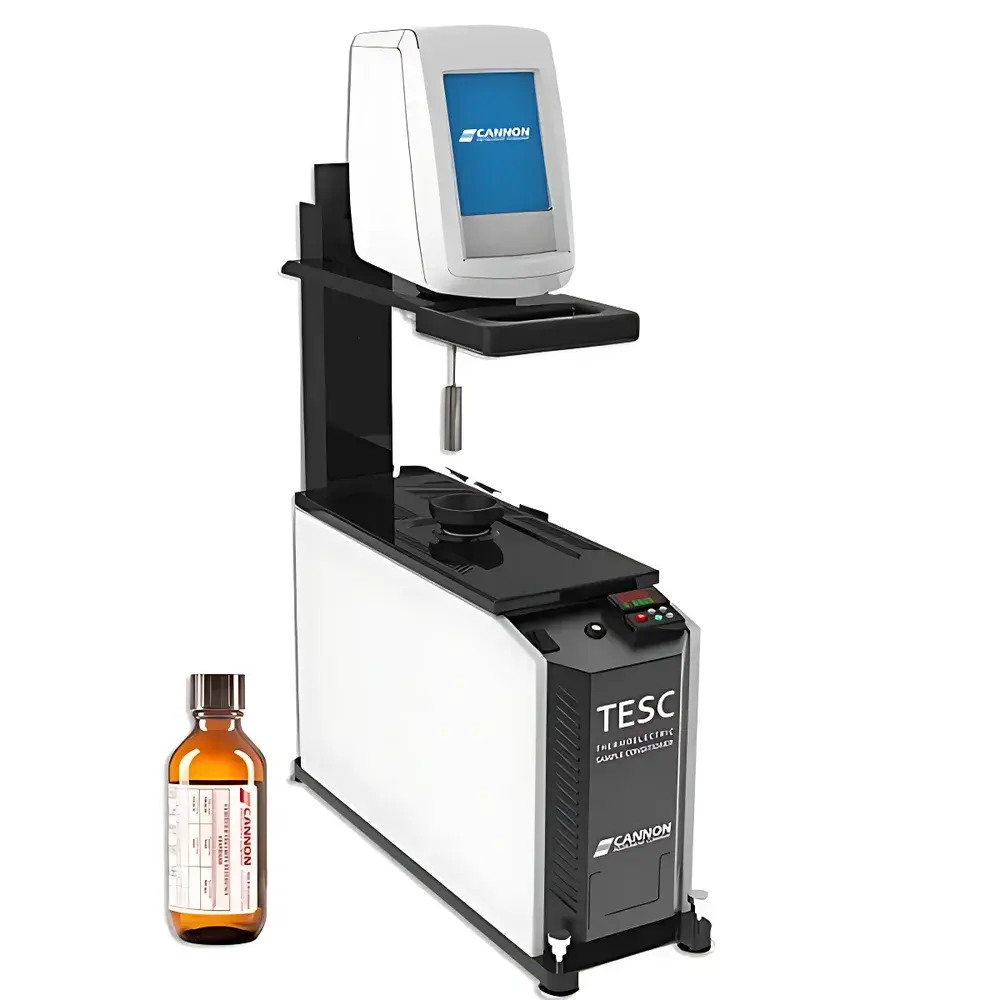
TESC-5133 Brookfield-Style Cold Cranking Simulator (CCS) / Gelation Index Analyzer
| Brand | CANNON |
|---|---|
| Origin | USA |
| Model | TESC-5133 |
| Temperature Control Range | −42 °C to 90 °C |
| Compliance | ASTM D5133, ASTM D7110, SH/T 0732, GB/T 11121 |
| Cooling Method | Solid-State Peltier |
| Sample Chamber | Sealed, Thermally Isolated Enclosure |
| Automation Level | Fully Automated, Unattended Operation |
| Footprint | Compact Benchtop Design |
Overview
The TESC-5133 Brookfield-Style Cold Cranking Simulator (CCS) and Gelation Index Analyzer is an engineered solution for precise low-temperature rheological characterization of lubricating oils, engine oils, and functional fluids. Unlike conventional rotational viscometers, the TESC-5133 operates on the principle of controlled shear under dynamically stabilized thermal conditions—mimicking cold-start engine environments where viscosity-related flow resistance directly impacts cranking torque and pumpability. It implements a standardized cold cranking simulation protocol defined by ASTM D5133 (Standard Test Method for Low-Temperature, Low-Shear-Rate Viscosity of Engine Oils), extended to include gelation index determination per ASTM D7110 and regional specifications such as SH/T 0732 (China) and GB/T 11121 (China). The system delivers reproducible torque-based viscosity measurements at shear rates ranging from 0.1 to 10 s⁻¹ and temperatures spanning −42 °C to +90 °C—enabling full compliance with OEM and regulatory requirements for winter-grade lubricants.
Key Features
- Fully automated temperature ramping and stabilization using solid-state Peltier thermoelectric modules—eliminating hazardous coolant baths and enabling rapid, repeatable thermal transitions.
- Integrated sealed sample chamber with active thermal isolation, minimizing ambient interference and ensuring <±0.1 °C temperature uniformity across the entire test volume during measurement.
- Unattended operation capability: once loaded and initiated, the instrument executes multi-step temperature holds, viscosity sweeps, and gel point detection without manual intervention.
- Modular benchtop architecture supports side-by-side deployment of multiple TESC-5133 units—increasing throughput in high-volume QC laboratories while maintaining consistent calibration traceability.
- Compliance-ready firmware with configurable audit trails, user access levels, and electronic signature support—designed to align with GLP, GMP, and FDA 21 CFR Part 11 data integrity expectations.
- Optimized mechanical design reduces footprint to <0.35 m² per unit, facilitating integration into space-constrained analytical workspaces without sacrificing thermal or mechanical stability.
Sample Compatibility & Compliance
The TESC-5133 accommodates standard 30-mL glass or metal sample cups conforming to ASTM D5133 geometry specifications. It is validated for use with mineral, synthetic, and semi-synthetic engine oils—including SAE 0W-x, 5W-x, and 10W-x multigrade formulations—as well as gear oils, hydraulic fluids, and specialty industrial lubricants exhibiting non-Newtonian behavior at sub-zero temperatures. All operational protocols adhere strictly to ASTM D5133 (cold cranking viscosity), ASTM D7110 (gelation index via torque inflection analysis), SH/T 0732 (Chinese specification for low-temperature pumpability), and GB/T 11121 (Chinese national standard for gasoline engine oils). Instrument calibration is traceable to NIST-certified reference oils and includes documented uncertainty budgets per ISO/IEC 17025 requirements.
Software & Data Management
The TESC-5133 is operated via CANNON’s proprietary CCS Studio software, a Windows-based application supporting method creation, real-time monitoring, raw torque/time/temperature logging, and automated report generation. Data files are stored in encrypted binary format with embedded metadata (operator ID, timestamp, calibration status, environmental logs). Export options include CSV, PDF, and XML formats compatible with LIMS integration. Software features include configurable pass/fail limits, trend analysis over time, batch comparison tools, and full audit trail functionality—including modification history, user login events, and electronic signature capture for critical actions. All software updates undergo formal validation per ICH Q9 and ISO 13485 principles.
Applications
- Determination of cold cranking viscosity (CCS viscosity) for engine oil formulation and quality control.
- Gelation index quantification to assess low-temperature structuring behavior in paraffinic base stocks and additive-treated oils.
- Supporting API licensing and OEM approval testing for winter-grade lubricants.
- Research into wax crystallization kinetics and pour point depressant efficacy.
- Batch release testing in manufacturing facilities operating under ISO 9001 or IATF 16949 quality management systems.
- Third-party certification labs performing accredited testing per ISO/IEC 17025 scope.
FAQ
What standards does the TESC-5133 fully support?
ASTM D5133, ASTM D7110, SH/T 0732, and GB/T 11121—all implemented with hardware and software configurations verified for method equivalence.
Is the instrument suitable for GLP-compliant environments?
Yes. Firmware includes configurable audit trails, role-based access control, electronic signatures, and data immutability features aligned with OECD GLP Principles and FDA 21 CFR Part 11.
How is temperature uniformity maintained during long-duration tests?
The sealed, insulated sample chamber combined with dual-zone Peltier control and real-time PID feedback ensures spatial temperature deviation remains below ±0.08 °C over 60-minute holds.
Can the TESC-5133 be integrated into an existing LIMS?
Yes. CSV and XML export formats, along with optional OPC UA connectivity, enable seamless bidirectional data exchange with major laboratory information management systems.
What maintenance is required for long-term accuracy?
Annual verification using NIST-traceable reference oils and biannual sensor calibration checks are recommended; no consumables or fluid replacements are required due to solid-state thermal architecture.





