
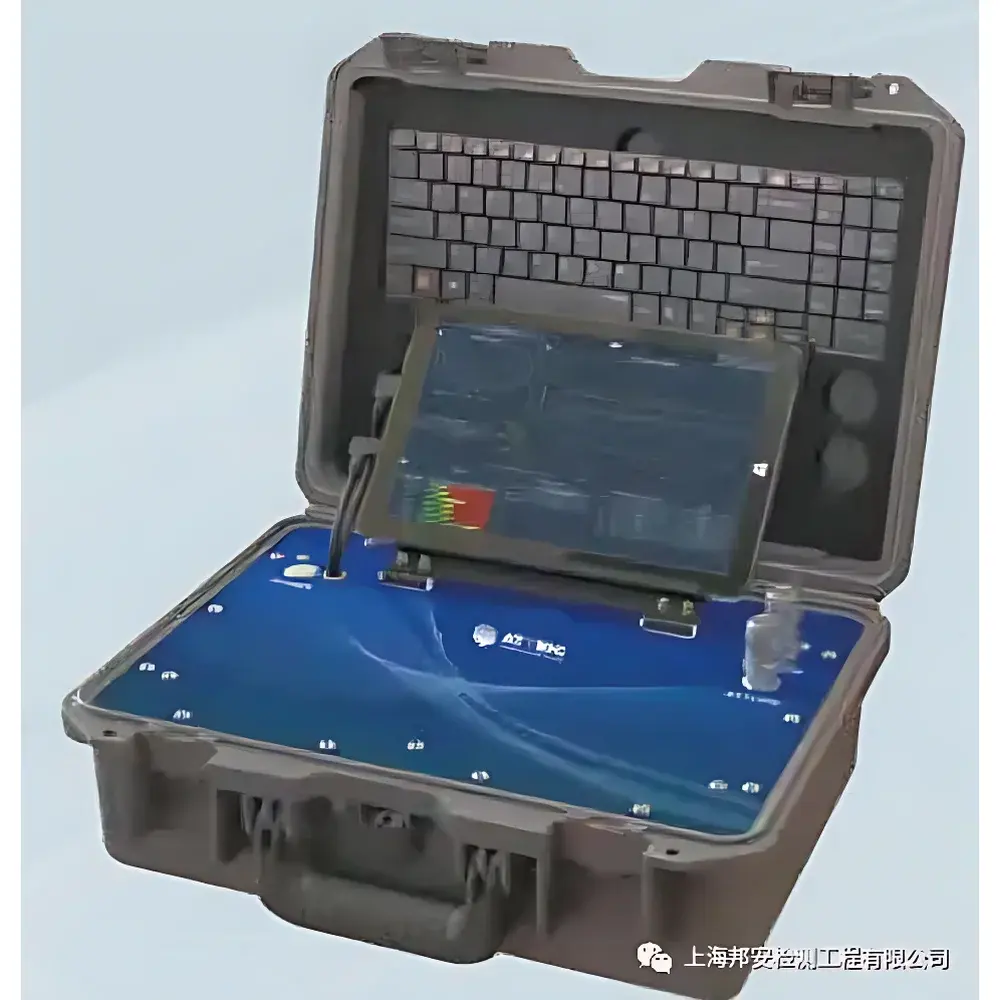
OilCMS Online Oil Condition Monitoring System
| Brand | atten2 |
|---|---|
| Origin | Spain |
| Model | OilCMS |
| Instrument Type | Online Lubricant Condition Monitor |
| Detection Parameters | Particle Contamination, Water Content (RH%), Oil Degradation State, Viscosity Estimation (up to 3000 cSt) |
| Compliance Standards | ISO 4406, SAE AS4059, NAS 1638 |
| Display | 10-inch capacitive touchscreen |
| Power | Integrated rechargeable lithium battery |
| Data Storage | Local database for up to 500 oil samples with trend aggregation |
| Flow Control | Built-in motorized pump with optional high-pressure adapter (compatible with real-time recirculation systems up to 350 bar) |
| Particle Analysis Method | Digital imaging with bubble suppression and morphological classification |
Overview
The OilCMS Online Oil Condition Monitoring System is an industrial-grade, real-time lubricant health assessment platform engineered for continuous or semi-continuous deployment in critical rotating equipment circuits—such as gearboxes, hydraulic systems, turbines, and compressors. Unlike traditional offline laboratory particle counters or benchtop FTIR analyzers, the OilCMS integrates digital imaging-based particle analysis with concurrent water activity measurement and empirical oil life modeling into a single compact, field-deployable architecture. Its core measurement principle relies on high-resolution optical imaging under controlled laminar flow conditions, where suspended particles are illuminated and captured frame-by-frame; proprietary algorithms then classify particles by morphology (e.g., cutting wear, fatigue spalling, fiber contamination), suppress interference from entrained microbubbles via dynamic image subtraction, and assign size distributions aligned to internationally recognized cleanliness codes—including ISO 4406, SAE AS4059, and NAS 1638. This enables not only quantitative contamination grading but also root-cause diagnostics of wear mechanisms directly in situ.
Key Features
- Digital imaging particle analyzer with automatic bubble suppression and shape-based wear mode classification (e.g., sliding, rolling, corrosion, fiber)
- Integrated moisture sensor reporting relative humidity (%RH) of oil—correlated to free water risk and oxidation catalysis
- Empirical oil condition algorithm estimating remaining useful life (RUL) based on cumulative particle load, water exposure history, and viscosity drift trends
- Viscosity estimation capability validated up to 3000 cSt (centistokes), supporting mineral, synthetic, and high-viscosity industrial oils
- Built-in motor-driven precision flow control system ensuring repeatable sample presentation across varying line pressures
- Optional high-pressure interface kit enabling direct integration with live 350 bar hydraulic or lube-oil recirculation loops
- 10-inch industrial-grade capacitive touchscreen with intuitive HMI for real-time visualization of histograms, time-series trends, and pass/fail alerts per ISO thresholds
- Onboard rechargeable lithium battery supporting ≥8 hours of continuous operation in remote or mobile inspection scenarios
- Local database storing metadata and full analytical records for up to 500 unique oil samples, with export-ready CSV and PDF reporting
Sample Compatibility & Compliance
The OilCMS is designed for use with mineral, synthetic, and bio-based lubricants across hydraulic, turbine, engine, and gear oil formulations. It accommodates oils ranging from ISO VG 10 to VG 1500 and exhibits robust performance in presence of additives, dispersants, and oxidation byproducts. All particle counting protocols adhere strictly to ISO 4406:2021 (fluid cleanliness coding), SAE AS4059F (aerospace fluid contamination standards), and NAS 1638 Class Code definitions. Moisture measurement conforms to ASTM D6304 (coulometric Karl Fischer titration correlation) for RH% interpretation. The system’s firmware and data logging architecture support audit-ready traceability, including user login timestamps, calibration event logs, and uneditable result archives—facilitating alignment with ISO 55001 asset management frameworks and internal GLP/GMP documentation requirements.
Software & Data Management
The embedded Linux-based operating system hosts a dedicated condition monitoring application with dual-mode operation: standalone field mode and networked enterprise mode. In standalone mode, all data—including raw image frames, particle counts per size bin, RH%, and RUL projections—are stored locally with SHA-256 hashed integrity verification. When connected via Ethernet or Wi-Fi, the system supports OPC UA server functionality for seamless integration into SCADA, CMMS (e.g., IBM Maximo, SAP PM), or cloud-based IIoT platforms (e.g., Siemens MindSphere, PTC ThingWorx). Export formats include ISO-compliant .csv reports, trend graphs in PNG/SVG, and structured JSON payloads containing metadata compliant with ISO 17359:2018 (condition monitoring standards). Audit trail features meet FDA 21 CFR Part 11 requirements for electronic records and signatures when deployed in regulated manufacturing environments.
Applications
- Preventive maintenance of wind turbine gearboxes using early detection of micropitting-related particles
- Hydraulic system reliability assurance in offshore drilling rigs, where water ingress and varnish formation pose operational risks
- Condition-based oil change scheduling in mining haul trucks, reducing unnecessary oil disposal and extending drain intervals
- Root-cause analysis of bearing failures in power generation turbines through morphology-driven wear mapping
- Verification of filtration efficiency in marine main engine lube systems before and after filter element replacement
- Commissioning validation of new machinery lubrication circuits prior to full-load operation
FAQ
Does the OilCMS require periodic calibration with reference standards?
Yes—particle sizing accuracy is maintained through quarterly verification using NIST-traceable latex sphere suspensions (ISO 21501-4 compliant). Moisture sensor calibration is recommended annually or after exposure to extreme thermal cycling.
Can the system operate continuously inside an explosion-proof enclosure?
The base unit is rated IP65 and can be installed in Zone 2 hazardous areas; for Zone 1/ATEX Group II applications, it must be housed in a certified pressurized or flameproof enclosure—configuration support is available from atten2 engineering services.
Is remote firmware update supported over cellular networks?
Yes—via secure TLS 1.3 encrypted OTA (over-the-air) updates using SIM-based LTE-M or NB-IoT modules (optional add-on kit).
How does the system handle highly aerated or foaming oils?
The integrated bubble suppression algorithm uses temporal image differencing and edge-detection masking to exclude transient gas-phase artifacts from particle quantification—validated per ISO 4406 Annex B guidelines.
What is the minimum detectable particle size?
The optical resolution supports reliable detection of particles ≥4 µm in equivalent spherical diameter (ESD) under standard flow conditions; lower thresholds may be achievable with extended dwell time and enhanced illumination settings.
Related Products






