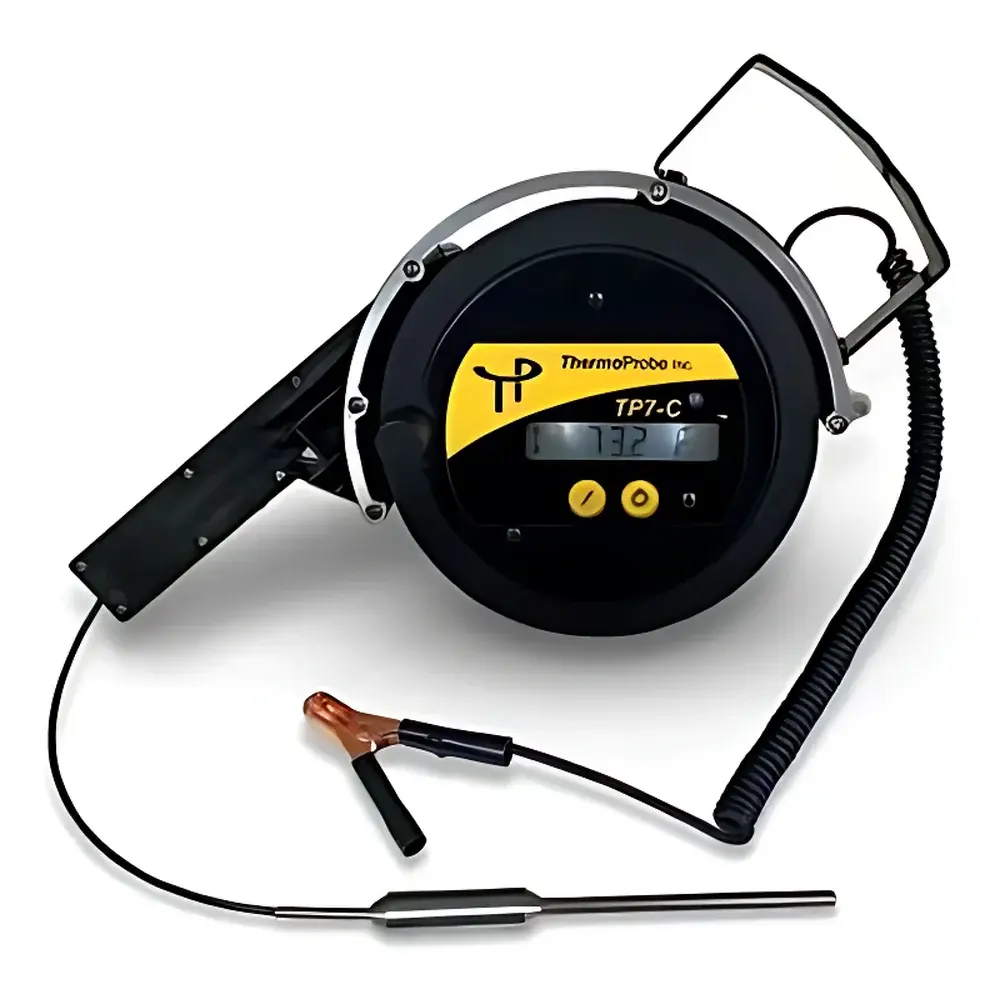
Thermoprobe TP7-C Intrinsically Safe Explosion-Proof Temperature Probe
| Brand | Thermoprobe |
|---|---|
| Origin | USA |
| Model | TP7-C |
| Temperature Range | −10 °C to 188 °C (14 °F to 370 °F) |
| Accuracy | ±0.2 °F (32–200 °F), ±0.5 °F (200–300 °F) |
| Resolution | 0.1 °C |
| Operating Ambient Temperature | −20 °C to 54 °C |
| Display | LCD |
| Power | 9 V alkaline battery (≈50 h life) |
| Dimensions | 34.3 × 18.4 × 11.4 cm |
| Weight | 1.4 kg (with 23 m cable) |
| Sensor | Pt100 platinum RTD in stainless steel sheath |
| Cable | FEP/PFA-insulated, aramid-reinforced, static-dissipative jacket |
| Enclosure Materials | Polypropylene blend, stainless steel, aluminum |
| Safety Certification | ATEX II 2 (1) EEx ib[ia] IIB T4 |
| Compliance | API RP 14C, IEC 60079-0/-11, UL 913 Class I, Div 1, Groups B, C, D |
Overview
The Thermoprobe TP7-C is an intrinsically safe, explosion-proof temperature probe engineered for continuous, high-fidelity temperature monitoring in hazardous locations where flammable gases, vapors, or dusts may be present. Designed in accordance with IEC 60079-0 and IEC 60079-11 standards, the TP7-C employs a certified intrinsic safety barrier architecture that limits energy—both electrical and thermal—to levels incapable of igniting classified atmospheres. Its core sensing element is a precision Pt100 platinum resistance thermometer housed in a 316 stainless steel sheath, offering long-term stability and corrosion resistance. The probe operates via a four-wire RTD configuration to eliminate lead resistance errors, ensuring traceable accuracy across its full measurement range of −10 °C to 188 °C (14 °F to 370 °F). Calibration data is NIST-traceable, with post-calibration uncertainty budgets documented per ISO/IEC 17025 requirements. The device is routinely deployed in offshore platforms, chemical process units, LNG terminals, and petrochemical refineries where compliance with API RP 14C safety lifecycle protocols is mandatory.
Key Features
- Intrinsically safe design certified to ATEX II 2 (1) EEx ib[ia] IIB T4 and UL 913 Class I, Division 1, Groups B, C, D — suitable for Zone 1 and Division 1 hazardous areas
- Pt100 RTD sensor with <0.05 %/year long-term drift, enabling extended recalibration intervals without compromising measurement integrity
- Aramid fiber-reinforced, static-dissipative cable jacket (23 m standard length) providing cut resistance, abrasion durability, and electrostatic discharge (ESD) protection
- FEP or PFA fluoropolymer insulation for exceptional chemical resistance, thermal stability up to 200 °C, and low outgassing characteristics
- Robust hybrid enclosure combining polypropylene copolymer housing, anodized aluminum heat sink, and stainless steel wetted parts for mechanical resilience and environmental sealing (IP67-rated)
- LCD display with 0.1 °C resolution and dual-scale readout (°C/°F), powered by a field-replaceable 9 V alkaline battery delivering ≈50 hours of continuous operation within −20 °C to 54 °C ambient envelope
Sample Compatibility & Compliance
The TP7-C is compatible with liquid, semi-solid, and gaseous process media encountered in upstream, midstream, and downstream hydrocarbon operations—including crude oil, refined fuels, solvents, steam, and sour gas streams. Its stainless steel sensor sheath and fluoropolymer cable meet ASTM D471 (fluid resistance) and ASTM D573 (heat aging) specifications. The instrument satisfies functional safety requirements outlined in API RP 14C for shutdown system instrumentation and supports SIL 2 capability when integrated with certified safety controllers. It complies with electromagnetic compatibility (EMC) per EN 61326-1 (industrial environment) and carries CE marking under the ATEX and RoHS directives. Documentation includes full Declaration of Conformity, test reports from notified bodies (e.g., Sira, UL), and calibration certificates traceable to NIST standards.
Software & Data Management
While the TP7-C operates as a standalone analog/digital probe, it is fully interoperable with industry-standard SCADA, DCS, and PLC systems via 4–20 mA output (HART-enabled option available). When connected to Thermoprobe’s optional TPC-Link interface module, users gain access to real-time diagnostics, trend logging, and automated calibration verification through the Thermoprobe Configuration Suite (v4.2+). All configuration changes are timestamped and logged with user ID and audit trail metadata, satisfying FDA 21 CFR Part 11 requirements for electronic records and signatures. Firmware updates are digitally signed and validated prior to installation to ensure integrity and prevent unauthorized modification.
Applications
- Continuous temperature monitoring of storage tank bottoms and vapor spaces in petroleum terminals
- Surface temperature surveillance of flare headers, knockout drums, and amine contactor vessels
- Process temperature verification during hydrotest and commissioning phases under API RP 1173 guidelines
- Monitoring of catalyst bed temperatures in fixed-bed reactors where localized hot spots indicate deactivation or coking
- Environmental compliance tracking for stack gas temperature in flue gas desulfurization (FGD) units
- Calibration reference point establishment in multi-sensor temperature arrays used for thermal profiling of heat exchangers and fired heaters
FAQ
What hazardous area classifications does the TP7-C support?
It is certified for use in ATEX Zone 1 (gas) and NEC Class I, Division 1 (Groups B, C, D) environments, with a maximum surface temperature rating of T4 (≤135 °C).
Can the 23 m cable be extended or shortened on-site?
No — the cable length is integral to the intrinsic safety certification. Any field modification voids the Ex approval and invalidates the device’s hazardous-area rating.
Is the probe suitable for immersion in aggressive chemicals such as H₂S-saturated hydrocarbons?
Yes — the 316SS sensor sheath and FEP/PFA insulation provide proven resistance to sulfide stress cracking and halogenated solvent exposure per NACE MR0175/ISO 15156.
How often must the TP7-C be recalibrated to maintain stated accuracy?
Annual calibration is recommended; however, the ≤0.05 %/year drift specification allows extension to 18 months in stable, low-vibration installations with documented risk assessment per ISO 10012.
Does the device support loop-powered operation without external power?
Yes — the standard 4–20 mA output version draws power directly from the control system loop, eliminating the need for local battery operation in permanently wired installations.