
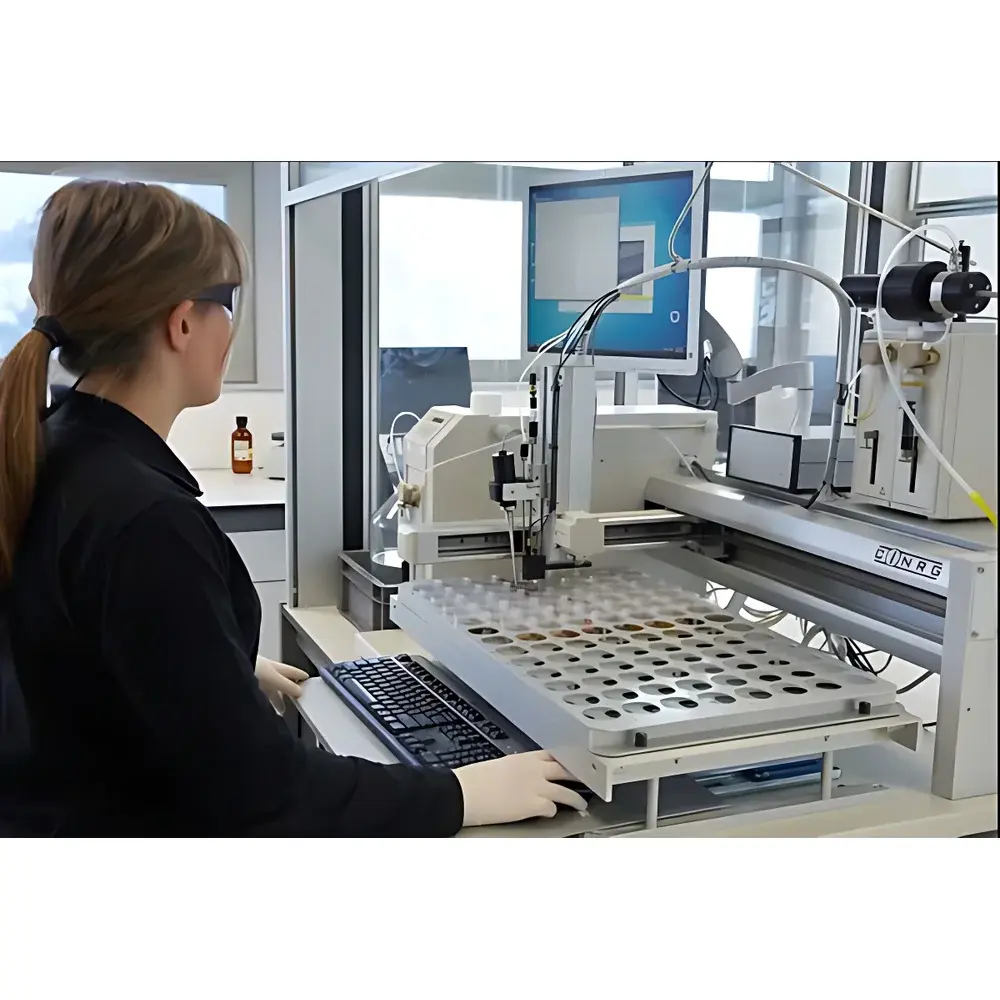
CINRG CS-APC-2 Automated Particle Counter
| Brand | CINRG |
|---|---|
| Origin | Canada |
| Manufacturer Type | Authorized Distributor |
| Origin Category | Imported |
| Model | CS-APC-2 |
| Product Category | Laboratory Instrument |
| Test Parameter | Contaminant Particles |
| Compliance | ASTM D7647-10 |
| Sample Processing Time | 4–5 min/sample |
| Solvent Consumption | 40 mL/sample |
| Autosampler Capacity | 102 samples (104-position tray |
| Sensor Model | KLOTZ LDS 45/50 Laser Sensor |
| Measurement Range | 1.5 µm – 100 µm |
| Flow Rate | 30 mL/min (calibrated) |
| Detection Thresholds | 25,000 particles/mL at ≥4 µm (neat oil), 50,000 particles/mL at ≥4 µm (1:1 dilution) |
| Volume Accuracy | ±2% (pre-dilution) |
| Customizable Reporting | User-defined pass/fail limits at 4 µm, 6 µm, and 14 µm |
| Data Export Fields | Solvent blank count, sample volume, dilution ratio, raw particle counts per channel |
Overview
The CINRG CS-APC-2 Automated Particle Counter is a fully integrated, walk-away laboratory system engineered for high-throughput, standardized particulate contamination analysis of lubricating oils and hydraulic fluids. It operates on the principle of light extinction (laser obscuration) using a KLOTZ LDS 45/50 dual-wavelength laser sensor, enabling precise detection and sizing of solid particulates in the range of 1.5 µm to 100 µm. Designed specifically for compliance with ASTM D7647-10 — Standard Test Method for Determining Particle Count in Lubricating Oils Using Automatic Particle Counters — the CS-APC-2 eliminates operator-dependent variability through automated sample dilution, volumetric aspiration, and batch-driven processing logic. Its architecture supports unattended operation across multi-sample campaigns while maintaining traceable, auditable measurement conditions required in ISO 4406:2017–based reporting and OEM fluid cleanliness specifications.
Key Features
- Full automation from solvent addition to final report generation, including automatic sample volume measurement (±2% accuracy pre-dilution) and programmable dilution protocols.
- 104-position autosampler tray accommodating 102 test samples, with dedicated positions for cleaning beaker (#1) and verification solvent (#2) to ensure baseline integrity between runs.
- Integrated KLOTZ LDS 45/50 laser sensor calibrated to 30 mL/min flow rate, optimized for robust performance in viscous petroleum matrices without clogging or signal drift.
- Real-time batch queue management: users may insert, remove, or reprioritize samples during active processing without interrupting instrument operation.
- Configurable pass/fail logic based on user-defined thresholds at three critical size channels (4 µm, 6 µm, and 14 µm), aligned with ISO 4406 code assignment and OEM equipment protection requirements.
- Dynamic process control: upon detection of an out-of-spec result relative to established process control limits, the system automatically flags subsequent samples for review and applies configurable hold rules.
Sample Compatibility & Compliance
The CS-APC-2 is validated for use with mineral-based, synthetic, and semi-synthetic lubricants, turbine oils, hydraulic fluids, and gear oils. Prior to analysis, samples are diluted with certified particle-free solvent (e.g., Isopar™ L or equivalent) to suppress interference from non-solid contaminants such as water droplets, varnish precursors, and soluble additives — a requirement explicitly addressed in ASTM D7647-10. All system components contacting fluid path meet USP Class VI and FDA-compliant material standards. The platform supports GLP/GMP-aligned workflows via audit-trail-enabled software logging (including user actions, calibration events, and sample metadata). Full traceability is maintained for each measurement cycle, including solvent blank values, measured sample volume, actual dilution ratio, and raw channel-specific counts.
Software & Data Management
The embedded control software provides a secure, role-based interface compliant with FDA 21 CFR Part 11 requirements, featuring electronic signatures, audit trails, and immutable data archiving. Users define output file structure directly within the batch processing template — selecting fields such as solvent background count, net particle concentration (per size channel), ISO 4406 code, and custom pass/fail status. Raw data exports support CSV and XML formats for integration into LIMS or enterprise QA databases. Batch files are write-protected once processing begins or completes, preventing post-hoc edits that could compromise data integrity — a design feature essential for regulatory submissions and third-party certification audits.
Applications
- Quality assurance of new lubricants prior to shipment or commissioning.
- In-service oil monitoring programs for critical rotating equipment (turbines, compressors, gearboxes) to assess wear severity and filter efficiency.
- Validation of filtration system performance under controlled bench-scale testing.
- Root cause analysis of component failures linked to particulate-induced abrasion or blockage.
- Supporting ISO 11218, ISO 12103-1 (ACFTD/ISOMTD reference dusts), and SAE AS4059F contamination classification protocols.
FAQ
Does the CS-APC-2 require manual sample preparation prior to loading?
No — the system performs automated solvent dilution, homogenization, and volumetric aspiration. Operators only load undiluted oil samples into designated 32 mL vials on the autosampler tray.
Can the instrument differentiate between metallic wear debris and non-metallic contaminants?
No — it reports total particle counts by size only. Morphological or elemental identification requires complementary techniques such as SEM-EDS or ferrography.
Is the KLOTZ LDS 45/50 sensor field-replaceable or serviceable onsite?
Yes — the sensor module is designed as a sealed, plug-and-play unit with factory calibration certificates. Field replacement can be performed by certified service personnel with minimal downtime.
How does the system handle viscosity-related flow inconsistencies?
The CS-APC-2 incorporates pressure-compensated flow control and real-time flow monitoring. If deviation exceeds ±5% of setpoint (30 mL/min), the run halts and alerts the operator, preserving data validity.
What documentation is provided to support regulatory validation?
CINRG supplies IQ/OQ documentation templates, ASTM D7647-10 conformance statements, sensor calibration certificates, and software validation summaries meeting GAMP5 and ISO/IEC 17025 requirements.




