
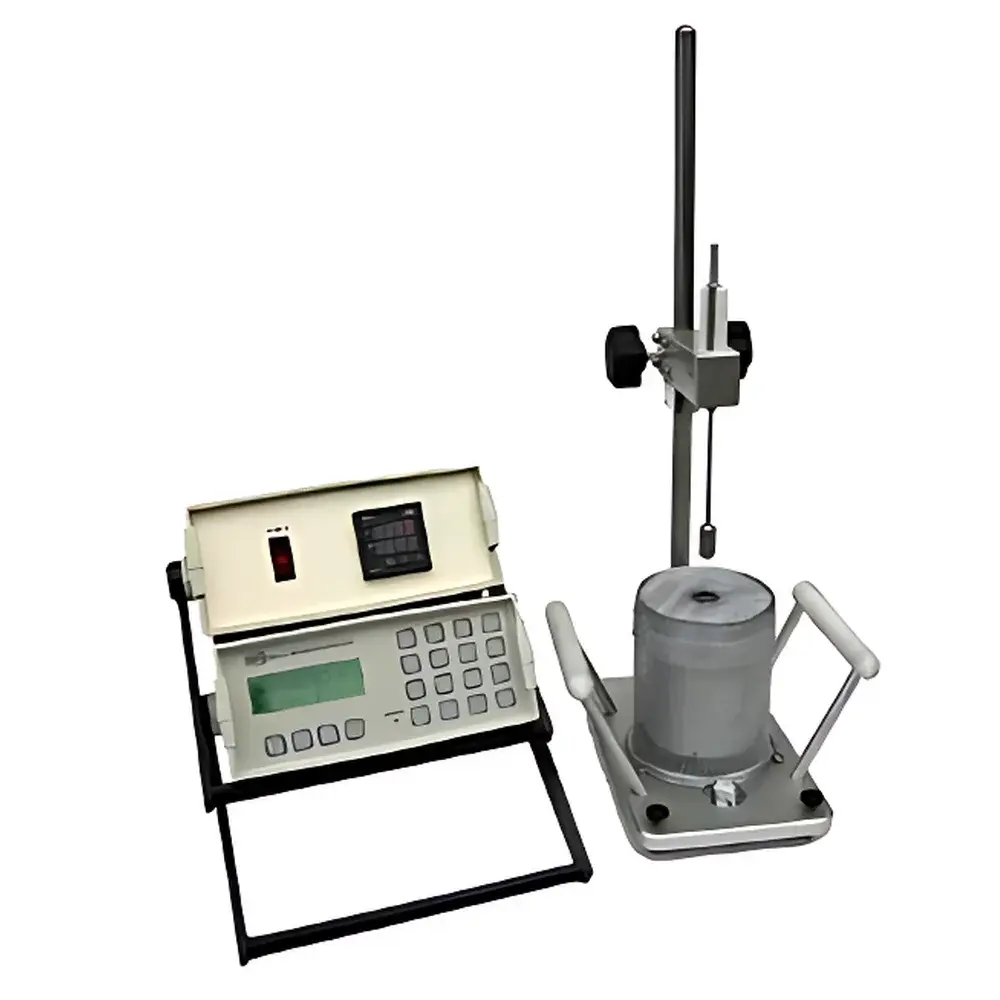
SBS HTV-100 High-Temperature Falling-Needle Viscometer
| Brand | SBS |
|---|---|
| Origin | USA |
| Manufacturer Type | Authorized Distributor |
| Origin Category | Imported |
| Model | HTV-100 |
| Pricing | Available Upon Request |
| Viscosity Range | 1–10⁸ cP (mPa·s) |
| Temperature Range | −40 to 200°C (standard) |
| Accuracy & Repeatability | < ±2% |
| Sample Volume | ~1.5 cm³ |
| Needle Material | Aluminum, Titanium, or Stainless Steel |
| Needle Density Range | 6–1000 g/cm³ |
| Instrument Weight | 5.4 kg (12 lbs) |
| Measurement Resolution | 0.001 s |
| Interface | RS-232 |
| Sample Tube | Disposable, No Cleaning Required |
Overview
The SBS HTV-100 is a high-temperature falling-needle viscometer engineered for precise, absolute viscosity measurement of liquids under thermally demanding conditions. It operates on the principle of Stokes’ law-based terminal velocity determination: a precision-engineered metal needle of known density and geometry falls freely through a vertically oriented sample column under gravity. The instrument measures the time required for the needle to traverse a fixed, optically defined distance within the fluid—enabling direct calculation of dynamic viscosity without empirical calibration curves or shear-rate assumptions. Unlike rotational or capillary viscometers, the HTV-100 imposes minimal mechanical perturbation on the sample, preserving native microstructure—critical for temperature-sensitive, shear-thinning, or structurally fragile systems such as polymer melts, thermosetting resins, or bioactive emulsions. Its dual-range thermal capability (−40 to 200°C standard; extended to 350°C with optional furnace assembly) supports characterization across glass transitions, curing profiles, and high-temperature process windows common in petrochemical refining, aerospace lubricant development, and advanced material synthesis.
Key Features
- Falling-needle methodology delivers absolute dynamic viscosity (mPa·s) traceable to SI units—no calibration fluids or instrument-specific constants required.
- Microprocessor-controlled console with RS-232 serial interface enables integration into automated lab networks and LIMS environments.
- Automated timing resolution of 0.001 s ensures high reproducibility across replicate measurements, supporting statistical process control (SPC) protocols.
- Disposable borosilicate or quartz sample tubes eliminate cross-contamination and cleaning validation burdens—fully compliant with GLP audit requirements.
- Modular needle set (Al, Ti, SS) with selectable densities (6–1000 g/cm³) allows optimization for low- and high-viscosity regimes, including non-Newtonian samples where yield stress or thixotropy must be assessed via multi-density analysis.
- Thermally isolated heating chamber maintains ±0.1°C stability over extended dwell periods, critical for temperature-ramp viscosity profiling per ASTM D341 and ISO 2555.
- Compact footprint (5.4 kg total mass) and plug-and-play operation reduce setup time and operator training overhead in QC laboratories.
Sample Compatibility & Compliance
The HTV-100 accommodates a broad spectrum of industrial and research-grade materials—including molten polymers, hot asphalt binders, high-solids slurries, thermally cured epoxies, and food-grade viscous matrices (e.g., heated honey, molten chocolate, or sterilized dairy concentrates). Its non-invasive measurement protocol avoids wall-slip artifacts common in rotational geometries and eliminates shear history effects induced by pre-shearing. All hardware components meet RoHS and CE electromagnetic compatibility (EMC) directives. For regulated environments, the system supports 21 CFR Part 11-compliant data logging when paired with validated SBS acquisition software—providing electronic signatures, audit trails, and immutable raw-data archiving aligned with FDA, EMA, and ICH-GCP standards.
Software & Data Management
SBS provides proprietary Windows-based software (v5.2+) for instrument control, real-time viscosity calculation, temperature ramp scripting, and multi-curve overlay analysis. Raw falling-time data, temperature logs, and metadata (operator ID, sample ID, timestamp, needle ID) are stored in encrypted .csv and .sbsd binary formats. Export options include ASTM D2196-compliant reports, ISO/IEC 17025 traceability templates, and direct import into MATLAB, Python (pandas), or JMP for advanced rheological modeling. Software validation packages—including IQ/OQ documentation, UAT test scripts, and change control records—are available upon request for GMP-regulated users.
Applications
- Petrochemical R&D: Viscosity-temperature profiling of base oils, synthetic lubricants, and heavy fuel fractions under refinery-relevant conditions.
- Coatings & Inks: Monitoring thermal thinning behavior of UV-curable resins and high-solids architectural paints during cure simulation.
- Pharmaceutical Manufacturing: Characterizing melt viscosity of hot-melt extrusion (HME) formulations containing APIs and polymeric carriers at 120–180°C.
- Food Science: Quantifying temperature-dependent flow behavior of caramelized syrups, molten cheese analogs, and sterilized nut butters without thermal degradation.
- Materials Engineering: Evaluating viscosity evolution during thermoset polymerization (e.g., phenolics, bismaleimides) from induction to gelation.
- Academic Research: Studying glass transition kinetics, crystallization onset, and phase separation dynamics in complex fluids via controlled cooling/heating ramps.
FAQ
How does the HTV-100 ensure measurement accuracy without calibration standards?
It applies first-principles physics: viscosity is calculated directly from needle geometry, density, fall distance, and transit time using the modified Stokes equation—eliminating reliance on reference oils or factory calibration.
Can the system handle highly abrasive or corrosive samples?
Yes—quartz sample tubes and Hastelloy-coated needles (optional) are available for aggressive media such as coal-water slurries or acidic catalyst suspensions.
Is temperature ramping programmable?
Yes—the console supports linear, stepwise, and isothermal hold profiles with user-defined ramp rates (0.1–10°C/min) and dwell durations up to 999 minutes.
Does the instrument comply with ISO 17025 accreditation requirements?
When operated with validated software, documented SOPs, and traceable NIST-certified temperature sensors, the HTV-100 meets key metrological criteria for accredited testing laboratories.
What maintenance is required beyond routine needle inspection?
None—no moving parts, no bearings, no fluid seals. Annual verification of temperature sensor drift and Hall sensor alignment is recommended per ISO/IEC 17025 Clause 6.4.10.




