
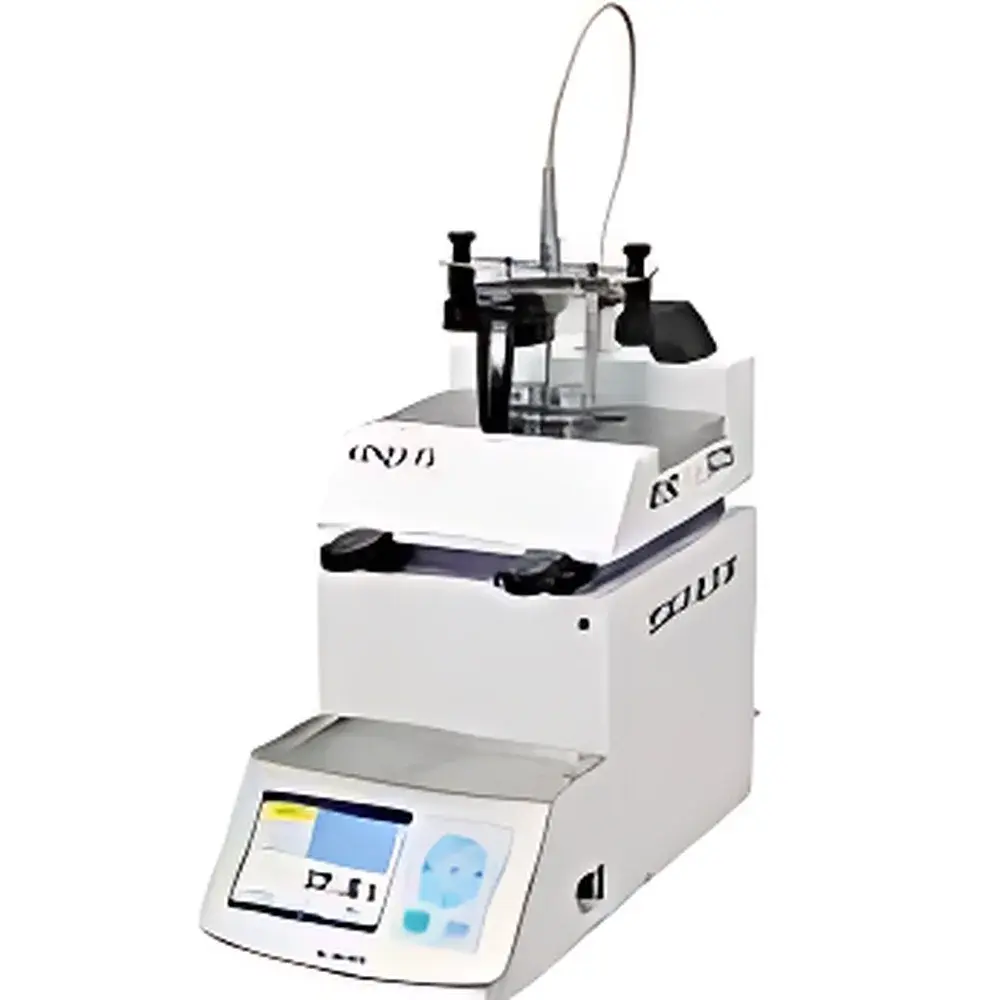
TANAKA ASP-6 Automatic Ring-and-Ball Softening Point Tester
| Brand | TANAKA |
|---|---|
| Origin | Japan |
| Model | ASP-6 |
| Measurement Method | Ring-and-Ball (Dual-Sample) |
| Temperature Range | Ambient to 200 °C |
| Display | 5.7-inch LCD, 0.1 °C resolution |
| Temperature Sensor | PT100 platinum resistance thermometer |
| Interface | RS-232C serial port |
| Power Supply | AC 220 V, 50/60 Hz, 12 A |
| Dimensions (W×D×H) | 230 × 440 × 420 mm |
| Weight | Approx. 14 kg |
Overview
The TANAKA ASP-6 Automatic Ring-and-Ball Softening Point Tester is a fully automated analytical instrument engineered for precise determination of the softening point of bituminous materials—including paving asphalts, roofing asphalts, coal tar pitches, and thermoplastic road marking compounds—according to internationally recognized standard test methods. It implements the classical ring-and-ball principle defined in ASTM D36 and IP 58, wherein a steel ball rests on a specimen disc confined within a brass ring; the assembly is suspended in a liquid medium (typically water or glycerin) and heated at a controlled linear rate. The temperature at which the softened specimen allows the ball to descend a specified distance (25.4 mm) is recorded as the softening point. Unlike manual setups requiring operator judgment and timing, the ASP-6 employs real-time thermal monitoring and mechanical displacement detection to identify the endpoint objectively—eliminating observer bias and enhancing measurement reproducibility across laboratories.
Key Features
- Automated endpoint detection via integrated mechanical displacement sensing and synchronized thermal profiling—no subjective visual assessment required.
- Dual-sample configuration enables parallel testing of two specimens under identical thermal conditions, improving throughput and inter-sample comparability.
- High-stability temperature control system with ramp accuracy compliant with ASTM D36 requirements (5.0 ± 0.5 °C/min), maintained using PID-regulated heating and PT100 feedback.
- 5.7-inch backlit LCD display with 0.1 °C resolution and intuitive icon-driven interface; softening point value flashes upon detection, accompanied by audible and visual alerts.
- Modular architecture separates control electronics from the thermal bath and detection mechanism—facilitating field service, calibration verification, and component-level replacement without full-system recalibration.
- Factory pre-calibrated and verified against NIST-traceable reference standards; no routine adjustment needed under normal operating conditions.
Sample Compatibility & Compliance
The ASP-6 accommodates standard ASTM/IP-compliant brass rings (15.9 mm inner diameter, 12.7 mm height) and 9.5 mm steel balls. It supports both water-bath (for softening points ≤ 80 °C) and glycerin-bath (for points up to 200 °C) configurations, with automatic bath medium recognition logic embedded in firmware. All operational parameters—including heating rate, endpoint threshold, and alarm thresholds—are configurable within limits defined by ASTM D36 Annex A1 and ISO 4625. The instrument meets electromagnetic compatibility (EMC) requirements per IEC 61326-1 and safety compliance per IEC 61010-1. Its design supports GLP-compliant workflows through audit-ready event logging and user-accessible calibration history storage.
Software & Data Management
Equipped with an embedded RS-232C serial interface, the ASP-6 transmits raw temperature/time data, detected softening point values, and system status flags (e.g., “test started”, “endpoint confirmed”, “heating stopped”) in ASCII format. When connected to a host PC running validated laboratory data management software (e.g., LabWare LIMS or custom SCADA), it supports automated data ingestion, electronic signature capture, and 21 CFR Part 11–compliant audit trails—including timestamps, operator ID, and instrument serial number. Data export formats include CSV and fixed-field text, enabling direct import into statistical process control (SPC) platforms or QA documentation systems. Firmware updates are performed via serial terminal emulation without hardware modification.
Applications
This instrument is routinely deployed in asphalt production QC labs, petroleum refinery quality assurance departments, road construction material certification bodies, and independent testing laboratories accredited to ISO/IEC 17025. Typical use cases include batch release testing of polymer-modified binders, evaluation of aging effects in RTFO- and PAV-aged samples, comparative analysis of reclaimed asphalt pavement (RAP) binder compatibility, and specification conformance verification for national highway authorities (e.g., AASHTO M 28, EN 1427). Its dual-sample capability also supports method validation studies requiring paired replicate measurements under identical thermal gradients.
FAQ
Does the ASP-6 support both water and glycerin heating media?
Yes—the instrument automatically adjusts thermal ramp parameters and endpoint detection logic based on user-selected bath medium, ensuring compliance with ASTM D36 Section 7.1 and Section 7.2.
Is calibration traceable to national standards?
All factory calibrations are performed using PT100 reference probes certified to ISO/IEC 17025-accredited laboratories, with full traceability to JCSS (Japan Calibration Service System) and NIST.
Can test results be exported directly to Excel or LIMS?
Yes—via RS-232C, ASCII-formatted data streams can be parsed by third-party software; optional TANAKA-provided utility software offers one-click CSV export and PDF report generation.
What maintenance is required between tests?
Routine cleaning of rings, balls, and bath vessel is recommended after each test cycle; no periodic recalibration is necessary unless subjected to mechanical shock or electrical surge events.
Is the ASP-6 suitable for GMP-regulated environments?
Yes—when operated with appropriate SOPs and connected to a 21 CFR Part 11–validated data acquisition system, it satisfies documentation and traceability requirements for pharmaceutical-grade excipient characterization where bituminous coatings are employed.





