
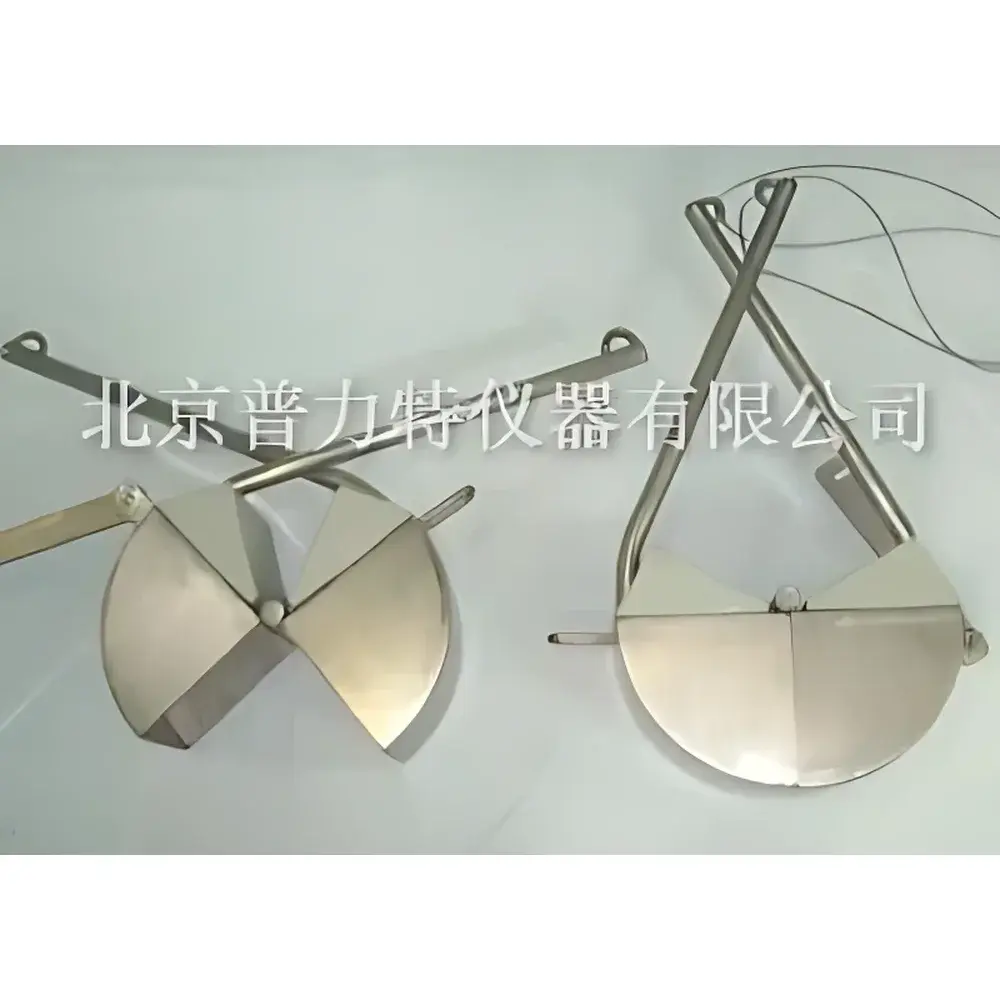
Van Veen Grab Sampler VG
| Origin | Beijing |
|---|---|
| Manufacturer Type | Distributor |
| Origin Category | Domestic |
| Model | VG |
| Quotation | Upon Request |
| Instrument Type | Laboratory Water Sampler |
| Material | Stainless Steel |
| Weight | 18 kg |
| Sampling Area | 30 cm × 15 cm |
| Sediment Penetration Depth | 15 cm |
| Sample Capacity | 5 L |
| Carrying Case | Aluminum Transport Case |
Overview
The Van Veen Grab Sampler VG is a precision-engineered, gravity-actuated benthic sediment sampler designed for reliable collection of undisturbed surface sediments from freshwater and marine environments. Based on the internationally recognized Van Veen principle—where opposing stainless steel jaws close symmetrically upon impact with the seabed—the VG model ensures high sample integrity and minimal sediment disturbance during retrieval. It is optimized for use in rivers, lakes, reservoirs, and shallow coastal zones (typically ≤ 50 m depth), where representative characterization of surficial deposits is critical for ecological risk assessment, contaminant mapping, and regulatory compliance monitoring. Its robust mechanical design eliminates dependence on electronic actuators or winch-integrated release systems, making it suitable for field deployment from small research vessels, docks, or inflatable boats without specialized lifting infrastructure.
Key Features
- Stainless steel jaw assembly engineered for corrosion resistance and long-term dimensional stability in saline and brackish water conditions
- Symmetrical dual-jaw closure mechanism ensuring uniform sampling pressure and consistent penetration depth of 15 cm across variable substrate types (sand, silt, clay, organic-rich mud)
- Effective sampling area of 450 cm² (30 cm × 15 cm), delivering statistically representative subsamples for grain-size analysis, heavy metal profiling, and organic pollutant quantification
- 5-liter nominal sample capacity—sufficient to support replicate analyses, preservation protocols, and archival storage per GLP-compliant workflows
- Integrated aluminum transport case (anodized finish) providing impact protection, corrosion shielding, and standardized field logistics; includes reinforced coarse nylon rope (≥ 12 mm diameter, UV-stabilized polypropylene) rated for repeated submersion and manual hauling
- Weight-optimized 18 kg configuration balancing inertial momentum for effective seabed penetration while remaining manually deployable by two personnel under typical field conditions
Sample Compatibility & Compliance
The VG Grab Sampler is validated for use with unconsolidated, non-rocky substrates exhibiting shear strength 95% of lacustrine, fluvial, and nearshore marine depositional environments. It complies with ASTM D6913–22 (Standard Test Methods for Particle-Size Distribution of Soil), ISO 10381-2:2022 (Soil quality — Sampling — Part 2: Guidance on sampling techniques for soil and sediment), and EPA Method 1664B (n-Hexane Extractable Material). When deployed as part of a certified environmental monitoring program, data generated using this instrument satisfy requirements for chain-of-custody documentation and are admissible in regulatory reporting under EU Water Framework Directive Annex V and US Clean Water Act Section 304(a) sediment assessment frameworks.
Software & Data Management
As a purely mechanical sampling device, the VG Grab Sampler requires no embedded firmware, drivers, or proprietary software. All operational parameters—including deployment location (GPS-tagged via external logger), time stamp, water depth (sonar or echo sounder verified), substrate description (USGS Unified Soil Classification System codes), and visual sediment stratigraphy notes—are recorded manually or entered into validated LIMS platforms such as LabWare LIMS or Thermo Fisher SampleManager. Audit trails, calibration logs (jaw alignment verification per quarterly maintenance checklist), and equipment certification records are maintained in accordance with ISO/IEC 17025:2017 Clause 7.7 and FDA 21 CFR Part 11-compliant electronic record systems when paired with digital field notebooks.
Applications
- Baseline sediment characterization prior to dredging or offshore construction projects
- Monitoring temporal trends in polycyclic aromatic hydrocarbon (PAH), PCB, and microplastic accumulation in urban estuaries
- Supporting benthic macroinvertebrate community surveys (e.g., ASTM D4767–22) through co-located physical-chemical habitat profiling
- Validation of in situ sensor arrays (e.g., porewater redox probes, O₂ microelectrodes) by enabling direct comparison between real-time measurements and ex situ laboratory analysis
- Training and method standardization across multi-agency water quality programs requiring inter-laboratory comparability (e.g., ITRC Sediment Remediation Guidance)
FAQ
What is the maximum recommended water depth for reliable operation?
The VG Grab Sampler is validated for depths up to 50 meters. Beyond this, reduced free-fall velocity and increased rope stretch may compromise jaw closure consistency; use with a weighted descent sleeve is advised for depths 50–100 m.
How frequently should jaw alignment be verified?
Alignment must be checked before each field campaign and after any impact event; a certified technician should perform angular deviation measurement (±0.5° tolerance) using optical leveling tools per manufacturer’s Maintenance Protocol VG-MP-2023.
Can the sampler be used in rocky or gravelly substrates?
No. The VG design assumes cohesive or semi-cohesive sediments. Gravel, cobbles, or shell hash will prevent full jaw closure and yield non-representative samples; alternative tools such as box corers or vibrocorers are recommended.
Is the aluminum carrying case waterproof?
The case features gasket-sealed hinges and IP54-rated ingress protection against splashing water and dust, but is not submersible; it is intended for transport and dry storage only.
Does the sampler meet ISO 5725 repeatability criteria for sediment sampling?
Yes—when operated by trained personnel following SOP VG-SOP-01, inter-operator relative standard deviation (RSD) for recovered dry mass is ≤ 8.2%, satisfying ISO 5725-2:2019 accuracy class B for heterogeneous environmental matrices.







