
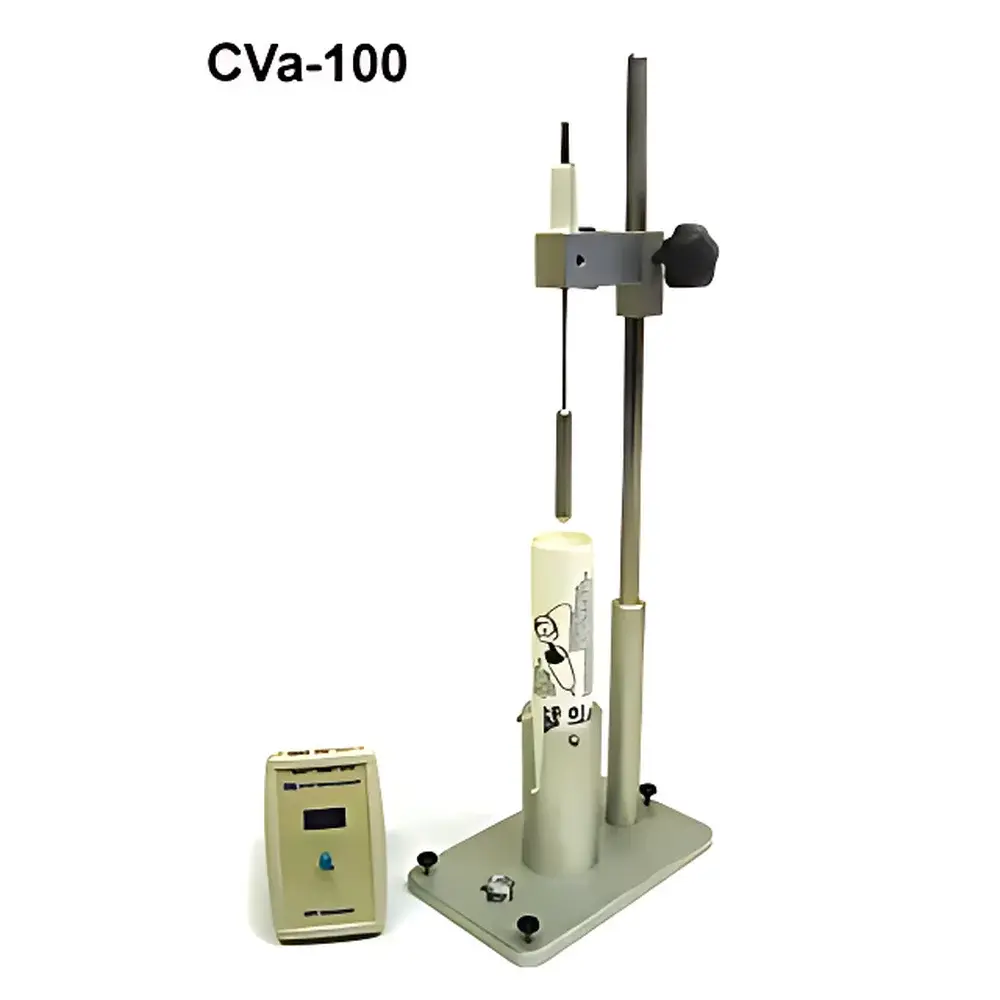
SBS CV-100 Falling Needle Viscometer
| Brand | SBS |
|---|---|
| Origin | USA |
| Manufacturer Type | Authorized Distributor |
| Origin Category | Imported |
| Model | CV-100 |
| Pricing | Upon Request |
| Measurement Principle | Falling Needle (Capillary-Free Gravitational Sedimentation) |
| Viscosity Range | Up to 1 × 10⁹ cP |
| Time Resolution | 0.001 s |
| Temperature Control | Optional Water Jacket (–40 to 150 °C) |
| Interface | RS-232 |
| Sample Tube | Disposable Polypropylene Caulking Tube (reusable up to 30× with proper cleaning) |
| Compliance | ASTM D1084, ISO 2555, USP <911>, GLP-compatible data logging |
Overview
The SBS CV-100 Falling Needle Viscometer is a precision-engineered, gravity-driven rheological instrument designed specifically for the absolute viscosity measurement of highly viscous, non-Newtonian, and structurally sensitive materials—without reliance on capillary flow or rotational shear. Operating on the principle of controlled gravitational sedimentation, the CV-100 measures the time required for a magnetized stainless-steel needle to fall a fixed vertical distance through a sample contained in a standardized disposable tube. This method eliminates wall-slip artifacts, minimizes sample disturbance, and avoids mechanical degradation common in rotary systems—making it especially suitable for gels, pastes, ointments, slurries, and thixotropic formulations where structural integrity must be preserved during testing. Unlike rotational viscometers requiring calibration with reference oils, the CV-100 delivers absolute viscosity (in centipoise) directly from fundamental physical parameters: needle geometry, density differential, gravitational acceleration, and measured fall time—ensuring traceability to SI units without periodic recalibration.
Key Features
- Disposable polypropylene caulking tube—designed for single-use but validated for up to 30 clean reuses under controlled lab conditions
- Direct absolute viscosity measurement across an extended range up to 1 × 10⁹ cP, covering semi-solids and yield-stress fluids
- No tube cleaning required between measurements when using fresh tubes—eliminating cross-contamination and downtime
- Calibration-free operation: viscosity derived from first principles, independent of instrument-specific constants
- Minimal mechanical perturbation—preserves microstructure of fragile dispersions, emulsions, and biomaterials during analysis
- High-resolution timing system with Hall-effect sensors and integrated magnet assembly, resolving fall times to ±0.001 s
- Optional thermostatic water jacket enabling precise temperature control from –40 °C to +150 °C for thermal rheology profiling
- Rapid test cycle: typical measurement completes within 30–120 seconds per sample, supporting high-throughput QC environments
- Simultaneous relative sedimentation rate assessment—valuable for stability screening of suspensions and colloidal systems
- Microprocessor-based console with RS-232 serial interface for integration into LIMS, ELN, or automated data archiving systems
Sample Compatibility & Compliance
The CV-100 accommodates a broad spectrum of industrial and research-grade materials—including adhesives, sealants, pharmaceutical ointments, cosmetic creams, food pastes (e.g., ketchup, mayonnaise, honey), polymer melts, coal slurries, latex dispersions, lubricating greases, and petroleum-based varnishes. Its non-invasive falling-needle methodology ensures representative measurement of materials exhibiting yield stress, time-dependent recovery, or shear-thinning behavior. The instrument conforms to widely accepted industry standards including ASTM D1084 (viscosity of adhesives), ISO 2555 (determination of apparent viscosity of polymer solutions), and USP Chapter (rheological characterization of semisolid dosage forms). When operated with audit-trail-enabled software and timestamped digital logs, the CV-100 supports GLP and GMP compliance requirements—including FDA 21 CFR Part 11 readiness for electronic records and signatures.
Software & Data Management
The CV-100 console supports bidirectional RS-232 communication with optional SBS ViscoLink™ software (Windows-based), enabling automated data capture, real-time fall-time plotting, batch reporting, and statistical process control (SPC) charting. Software modules include Non-Newtonian Analysis Suite for modeling flow curves via power-law or Herschel-Bulkley fits—critical for formulation development and QC release testing. All raw timing data, temperature stamps, operator IDs, and instrument configuration metadata are stored in CSV- and XML-compliant formats. Audit trails record user actions, parameter changes, and calibration events—fully traceable for regulatory submissions. Data export integrates seamlessly with LabWare LIMS, Thermo Fisher SampleManager, and other enterprise laboratory informatics platforms.
Applications
This viscometer serves critical roles across R&D, manufacturing, and quality assurance workflows. In coatings and paints, it quantifies sag resistance and leveling behavior. For pharmaceuticals, it validates consistency of topical gels and transdermal patches per ICH Q5C guidelines. In food science, it monitors structural breakdown in dairy-based spreads and starch-thickened sauces. Adhesive manufacturers use it to correlate open time and bond strength with low-shear viscosity profiles. Battery slurry developers apply it to assess electrode coating homogeneity prior to slot-die deposition. Additionally, the CV-100 supports ASTM D7178 (yield stress determination of grease) and ISO 6743-9 (lubricant classification) protocols—making it a versatile tool for material scientists, QC analysts, and process engineers working with complex, high-viscosity fluids.
FAQ
How does the CV-100 differ from rotational viscometers in measuring high-viscosity materials?
The CV-100 applies near-zero shear stress during measurement, avoiding structural breakdown and wall slip—whereas rotary instruments impose defined shear rates that may alter sample rheology or exceed yield thresholds.
Is temperature control mandatory for accurate results?
While room-temperature operation is possible, viscosity is highly temperature-dependent; the optional water jacket is recommended for method standardization, regulatory compliance, and comparative studies.
Can the CV-100 measure yield stress?
Yes—by analyzing the critical needle weight at which movement initiates, the system enables empirical yield stress estimation consistent with ASTM D7178 Annex A2.
What maintenance is required beyond routine sensor checks?
No moving parts or bearings require servicing; primary upkeep involves periodic verification of magnet alignment, Hall sensor response, and water jacket circulation integrity.
Does SBS provide validation documentation for IQ/OQ/PQ protocols?
Yes—factory-issued Installation Qualification (IQ) templates, Operational Qualification (OQ) test scripts, and Performance Qualification (PQ) reference materials are available upon request for regulated environments.






