
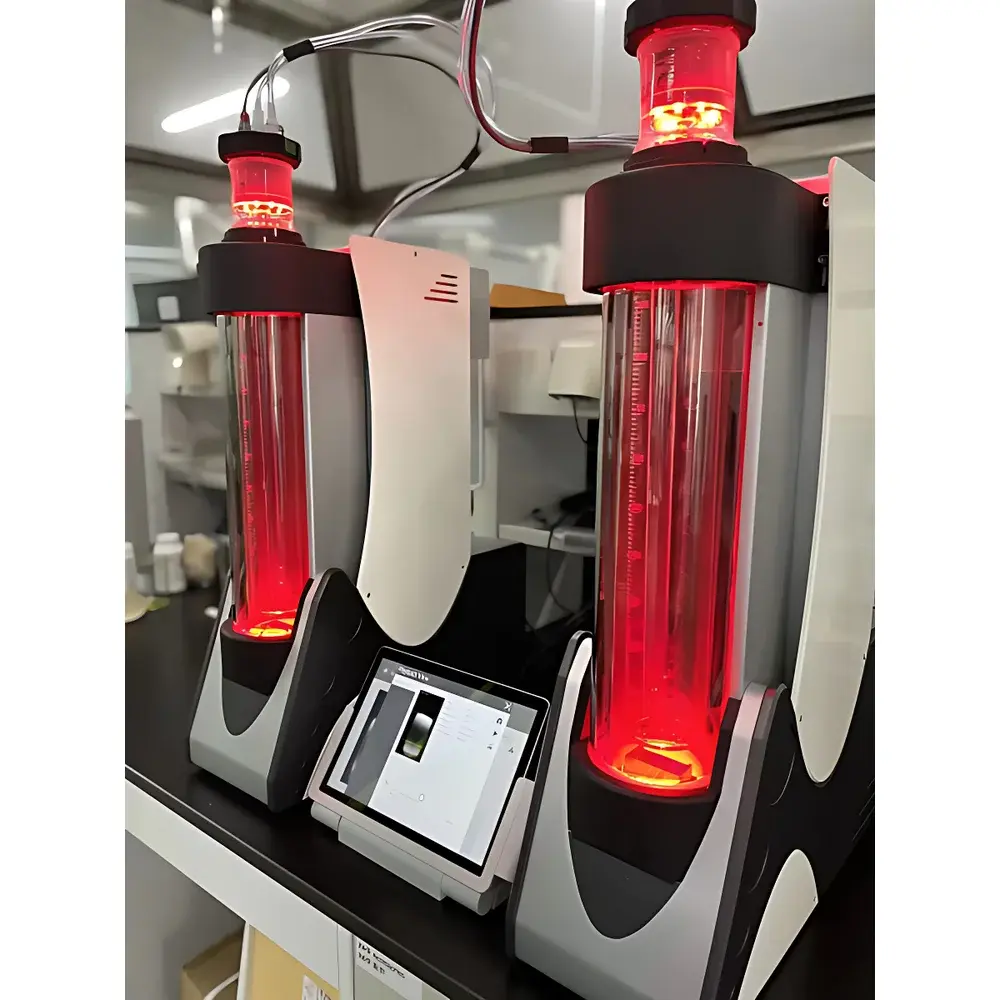
VISAYA Foam DDI Automated Foam Characterization Instrument
| Brand | VISAYA |
|---|---|
| Origin | USA |
| Model | FOAM DDI |
| Compliance | ASTM D892, ASTM D6082, GB/T 12579, SH/T 0722 |
| Imaging System | High-Resolution CCD with LED Illumination Control |
| Sample Volume | ~200 mL in 1000 mL calibrated cylinder |
| Temperature Control Range | Ambient to 99.9 °C |
| Display | Integrated HD Touchscreen Interface |
| Data Output | Exportable CSV/Excel reports with timestamped video log |
| Software Features | Real-time foam height tracking, algorithmic foam volume quantification, manual result override, full-test video recording |
Overview
The VISAYA Foam DDI Automated Foam Characterization Instrument is a precision-engineered system designed for objective, repeatable evaluation of foaming behavior in lubricating oils and functional fluids. It operates on the principle of digital optical metrology—leveraging a calibrated high-resolution CCD imaging subsystem coupled with programmable LED illumination—to capture, quantify, and analyze foam structure evolution over time. Unlike traditional manual foam measurement methods, the Foam DDI eliminates operator-dependent parallax errors and subjective endpoint judgments by converting foam column geometry into traceable digital metrics. The instrument executes standardized test protocols—including ASTM D892 (Foaming Tendency and Stability at 24 °C and 93.5 °C), ASTM D6082 (High-Temperature Foaming Characteristics at 150 °C), GB/T 12579, and SH/T 0722—under fully automated thermal and pneumatic control. Its architecture integrates fluid temperature regulation, timed air sparging, dynamic image acquisition, and proprietary foam segmentation algorithms to deliver quantitative foam height, collapse kinetics, and residual foam volume data—all synchronized with time-stamped video documentation.
Key Features
- Fully automated execution of ASTM D892, ASTM D6082, GB/T 12579, and SH/T 0722 test sequences without manual intervention after sample loading
- CCD-based optical detection system with auto-adjusting LED backlighting ensures consistent contrast and minimizes glare-induced measurement variance
- Precise temperature control from ambient to 99.9 °C (ASTM D892) or up to 150 °C (ASTM D6082) via integrated heated bath and PID-regulated cylinder jacket
- Real-time foam height tracking with sub-millimeter spatial resolution; software computes foam volume via cross-sectional area integration
- Onboard HD touchscreen interface enables method selection, parameter configuration, live image preview, and immediate result visualization
- Full-test video recording (H.264 encoded) synchronized with sensor timestamps supports auditability and forensic review per GLP/GMP requirements
- Algorithmic post-processing includes foam onset detection, maximum foam height identification, half-life calculation, and 10-/24-minute stability indexing
Sample Compatibility & Compliance
The Foam DDI accommodates standard 1000 mL graduated glass cylinders (ASTM-compliant dimensions) and accepts sample volumes of approximately 200 mL—sufficient to maintain consistent gas dispersion geometry across viscosity ranges typical of engine oils, hydraulic fluids, gear oils, and compressor lubricants. The system is validated for use with mineral, synthetic, and semi-synthetic base stocks, including those containing silicone antifoams, polyacrylate dispersants, or phosphorus-containing additives. All operational firmware and reporting modules comply with data integrity expectations outlined in FDA 21 CFR Part 11 (electronic records/signatures) when deployed in regulated QC environments. Test reports include metadata such as operator ID, method version, calibration certificate reference, environmental temperature/humidity logs, and video hash verification for tamper-evident archiving.
Software & Data Management
The Foam DDI runs on an embedded Linux-based platform with dedicated firmware optimized for real-time image analysis. The user interface supports multi-language localization (English, Chinese, German, Japanese) and allows creation of custom test templates with defined temperature ramp profiles, airflow rates (standardized per ASTM), and duration parameters. Data is stored locally in encrypted SQLite databases and exportable in CSV, Excel (.xlsx), or PDF formats—with optional integration into LIMS via TCP/IP or USB mass storage. Audit trails record all user actions, parameter modifications, and result edits—including timestamps, IP addresses (if network-enabled), and justification notes for manual overrides. Video files are tagged with SHA-256 checksums and retained alongside numerical outputs to satisfy traceability requirements under ISO/IEC 17025 and ASTM E2500.
Applications
- Quality control laboratories evaluating batch-to-batch consistency of finished lubricants against OEM specifications
- R&D departments screening antifoam additive packages and optimizing base oil–additive interactions
- Third-party testing facilities performing contract analyses for API licensing, OEM approvals, or regulatory submissions
- Failure analysis investigations where foam-related equipment malfunction (e.g., pump cavitation, oil starvation in gearboxes) requires root-cause correlation
- Stability benchmarking of biodegradable or low-SAPS formulations under extended thermal stress conditions
FAQ
Does the Foam DDI require external PC connectivity to operate?
No—the instrument functions as a standalone unit with integrated computing, display, and storage. A PC is only required for advanced report customization or LIMS integration.
Can the system be calibrated using NIST-traceable standards?
Yes—calibration routines include geometric verification using certified gauge blocks and thermal validation with NIST-traceable RTDs. Certificate of Calibration is issued with each service event.
Is video recording mandatory during every test?
Video capture is enabled by default but can be disabled via administrator settings. However, disabling it voids compliance with 21 CFR Part 11 audit requirements.
What maintenance intervals are recommended for the optical path?
The CCD lens and LED diffuser should be inspected quarterly; cleaning is performed using Class 100 cleanroom swabs and reagent-grade isopropyl alcohol per manufacturer guidelines.
How does the system handle samples with high particulate content or opacity?
The algorithm applies adaptive thresholding and edge-enhancement filters to maintain accuracy in moderately turbid fluids; severely opaque or carbon-laden samples may require pre-filtration per ASTM D2276 guidance.





