
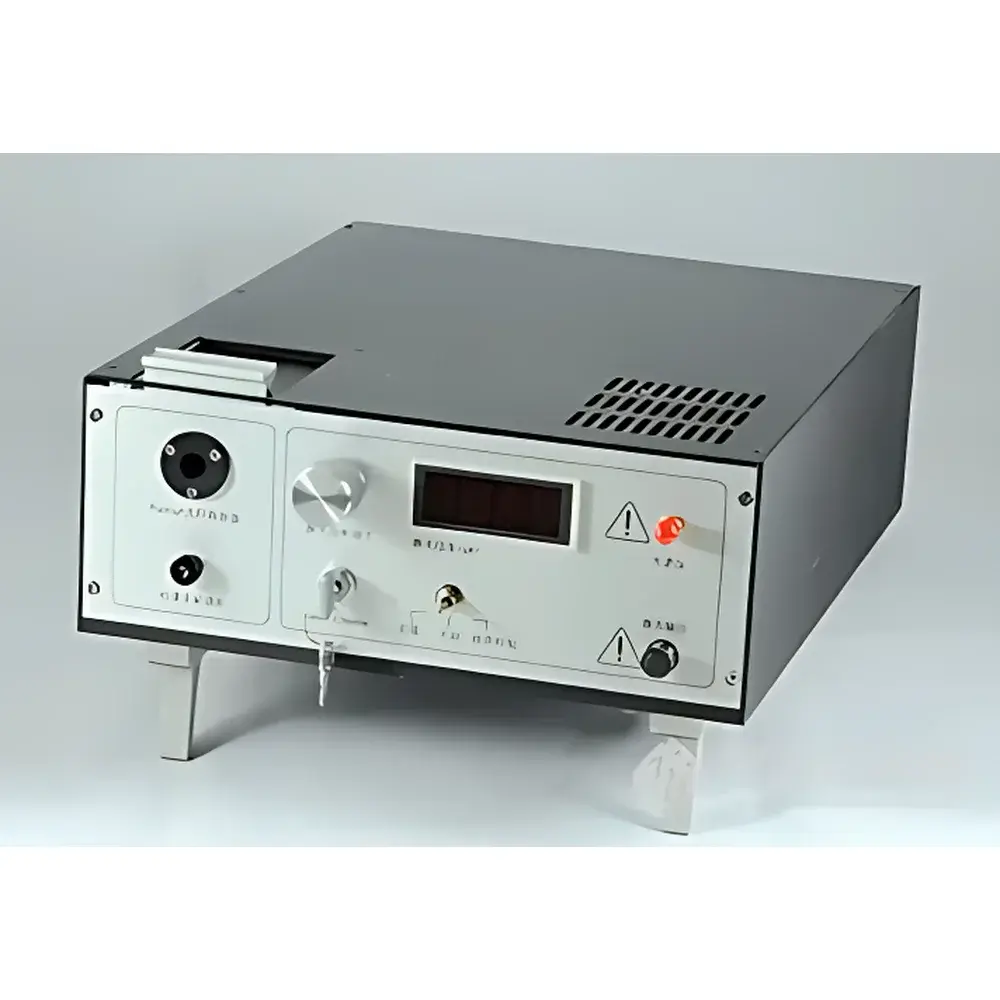
SPL-RAMAN Portable Raman Spectrometer System
| Brand | SPL Photonics |
|---|---|
| Origin | Zhejiang, China |
| Manufacturer Type | Authorized Distributor |
| Instrument Type | Handheld Portable Raman Spectrometer |
| Excitation Wavelength | 785 nm (±0.5 nm) |
| Laser Output Power | 0–500 mW (CW, TEC-stabilized) |
| Spectral Range | 200–2000 cm⁻¹ or 200–3900 cm⁻¹ (user-selectable) |
| Spectral Resolution | 6–10 cm⁻¹ |
| Optical Resolution (wavelength domain) | 0.1–6.5 nm (dependent on grating and slit) |
| Slit Options | 25 µm / 50 µm |
| Grating Options | 600 or 1200 lines/mm |
| Detector | Hamamatsu S7031-1006 back-illuminated FFT-CCD with TE cooling |
| Signal-to-Noise Ratio | ≥1000:1 (at 1 s integration) |
| Integration Time | 1 ms – 15 min |
| Fiber Probe | SPL-RPB-785, dual-fiber configuration (105 µm excitation / 200 µm collection), OD >6 Rayleigh rejection, 7.5 mm working distance |
| Operating Temperature | 0–40 °C (probe), –10 to +45 °C (laser) |
| Compliance | CE, RoHS |
| Dimensions (spectrometer) | 182 × 110 × 47 mm |
| Weight | 1180 g |
| Interface | USB 2.0 |
| Software | Analyze IQ Lab + Spectra Manager + Raman Spectra Library (1868 reference spectra) |
Overview
The SPL-RAMAN Portable Raman Spectrometer System is an engineered solution for field-deployable, non-destructive molecular identification based on inelastic light scattering—Raman spectroscopy. It operates on the principle that monochromatic 785 nm laser photons interact with molecular vibrational modes, generating frequency-shifted scattered light (Stokes and anti-Stokes bands) characteristic of chemical bonds and molecular symmetry. Unlike destructive or solvent-dependent techniques such as HPLC or FTIR, Raman spectroscopy requires no sample preparation, enables through-barrier analysis (e.g., through glass vials, plastic packaging, or polymer films), and preserves sample integrity. The system integrates a high-stability 500 mW TEC-cooled 785 nm diode laser, a back-illuminated FFT-CCD spectrometer with thermoelectric cooling, and a patented fiber-coupled probe (SPL-RPB-785) featuring >6 OD Rayleigh rejection. Designed for reproducible spectral acquisition under variable ambient conditions, it delivers consistent wavenumber calibration stability (<0.005 nm/°C) and low RMS noise (<1% over 10 Hz–100 MHz), meeting baseline requirements for qualitative screening and semi-quantitative assessment in regulated environments.
Key Features
- Field-Ready Portability: Compact spectrometer module (182 × 110 × 47 mm, 1.18 kg) with integrated USB 2.0 interface and 1 m flexible fiber probe enables rapid deployment in laboratories, customs checkpoints, pharmaceutical cleanrooms, or outdoor forensic sites.
- Optimized Excitation & Detection: 785 nm laser minimizes fluorescence interference from organic matrices; narrow linewidth (0.2 nm FWHM) ensures precise excitation; dual-fiber probe with matched NA (0.22) maximizes signal throughput while rejecting elastically scattered light.
- Configurable Spectral Performance: Selectable grating (600 or 1200 l/mm) and slit (25 or 50 µm) allow trade-offs between resolution (6–10 cm⁻¹) and sensitivity across 200–2000 cm⁻¹ or extended 200–3900 cm⁻¹ ranges—suitable for polymorph discrimination, hydrate analysis, and mixture deconvolution.
- Ruggedized Optical Architecture: All optical components—including collimating optics, filters, and detector—are mechanically locked and shock-isolated to maintain alignment during transport or handheld use; probe housing is anodized aluminum/stainless steel with Class I laser safety certification.
- Thermally Stable Acquisition: TE-cooled CCD (–10 °C stabilization) supports long integrations (up to 15 min) without thermal drift, enabling detection of weak Raman signals from trace analytes or low-cross-section materials.
Sample Compatibility & Compliance
The SPL-RAMAN system is validated for direct analysis of solids, powders, liquids, gels, and packaged samples—including pharmaceutical tablets in blister packs, illicit substances in plastic bags, food contaminants in transparent containers, and cultural heritage artifacts behind protective glazing. Its non-contact, non-invasive nature aligns with ISO 17025 guidelines for minimal sample alteration and supports GLP-compliant workflows where chain-of-custody preservation is critical. While not FDA 21 CFR Part 11–certified out-of-the-box, the software architecture supports audit-trail-enabled configurations (via optional logging modules) and adheres to data integrity principles outlined in ICH GCP and USP . CE and RoHS declarations confirm electromagnetic compatibility and hazardous substance restrictions for EU market deployment.
Software & Data Management
Analyze IQ Lab serves as the primary acquisition and chemometric analysis engine, offering model-driven spectral interpretation using PCR, PLS, and proprietary multivariate algorithms optimized for complex overlapping peaks. Its guided modeling wizard streamlines calibration development for custom applications—from API quantification in excipient blends to adulterant detection in botanical extracts. Spectra Manager provides LIMS-light spectral asset management: CAS numbers, IUPAC names, batch metadata, purity grades, and supplier details are indexed and searchable. The bundled Raman Spectra Library contains 1868 experimentally acquired reference spectra—1103 pure compounds and 765 multi-component mixtures—with concentration-weighted annotations and full spectral metadata. All libraries integrate natively into Analyze IQ Lab for library search, spectral subtraction, and similarity scoring (Cosine, Euclidean, Correlation). Data export supports CSV, JCAMP-DX, and vendor-neutral HDF5 formats for third-party validation or regulatory submission.
Applications
- Pharmaceutical Quality Control: Rapid verification of raw material identity (RMID), detection of counterfeit APIs, polymorph screening of crystalline forms, and real-time monitoring of lyophilization endpoints through vial walls.
- Food Safety & Authenticity: Identification of melamine in dairy products, detection of Sudan dyes in spices, olive oil adulteration assessment, and pesticide residue screening in fruit skins.
- Forensics & Hazardous Materials: On-site identification of explosives (e.g., TNT, RDX), narcotics (fentanyl analogues, synthetic cannabinoids), and toxic industrial chemicals without opening containment vessels.
- Environmental Monitoring: In-field analysis of microplastics in water filters, hydrocarbon contamination in soil samples, and heavy metal complexes in sediment extracts.
- Cultural Heritage Science: Non-invasive pigment identification in paintings, analysis of corrosion products on archaeological metals, and degradation assessment of historic polymers.
FAQ
Is the SPL-RAMAN system suitable for quantitative analysis?
Yes—when paired with validated calibration models in Analyze IQ Lab, it supports semi-quantitative concentration estimation (e.g., % w/w in binary mixtures) with typical RSD <5% under controlled illumination and sample presentation conditions. Full quantitative compliance requires method validation per ICH Q2(R2).
Can the system operate without a laptop?
No—the spectrometer requires external Windows-based control (Windows XP or later) for laser triggering, spectral acquisition, and real-time processing. A ruggedized tablet with USB OTG support may be used in field settings.
What is the minimum detectable concentration for common analytes?
Detection limits vary by compound and matrix. For crystalline benzoic acid in lactose, LOD is ~0.5% w/w (S/N ≥ 3); for aqueous ethanol, LOD is ~2% v/v. Enhancement via SERS substrates is supported but requires external probe modification.
Does the software support multi-user access with role-based permissions?
Standard Analyze IQ Lab does not include user authentication or permission tiers. However, Spectra Manager allows project-level folder segregation, and database backups can be integrated into enterprise backup protocols.
Are firmware updates and spectral library expansions available post-purchase?
Yes—SPL Photonics provides biannual firmware patches (USB-delivered) and optional annual subscription-based library updates, including newly measured spectra for emerging threats (e.g., novel psychoactive substances) and regulatory priority compounds.





