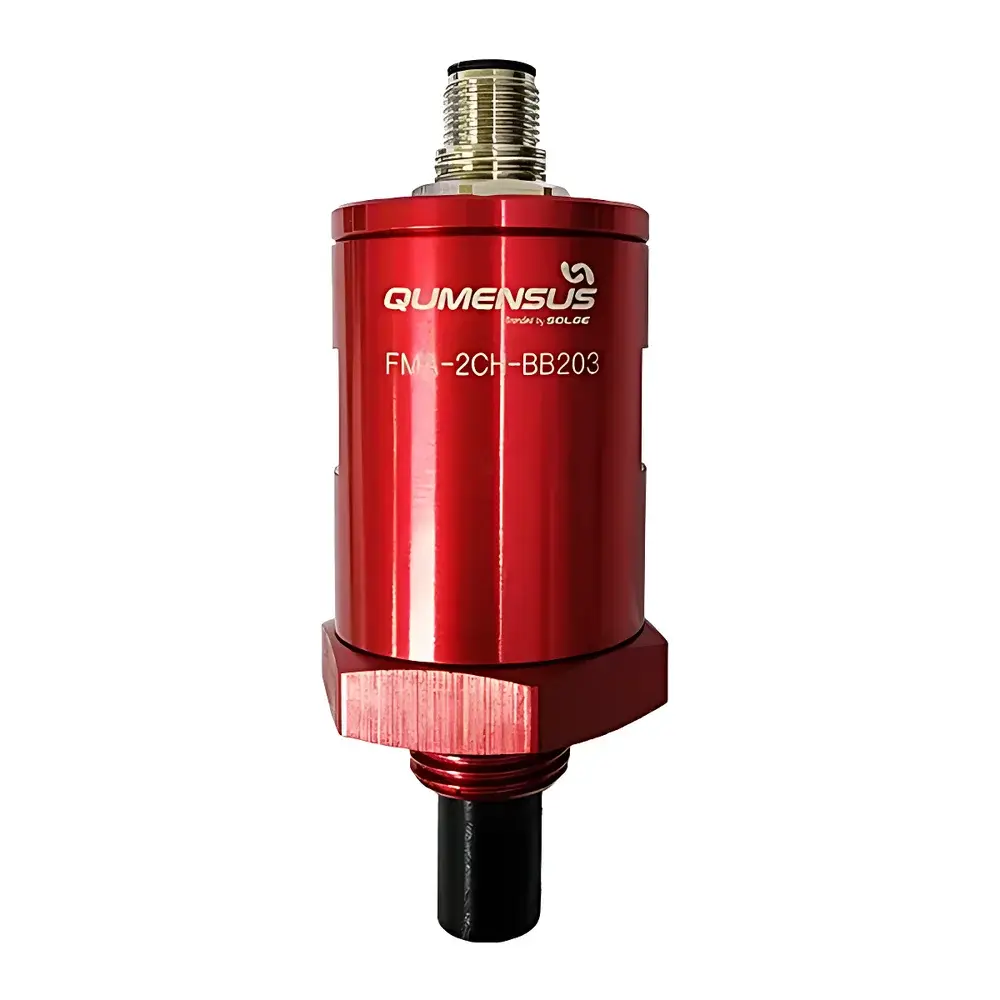
SOLGE Ferro-Mon Sensor Online Ferrous Debris Monitor
| Brand | SOLGE |
|---|---|
| Origin | South Korea |
| Manufacturer Type | Authorized Distributor |
| Origin Category | Imported |
| Model | Ferro-Mon Sensor |
| Product Type | Online Instrument |
| Detection Parameter | Ferrous Wear Debris Concentration |
| Output Format | Fe Saturation (%) |
| Communication Interface | LoRa Wireless |
| Compliance | PQ Standard |
| Application Domain | In-Service Lubricating Oil Monitoring for Rotating Machinery |
Overview
The SOLGE Ferro-Mon Sensor is an online ferromagnetic debris monitoring instrument engineered for continuous, real-time assessment of ferrous wear particle concentration in circulating lubricating oil systems. Operating on the principle of magnetic flux perturbation detection, the sensor employs a high-sensitivity electromagnetic transducer to quantify changes in magnetic reluctance caused by the accumulation of ferromagnetic particles—primarily elemental iron, steel fragments, and nickel-based alloys—on its precisely calibrated sensing surface. Unlike optical or acoustic methods, this technique provides direct, mass-proportional measurement of magnetically active wear debris without reliance on particle size distribution assumptions. The output is expressed as Fe saturation (%), a normalized metric representing the degree of magnetic surface coverage relative to full monolayer saturation under defined flow and field conditions. Designed specifically for hazardous (explosion-proof) environments—including Class I Div 1/Zone 1 installations—the Ferro-Mon Sensor enables early-stage detection of abnormal wear progression in critical rotating equipment such as gas turbines, centrifugal compressors, gearboxes, and hydraulic power units.
Key Features
- Real-time, continuous online monitoring of ferrous debris concentration without oil sampling or offline lab analysis
- Dual-channel analog/digital output: independent signals for baseline (normal) wear activity and threshold-exceeding (severe) wear events
- Intrinsically safe design compliant with ATEX/IECEx requirements for installation in classified explosive atmospheres
- High-affinity ferromagnetic capture surface optimized for sub-10 µm iron-rich particles, ensuring sensitivity to early-stage fatigue spalling and adhesive wear
- LoRaWAN-compatible wireless communication module supporting long-range, low-power telemetry to central SCADA or CMMS platforms
- Robust stainless-steel wetted parts (316 SS housing and probe) rated for pressures up to 10 bar and temperatures from −20 °C to +85 °C
- No moving parts or consumables—designed for >5 years of uninterrupted operation in harsh industrial settings
Sample Compatibility & Compliance
The Ferro-Mon Sensor is validated for use with mineral-, synthetic-, and semi-synthetic-based lubricants, including turbine oils (ISO VG 32–68), gear oils (ISO VG 100–680), and hydraulic fluids (HL, HM, HV). It maintains functional accuracy across viscosity ranges of 10–400 cSt at 40 °C and is unaffected by common additives (e.g., ZDDP, detergents, dispersants) or water contamination below 0.5% v/v. The device conforms to PQ (Particle Quantification) standard methodology—a widely adopted industry benchmark for ferrous debris quantification in predictive maintenance programs. While not certified to ISO 4406 or ASTM D7690 per se, its Fe saturation output correlates directly with PQ index values via traceable calibration curves established using NIST-traceable ferrous powder standards. System-level validation supports alignment with ISO 17359 (Condition Monitoring and Diagnostics of Machines) and API RP 541/546 (electrical machinery and rotating equipment reliability guidelines).
Software & Data Management
The Ferro-Mon Sensor operates as a standalone edge device; data acquisition and diagnostic interpretation require integration with SOLGE’s proprietary Lubricant Health Diagnostic Suite (LHDS), sold separately. LHDS provides time-series trending, alarm logic configuration (including configurable thresholds for both wear channels), statistical process control (SPC) charts, and automated report generation compliant with ISO 13374-2 (Machinery condition monitoring and diagnostics — Data processing, communication and presentation). Raw sensor outputs support Modbus RTU/TCP and MQTT protocols for seamless ingestion into OSIsoft PI, Inductive Automation Ignition, or custom IIoT dashboards. Audit trail functionality—including user access logs, parameter change history, and calibration event timestamps—meets GLP/GMP documentation requirements where applicable. FDA 21 CFR Part 11 compliance is achievable through LHDS deployment with electronic signature and role-based access controls.
Applications
- Early detection of bearing cage fracture, gear tooth pitting, and journal bearing wipe in turbomachinery
- Monitoring wear acceleration during commissioning, load ramp-up, or post-maintenance verification
- Integration into reliability-centered maintenance (RCM) and PdM programs for mission-critical assets in oil & gas, power generation, and marine propulsion
- Supporting root cause analysis when correlated with vibration spectra, temperature profiles, and oil analysis (ASTM D6595, D7684)
- Enabling dynamic oil drain interval extension based on actual wear kinetics rather than fixed calendar/mileage schedules
FAQ
Does the Ferro-Mon Sensor measure total particle count or only ferrous debris?
It measures only magnetically susceptible ferrous particles (Fe, Ni, Co, and their alloys); non-ferrous wear debris (e.g., copper, aluminum, lead) is not detected.
Can it be installed on pressurized lube oil lines without process interruption?
Yes—it features a compact inline T-fitting design compatible with ANSI B16.5 Class 150/300 flanges and supports hot-tap installation using standard isolation valves.
Is calibration required after initial setup?
Field calibration is not needed; factory calibration is performed using certified ferrous reference slurries and remains stable over the sensor’s operational lifetime.
What is the minimum detectable Fe saturation level?
The system resolution is 0.1% Fe saturation, with repeatability better than ±1.5% of full scale under steady-state flow conditions.
How does LoRa connectivity perform in metallic enclosures or underground facilities?
An external antenna kit (optional) and signal repeater nodes are available to ensure reliable RF propagation in electromagnetically dense or shielded infrastructure environments.